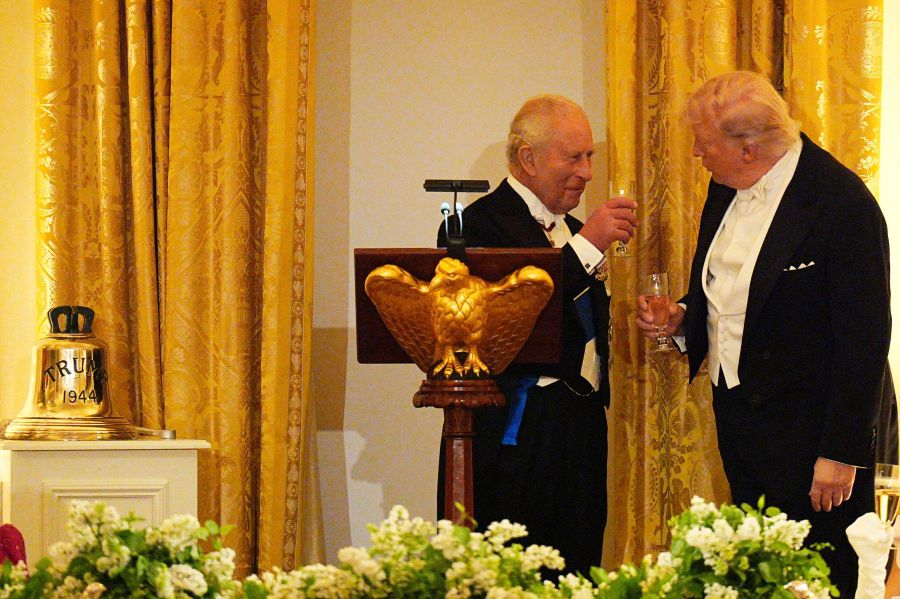
Submarine diplomacy: King Charles charms President Trump at the White House State Dinner by gifting him the bell from the British WWII submarine that shared his name © PA Images / Alamy Stock Photo
Two years ago, who could have predicted this is how the first parliamentary session would end. As Parliament was prorogued this week, Keir Starmer faced the prospect of a parliamentary inquiry into his statements to Parliament regarding Mandelson’s appointment as US ambassador, endless leadership briefings, a mutinous backbench and exhausted Cabinet, and an imminent bloodbath in the local elections. He was lucky enough to avoid the former, as an opposition motion referring the Prime Minister’s comments regarding whether “full due process” had been followed in Mandelson’s appointment to the Privileges Committee was voted down by dutiful Labour MPs (who were whipped to do so). Meanwhile, the Foreign Affairs Committee dragged none other than Morgan McSweeney before it to give evidence, where he admitted he made a “serious mistake" in pushing Mandelson’s appointment, but insisted he did not pressure the Foreign Office to "skip steps". Rumours abound that Health Secretary Wes Streeting has the numbers to make a move for the leadership, while Angela Rayner and Andy Burnham conspire on how to use Labour’s expected drubbing in the local elections to manoeuvre into No. 10. Meanwhile, at PMQs, the Prime Minister failed to even guarantee he will keep the Chancellor in post. Where did it all go wrong? Unforced errors, distraction by international events, constrained budgets and unengaged leadership have all but destroyed Starmer’s premiership in less than two years; he may yet survive and limp on, but the vultures are circling.
All eyes are now on next week’s local elections. According to pollster and Conservative peer Robert Hayward, Labour could lose as many as 1,850 of the 2,557 seats it is defending across England, while Reform UK are predicted to reap the benefits, gaining around 1,550 seats, with the Greens also picking up 500 and the Conservatives (can’t forget about them) projected to lose around 600. It is worth noting that a loss on the scale of 1,850 seats is not just a “drastic” loss, but is also comfortably above the 1,500-seat threshold that some in Westminster have previously suggested would trigger serious questions about Keir Starmer’s leadership… Unfortunately for Starmer, Labour’s difficulties are also expected to extend beyond England, with the party set to lose out in Wales to Plaid Cymru and Reform UK, and in Scotland to the SNP, with the latter forecast to finish just shy of an overall majority.
With Parliament now in prorogation, all eyes turn to the 13th May, where the King will set out the Government’s ambitions for the new session, in the second King’s Speech of this Government. Having spent the first session focused on key manifesto pledges, passing legislation such as the Renter’s Rights Act, Employment Right’s Act and the Planning and Infrastructure Act, it is likely Labour will use this King’s Speech to set out some longer term aims for the country. Several Bills have already been alluded to, focusing on wider reforms to the energy and immigration systems, and the NHS. Bills likely to be included in the speech include:
Energy Independence Bill – a bill focusing on energy is highly anticipated for the next session, with the Chancellor confirming in a statement to the Commons in March, that the Government will “legislate to implement the Fingleton review” in the new session. Aside from nuclear, the bill is expected to focus more widely on energy security and lowering bills and could include policy on oil and gas licenses.
Digital ID Bill – the PM’s Chief Secretary Darren Jones confirmed in a statement in the Commons that a bill covering the Government’s new voluntary Digital ID scheme will be introduced “later this year”, following the Government’s U-turn on Digital ID mandation last year.
Immigration Bill – the Government’s November 2025 Statement on its asylum and returns policy includes several policies that will require primary legislation. It is expected that the upcoming session will see MPs debate a bill with provisions for: a new independent appeals body, denial of appeal rights for people with ‘clearly unmeritorious claims’, restriction of the use of Article 8 in the ECHR, and possible reforms on modern slavery.
Dynamic Alignment Bill – a bill resetting the UK’s relationship with the EU has been widely reported, to ensure the implementation of a sanitary and phytosanitary agreement, and emissions trading scheme agreement. It is likely that the bill will include powers for the UK to ‘dynamically align with the EU, allowing the UK to quickly implement new rules of the single market without parliamentary scrutiny, if the Government deems it in the national interest.
Financial Services Bill – a bill focussed on financial services is expected to implement some of the policies announced by the Chancellor in the Leeds reforms, as set out last year. This could include: the abolition of the Payment Systems Regulator, a reduction in the Financial Ombudsman Service’s powers, and a scale-back of the Senior Managers and Certification Regime.
Water Bill – Environment Secretary Emma Reynolds confirmed in a written statement in January that the Government will introduce a “new Water Bill”, which we could see introduced in the new session. Amongst other things, the bill will implement the Government’s plans to ‘overhaul the water system’ as set out in their January 2026 White Paper, including abolishing Ofwat in favour of a new integrated water regulator.
Removal of Disgraced Peerages – following the allegations against Lord Mandelson, the Government have pledged to introduce a bill which would remove peerage titles from disgraced peers. Several news outlets have reported that this will be included in this year’s King’s Speech.
NHS Reform Bill – with the Government’s intention to merge most of NHS England’s functions with the Department of Health and Social Care by April 2027, it is expected this King’s Speech will include a bill to reform the Health Service and associated arm’s length bodies ahead of that deadline. It has also been reported that the bill will legislate to create a single electronic patient record throughout the NHS.
Visitor Levy Bill – in March, Local Government Minister Alison McGovern confirmed in a Westminster Hall debate that the Government intend to include provisions for a framework for local mayoral authorities to introduce a visitor levy in this year’s King’s Speech.
State Threats and Terrorism Bill – Security Minister Dan Jarvis issued a written statement in March following the report by the Independent Reviewer of Terrorism Legislation, Jonathan Hall KC, in which he confirmed the Government’s intention to introduce legislation to close gaps identified in the report. The BBC also reported that the Government plans to introduce new anti-terror powers enabling the banning of state threats, such as Iran's Islamic Revolutionary Guards Corps in the next session, which could sit under the same Bill.
Police Reform Bill – announcing the Government’s White Paper on police reform to the Commons in January, Home Secretary Shabana Mahmood said that she would “introduce legislation later in the year” on the reforms. It has been reported that the bill will introduce plans to reduce the number of police forces in England and Wales, and merge the responsibilities for counterterrorism, fraud, National Crime Agency, the College of Policing and other specialist activities into a new National Police Service.
There have been several other topics floated in the media which might also be included in the Government’s legislative plans, include regulation on: the special educational needs system (following the Government’s White Paper published in February); veterinary and animal welfare policy (though Rural Affairs Minister Angela Eagle suggested in Westminster Hall that there will “not be one great big Bill” to implement all policies in the Animal Welfare Strategy); public procurement (following the Government’s procurement strategy, published in March); and late payments (with the Government pledging to bring forward legislation in the outcome to its consultation on the topic).
Seven Bills from the 2024-26 Session have also been granted a carry-over motion and will appear in the Speech: the Armed Forces Bill, the Courts and Tribunals Bill, the Cyber Security and Resilience (Network and Information Systems) Bill, the Public Office (Accountability) Bill (also known as the Hillsborough Law), the Northern Ireland Troubles Bill, the Railways Bill and the Representation of the People Bill. The Equality (Race and Disability) Bill and the Leasehold and Commonhold Reform Bill could also make an appearance in the Speech, having been published, but not introduced, in the last session.
03:26:20 – time of the fastest MP in the London Marathon (Calvin Bailey), with David Simmonds clocking in as the slowest MP to run it at 06:35:05 (sorry David!).
8,500 – additional mental health workers recruited since the end of June 2024.
10 billion – the number of meals that could be at risk every week across the globe due to the interruption to fertiliser supplies from the Iran war.
Almost 7,000 – illegal sewage discharges that Southern Water were charged for between 2019 and 2021.
15 – the number of hereditary peers the Conservatives want to nominate for life peerages, following the House of Lords (Hereditary Peers) Act 2026 passing through Parliament in March.
5.56 million – the peak projected population of Scotland in 2033, before falling to 5.47 million in 2049. It was previously projected to continue rising steadily until 2049 to over 5.8 million.
6 – the number of days until the Scottish, Welsh and local council elections.
41 – days until the World Cup begins in America. Iran have already qualified, with FIFA confirming this week that they will still be going - raising fresh questions about whether global sport can ease political divides.
An antisemitic terrorist attack took place in Golders Green this week, as two Jewish people were stabbed. The Prime Minister announced that there would be a strengthened police presence in Jewish communities and said the Government were looking at what measures could be taken in relation to protests, particularly in relation to chants, banners and the repeated nature of some protests. With a rising number of antisemitic attacks taking place, the PM urged people to “open their eyes to Jewish pain, Jewish suffering and Jewish fear” and to “fight for the decent, respectful, tolerant Britain that I and millions of people love”. In response to the attack, the UK National Threat Level was raised from substantial to severe, meaning an ‘attack is highly likely in the next six months.’
King Charles visited the USA on a State Visit this week, with the Monarch seeking to somewhat repair the increasingly strained UK-US relations. In a speech to Congress the King highlighted the importance of NATO and mentioned his service in the Royal Navy, while in a speech at the State Dinner he joked that without the UK the US would be speaking French. The visit has been widely hailed as a success, and concluded with President Trump stating that the US would remove all restrictions and tariffs on whisky imports from the UK. In typical Trump style, he said the Royal visit “got me to do something that nobody else was able to do, without hardly even asking".
No-fault evictions have finally been banned from today, as part of a plethora of new renters’ rights that have come into force from 1 May. Alongside ending section 21 no-fault evictions, other changes include that: all tenancy agreements will become rolling with no end date; landlords can no longer ban pets; it will be illegal for landlords and letting agents to suggest or accept offers over the advertised listing price; landlords will only be able to raise the rent once a year, to ‘the market rate’; and it will be illegal to refuse tenants because they have children or are on benefits.
The last hereditary peers have formally left the House of Lords, after Parliament’s prorogation on Wednesday marked their final sitting. It comes as new legislation promised in Labour’s manifesto saw the remaining 92 hereditary Peers lose their right to sit in the Lords, as part of party efforts to end the principle of birthright. However, the mass exodus you may be picturing isn’t actually quite happening… with 15 Conservatives and some crossbenchers due to be allowed to stay on as life peers, although it is not yet known which Conservative peers have been put forward by the party.
The Tobacco and Vapes Act was signed into law this week, meaning that from next year, it will be illegal to sell tobacco to anyone born on or after 1 January 2009. The Act also includes measures to ban the advertising and sponsorship of vapes and nicotine products, alongside powers to restrict their packaging, branding and displays that are designed to appeal to children. It will also seek to strengthen smokefree protections in certain public places and introduce stronger enforcement powers, including through a retail licensing scheme.
Alongside this, a series of other acts received royal assent ahead of prorogation: the Victims and Courts Act; the Crime and Policing Act; the Children’s Wellbeing and Schools Act; the English Devolution and Community Empowerment Act; the Pension Schemes Act; the National Insurance Contributions (Employer Pensions Contributions) Act; the Grenfell Tower Memorial (Expenditure) Act; and the Ministerial Salaries (Amendment) Act.
Further reforms to Right to Buy were announced, which will see the minimum eligibility period rise from three to ten years before council tenants can apply to buy their home. There will also be a 35-year new build exemption period so new social homes cannot be sold under Right to Buy for 35 years after they are built – in a bid to help local authorities protect much-needed social housing stock amid depleting supply. Additionally, discount rules will be amended so they start at 5% of the property value and increase by 1% each year up to either the maximum 15% discount or the cash cap (whichever is lower).
Interest rates remain at 3.75%, after the Bank of England Monetary Policy Committee voted by 8-1 to keep rates unchanged. BoE Governor Andrew Bailey noted that rates could rise in the future, and it will be determined by the “size and duration of the energy price shock".
The Government will “dismantle” the leasehold system, Housing Minister Matthew Pennycook announced in a speech, explaining the “archaic and iniquitous system” could not be abolished overnight. Rejecting accusations that the Government were “dragging their feet” or “caving into vested interested”, Pennycook emphasised that “we are going to get the job done”, stating they were “progressing the most ambitious overhaul of land and property law in a century”.
There needs to be a “decisive move” to support British AI companies, as well as closer work with international partners on setting the standards for the deployment of AI. This was the message from Technology Secretary Liz Kendall in a speech at RUSI, where she also warned that nations not harnessing AI to their advantage risk not being in control of both their security and economic future.
A new poll predicts big changes in London, with as much as a third of the city potentially falling into no overall control after the local elections according to modelling commissioned by the LSE. This is largely down to a crash in support for Labour, with their vote share in some areas expected to drop dramatically: Barking and Dagenham, in which 80% of ballots cast in 2022 were for Labour, could see that number almost halved to 44%. The Greens are expected to be the main beneficiaries of this collapse, polling 37% in Hackney and Haringey and 35% in Lewisham, with Reform UK picking up support in outer parts of the capital from the also-beleaguered Tories. Meanwhile, south west London is expected to remain a Lib Dem citadel, with a projected 49% vote share in Richmond-upon-Thames and 47% in Kingston-upon-Thames.
Over in Wales, a new poll from Survation suggests that elections to the Senedd will be a straight shot between Reform UK and Plaid Cymru, with the traditionally dominant Labour Party’s share of the vote falling to 15%. Importantly, the poll showed Reform UK (which received 1% of the vote in the previous 2021 election) edging slightly ahead of Plaid Cymru, achieving 30% to the latter’s 28%. The Tories and Greens were each predicted to gain 10% of the vote, with the Lib Dems languishing on 4%.
Electric Vehicle charging is consistently popular across party lines, according to research commissioned by the UK Sustainable Investment and Finance Association. In light of the energy shocks caused by the war in the Middle East, it may be small wonder that more people are turning to electric cars, with 74% of Brits confirming their support for investment in EV charging points. What’s particularly interesting, though, is the fact that this roughly carries across all the major political groupings in Britain today. If nothing else, the poll managed to find an issue on which Green voters and two-thirds of Reform voters can agree.
The Resolution Foundation took a closer look at Britain’s ‘NEET rate’, referring to the prevalence of individuals, particularly young people, ‘not in education, employment or training’. The think tank’s report noted that the number of 18 to 24-year-olds in this category has risen by almost 900,000 since 2019, spurring much political discussion and a Government review. The factors behind this include poorer job prospects and a rise in incapacity benefit claims. The Resolution Foundation argued that tackling this issue ‘will require action across health, education and benefits’, aiming to show how other countries are able to achieve better ‘NEET rates’ than the UK.
Voters across Wales head to the polls next week, with politicians on the campaign trail doing their upmost to convince any voters who might still be undecided. Unfortunately, it appears Welsh Labour leader Eluned Morgan was just as confused, when during an event at Barry Island she encouraged voters to vote Welsh Labour, followed by “pleidleisiwch Plaid Cymru” which actually means… “vote Plaid Cymru.” Maybe she should have asked Bryn and Nessa to sing instead…
King Charles went on his much-debated trip to Washington this week as he attempted to revitalise the ‘special relationship’ between the US and the UK that has come under *slight* strain over the last few months. At a state dinner, the King noted the changes that President Trump had made to the East Wing of the White House, joking the British made their own attempts to redevelop the White House in 1814. He wasn’t done there however as, in reference to Donald Trump’s comments that Europe would be speaking German were if not for the US, the King retorted that if wasn’t for Britain, the US would be speaking French. Sacré bleu!