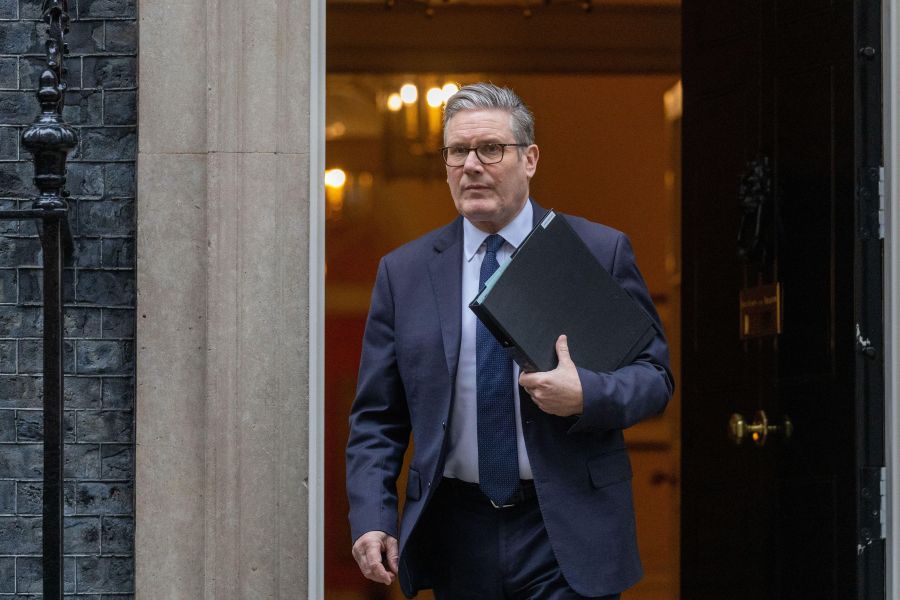
A rough week: Keir Starmer visited a community centre in Hertfordshire on Tuesday, two days after his Chief of Staff resigned and the day after the Scottish Labour Leader called on the Prime Minister to step down © PA Images / Alamy Stock Photo
The question of Keir Starmer’s authority has refused to leave the limelight this week, with Monday seeing the PM come under direct challenge from within his own ranks after Scottish Labour Leader Anas Sarwar used a speech to call for his resignation, to bring an end to what Sarwar described as damaging “distraction” in Downing Street. In rather blunt terms, Sarwar argued that the opportunity to “get rid of a failing SNP Government is too important to be missed”, insisting his position was guided by “what’s right” for Scotland. While acknowledging that “good things” have been achieved in Westminster, he said they were being “drowned out” by “too many mistakes” that “cannot continue.” Notably, Sarwar stopped short of endorsing any alternative candidate, describing the Prime Minister as a “decent man” and confirming he had spoken to him earlier that day, along with senior figures in and out of Cabinet. Quick to his defence, a series of senior Labour ministers, alongside Angela Rayner, lined up to rally behind Starmer to express their support, while the Prime Minister himself defiantly told Labour MPs that he was “not prepared to walk away” from his mandate or “plunge us into chaos.”
While the PM was facing criticism from all sides, Starmer spent much of the week focused on resetting his top team. The process began on Sunday, when the Prime Minister’s Chief of Staff, Morgan McSweeney, resigned. In his resignation statement, he accepted full responsibility for advising Starmer to appoint Lord Mandelson and called for a fundamental overhaul of the due diligence and vetting procedures for government appointments. Shortly afterwards, Starmer’s Director of Communications, Tim Allan, stepped down after only five months in the role. In his statement, he said he was leaving to “allow for a new No 10 team to be built.” In a further unexpected development, Cabinet Secretary Chris Wormald also departed Downing Street later in the week, with the Cabinet Office describing the move as a “mutual agreement.” Wormald, who had served as Head of the Civil Service since December 2024, had been responsible for overseeing the due diligence checks relating to Mandelson’s appointment as US ambassador. Attention is now turning to potential successors. Early speculation suggests that Dame Antonia Romeo, who has held senior roles in the Department for International Trade, the MoJ, and the Home Office, is a leading candidate. If appointed, she would become the first female Head of the Civil Service, a move that could help counter recent “boys’ club” criticism directed at Downing Street.
0.1% – percentage by which the British economy grew in the last quarter of 2025
£400 million – one-off amount granted by the Treasury to the Northern Ireland Executive to balance its budget this year, after facing a significant overspend
9% - rise in council tax proposed by Reform UK-led Worcestershire council, the largest increase in its history
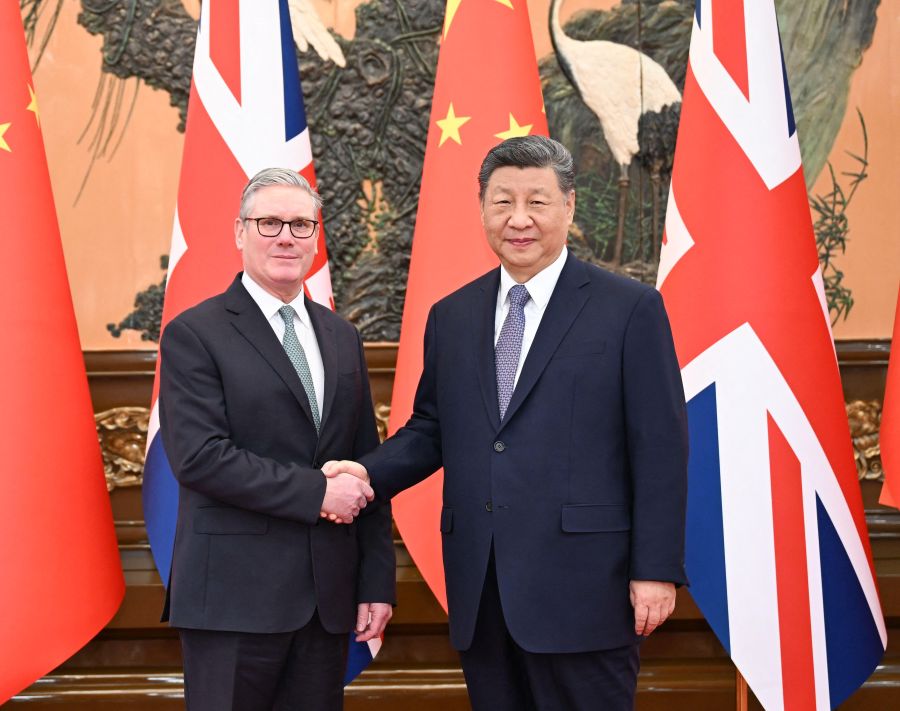
20 – number of years for which pro-democracy Hong Kong businessman Jimmy Lai will be jailed under the territory’s draconian National Security Law, hot on the heels of the Prime Minister’s recent visit to China
£250,000 – payoff Chris Wormald will reportedly receive following his ‘resignation’ as Cabinet Secretary
35 – number of Labour MPs who wrote to Home Secretary Shabana Mahmood urging her to reconsider the Government’s reforms to Indefinite Leave to Remain
269,321 – number of seizures of drugs made by Police and Border Forces in the year to March 2025, a 24% increase on the previous year
15 years – length of time Larry the Cat has now resided at 10 Downing Street, during which he has seen five (and potentially soon six) prime ministers come and go
0 – number of medals GB has won at the so far at the Winter Olympics, one less than Australia…
The UK will double the number of British troops in Norway over the next three years to 2,000 personnel. Defence Sec John Healey made the announcement on a visit to the country’s aptly named Camp Viking in the Article Circle this week. The move comes as the UK-led Joint Expeditionary Force confirmed major military activity in the High North this year, with Exercise Lion Protector due to take place in September 2026, seeing air, land, and naval forces from JEF nations coming together to 'train to protect critical national infrastructure from attacks and sabotage and enhance their joint command and control capabilities.'
National Apprenticeship Week took place, with the Government unveiling reforms aimed at encouraging more people to pursue the path. There will be a pilot of a clearance-style system where those who miss out on their top choice apprenticeship are directed to similar opportunities in their area. Efforts will also be made to fast-track the application process, with new short courses able to be completed in just three months.
Every school will have an “inclusion base” under new plans announced in the Education Estates Strategy this week. The new plans will provide a “dedicated safe space” away from classrooms to provide targeted support for children requiring specialist provision. The announcement comes as part of the wider 10 year strategy that pledges to invest in repairs and upgrades across the country.
Communities will be able to own and control their own energy projects, as the Government published the Local Power Plan backed by £1bn of funding. It aims to lower bills for community buildings and businesses, create stronger energy resilience, and ensure profits from clean power are ‘driven back into communities’. The results of the latest clean energy auction were also announced this week, with record levels of new solar and onshore wind projects.
Action is being taken to crack down on foreign interference in British politics, after the Representation of the People Bill was introduced to Parliament. It contains measures such as requiring companies making political donations to show they have a ‘genuine connection’ to the UK (sorry Elon), and to demonstrate they have generated sufficient revenue to make the donation. The Bill is also the legislative vehicle being used to extend the vote to 16 and 17-year-olds in all UK elections.
Great British rail won’t be a “Kafkaesque blob”, the Transport Secretary assured in a speech this week, in which she criticised the modern rail system for its “fragmented structure” and “little accountability and coordination”. She noted it costs “£400 per household to just run the trains and maintain the track”, and criticised the fact that the UK’s “infrastructure costs per kilometre outstrip our European neighbours”, arguing “nothing short of wholesale reform is needed to secure rail’s future”.
Politicians on all sides leapt on GDP figures published this week to try to argue the Government’s successes/failures (delete as appropriate). With GDP growing by 0.1% from October to December 2025, the second successive quarter it has done so, Labour MPs were quick to take to the artist formally known as Twitter to, somewhat bravely, sing the Government’s praises… before being swiftly shut down by a cacophony of opposition posts highlighting that GDP per capita has once again fallen by 0.1% for a second quarter.
MI5 Director General warned of the security threat to universities and the political system, in briefings to senior leaders from 70 universities this week. Sir Ken McCallum was joined by National Cyber Security Centre CEO Richard Horne as they met with Vice Chancellors and others to increase understanding of how foreign interference can manifest, including attempts to shape and censor research or teaching, along with how to resist and report it.
As the relentless downpours continue, Leader of the House of Commons Sir Alan Campbell provided MPs (and the rest of Westminster) with a much needed, holiday-booking boost this week through updated recess dates for the rest of the year. For those looking to escape for the summer, the Commons will rise for the summer recess on Thursday 16th July and return on Tuesday 1st September. Conference recess will take place between 15th September and 12th October; and – if you can think that far ahead – the green benches will depart for Christmas on 17 December and return early in the new year on 4th January.
£78bn has been made available for councils across England through the Final Local Government Finance Settlement, bringing the total new investment in local services to over £5.6bn over the next three years and providing an additional £740m in funding between the provisional and final settlement. ' Other measures set out in the settlement include a £440m Recovery Grant uplift for councils most impacted by historic funding cuts, a £39.6m boost to mayoral capacity funding, and a £272m uplift for the Homelessness, Rough Sleeping and Domestic Abuse Grant.
It’s not a week in Westminster without another Reform press conference. This week Prime Ministerial hopeful Nigel Farage used a gathering of the Lobby to announce the founder of Checkatrade Kevin Byrne would mentor Reform UK to create the right policies for people setting up their own business. Farage also announced he would be revealing his list of shadow ministerial roles in “just a few days’ time” and that they had opened the lists for potential candidates for the next General Election (anyone fancy taking up the daunting role of the party’s Vetting Officer?).
The Lib Dems would break up the Treasury, the party’s Treasury spokesperson Daisy Cooper announced this week. If elected to Government (no one mention the current polls…) the Lib Dems will replace the centuries old all-powerful centre of public funds, with a new Department for Growth (located in Birmingham), which will be merged with the Department for Business and Trade, to deliver stronger economic growth, invest in the NHS, renewable energy and defence, and deliver “a better trading relationship with Europe”. A smaller Department for Public Expenditure would also be established to oversee departmental spending.
It was a big week for elections. In Japan, Prime Minister Sanae Takaichi’s decision to call a snap election paid dividends, as her Liberal Democratic Party (LDP) won a landslide 316 out of 465 seats, the first time a single party has won a two-thirds majority since Japan's modern parliament was established in 1947. The result gives her a sweeping mandate to pursue her conservative agenda, including toughening the immigration system, cutting taxes and changing Japan’s pacifist constitution. In Bangladesh, the main opposition Bangladesh Nationalist Party (BNP) also won more than two-thirds of the seats, although the former ruling Awami League (which was led by Shekih Hasina, aunt to Hampstead MP Tulip Siddiq), was barred from competing. Meanwhile, in Thailand, the widely expected win for the progressive People's Party failed to materialise, with the ruling conservative Bhumjaithai Party returning to power.
It was a week light on legislation for the green benches this week, with debate in the Commons Chamber consisting of several backbench debates, motions approving regulations and (as usual) several UQs and statements. With primary legislation confined entirely to bill committees, one might be forgiven for wondering if the Government were a little too keen to get to recess this week… In the absence of any major Government business, debates in the Chamber this week focused on free-trade agreements, the response to Storm Chandra flooding, mobile connectivity, school minibus safety and LGBT+ History Month, with Jarrow MP Kate Osbourne issuing a plea to the Football Association to “let the dolls play”. Outside of debating, motions on the Police Grant Report, Local Government Finance Report, the draft Guaranteed Minimum Pensions Increase Order 2026 and Child Benefit were all approved.
Over on the red benches was where all the legislation was to be found, as the Children’s Wellbeing and Schools Bill passed its third reading, alongside committee stage debates on the Victims and Courts Bill, the English Devolution and Community Empowerment Bill, the Rare Cancers Bill and the Medical Training (Prioritisation) Bill, as well as report stage of the Sustainable Aviation Fuel Bill… and breathe! The Lords also discussed topics including reforming the law on donations to political parties, a counter-extremism strategy and waste crime, and no doubt enjoyed repeating a plethora of UQs and statements sent their way from the Commons.
32% of Brits say they would find it difficult to date someone with different political views to their own according to an Ipsos poll out just in time for Valentine’s Day, with women more likely to say they would find it difficult than men. The poll found that Brits are most likely to find it easy being in a relationship with a Green Party supporter – at 40%, with (probably the same) 40% of people saying they’d find it difficult to be in a relationship with a Reform UK supporter. When it comes to their leaders, 49% of Brits said they would not date a supporter of Reform UK leader Nigel Farage, and 39% would not date a supporter of the Prime Minister. Lib Dem leader Ed Davey leads the way, with 27% of people saying they would not date a supporter of his (#winninghere). It doesn’t get much better for Farage, with the British public believing he would be most likely (25%) to make you pay on the first date.
The Government should commit to a Declaration of Digital Rights argued a new Demos report, in order to integrate human rights into the digital age. The report proposes a ‘principle-based declaration, grounded in international human rights law’ in order to demonstrate a commitment to preserving human rights. It views this as significant in an agenda more and more driven by geopolitical competition, security priorities and corporate influence where rights-based approaches are ‘increasingly being challenged.’ It argues that the absence of a comprehensive cross-sectoral framework for AI, alongside the weakening of existing data protection regulations, not only risks leaving substantial gaps in human rights protection, but also will undermine public trust in policy decisions and initiatives.
A strong welfare state can be a ‘springboard’ to economic success according to the latest publication from the IPPR which looked at the ‘perceived conflict between social spending and economic dynamism.’ The report detailed evidence that a number of countries manage to balance high social spending with positive economic outcomes through a high GDP per capita, high labour productivity, and strong innovation performance. It recommended a renewed drive towards a national consensus on economic development, a social spending shift in areas that directly address both social and economic objectives, and the pursuit of a ‘social partnership’ between sectoral bargaining and corporate governance.
While fighting for his political life earlier this week, Starmer met with his parliamentary foot soldiers as he attempted to shore up their support. In what was apparently a decently barnstorming speech (by Starmer’s standards), he apparently told them he had “won every fight” he had “ever been in.” Some might look at, off the top of our heads… the U-turns on the grooming gangs inquiry, winter fuel payments, benefit reforms and the two-child benefit cap, digital ID, business rates on pubs, and inheritance taxes on farmers and think otherwise…
The reject’s corner of the Commons is always a peculiar place, and never more so than in this parliament, in which small parties and independent MPs have multiplied, yet by the traditions of the House must cram onto the same benches in one corner. This inevitably creates farce, such as at this week’s PMQs, when Corbynite independent MP Ayoub Khan stood over the Reform UK-stuffed bench in front of him and raised the continuing bin strikes in Birmingham, remarking that “rubbish is building up right beneath my very nose.” Richard Tice took it with good grace, while Sarah Pochin looked rather more affronted.
Reform are just as capable of playing games. In response to Rachel Blake, Labour MP for the Cities of London and Westminster, complaining that Richard Tice visited a synagogue in her constituency in a “political” capacity without telling her (by tradition, MPs should let each other know when they are visiting one another’s constituencies), Tice declared that since he is ‘in Westminster most days of the year’, he would henceforth send her an automated email at 6am every day informing her of his presence. Catty!
And finally, with leadership rumours are flying round Westminster at warp speed, we couldn’t help but notice one regular attendee in the Chamber is already engaging in some well-deserved self-promotion. A beady-eyed Navigate staffer noticed Jennie, the golden retriever and guide dog to Lib Dem MP Steve Darling, is advertising herself as ‘Leader of the Pawsition’ on her lead. The polls currently have her well ahead.