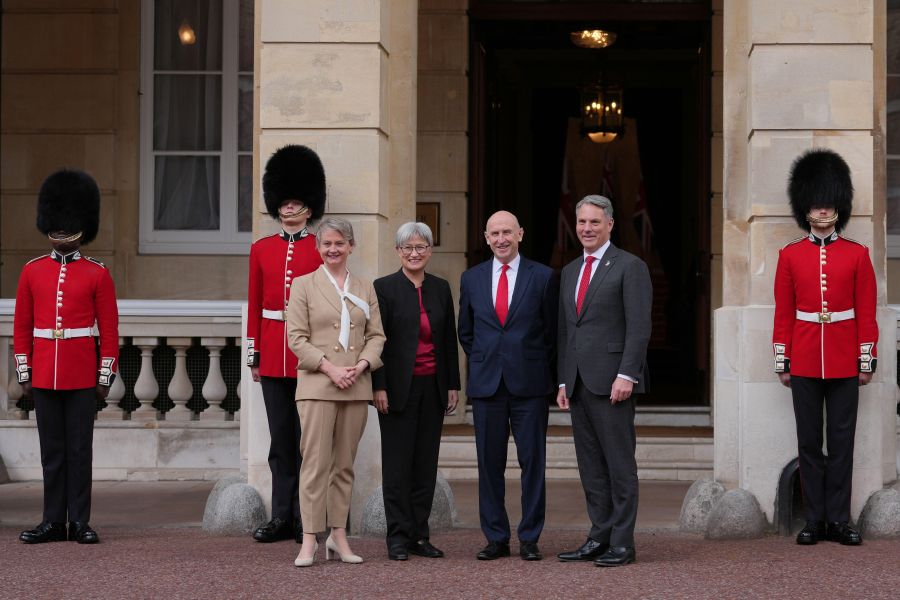
Outfoxed: Andy Burnham (middle) celebrates winning the Makerfield by-election, paving the way for a leadership challenge against Keir Starmer © Associated Press / Alamy Stock Photo
The King of North will officially make his grand return to the Commons after nine years, as Andy Burnham decisively won the Makerfield by-election with 55% of the vote (nearly 25,000 votes) – receiving more votes that all the other candidates combined and 20% more than the next candidate, Reform UK’s Rob Kenyon. With such a resounding victory arguably proving Burnham’s case that he has what it takes to defeat Reform and win in spite of Labour’s unpopularity (although you’d imagine it would be somewhat more of a challenge to replicate this across the country after a three-year crack at being PM), he made sure to appropriately distance himself from his party’s current status in his acceptance speech, saying “politics is not working” and suggesting this result “could be the turning point”. So, in what has the potential to be one of the most significant and influential by-elections in modern history, all eyes now turn to what happens next… when will Burnham and/or Streeting and/or Carns launch their inevitable leadership campaigns; will Starmer set out a timetable for his departure or contest in a future leadership race; and who’s backing who?
Two more MPs have also been elected in Scotland. With the Makerfield by-election hogging the limelight, it seems easy to forget that two more by-elections were also held after the SNP’s Stephen Flynn and Stephen Gethins both stood down as MPs following their respective elections to the Scottish Parliament last month. The Arbroath and Broughty Ferry by-election went as expected, with the SNP comfortably retaining the seat as Lara Bird won (although turnout was remarkably low, at just 31.9%). However, the Aberdeen South by-election was a different story, as Conservative MSP Douglas Lumsden stormed to victory with 49.5% of the vote, having campaigned heavily on a promise to fight for the constituency’s oil and gas workers. This marks the first time the Scottish Conservatives have won a Westminster by-election in more than 50 years. Under Holyrood’s dual mandate ban, Lumsden will now have to resign as an MSP, with his place in the Scottish Parliament to be taken by the next candidate on the Conservatives’ North East Scotland list: James Adams.
And where’s the PM been? Well abroad of course! Amid a week of speculation and uncertainty at home, Starmer headed to Evian-les-Bains in France to attend the G7 summit alongside US President Trump and other world leaders – including Indian PM Narendra Modi, Canadian PM Mark Carney and French President Emmanuel Macron. And it was at the summit that President Trump formally signed his new deal with Iran aiming to end the war and reopen the Strait of Hormuz. The Memorandum of Understanding contains 14 core points, which include: the immediate and permanent termination of military operations on all fronts, including Lebanon; committing to negotiate and achieve the final deal in maximum 60 days; Iran agreeing not to procure or develop nuclear weapons; and the US beginning the removal of its naval blockade.
10 – number of goals Harry Kane has now scored for England, equalling Gary Lineker’s record
163 – number of votes the Lib Dems won in the Makerfield by-election, its worst by-election result since its founding
50% – reported planned reduction of the Zero Emission Vehicles (ZEV) mandate, down from the planned 80% of new cars which must be electric by 2030
1.83 billion – number of train journeys made between April 2025 and March 2026, the highest number since 1920.
35C – peak of the coming heatwave, just in time for England’s match on Tuesday…
6% – hit the UK economy has taken since Brexit, according to Bank of England data
£650 – average amount the Government hopes homeowners will save, under homebuying reforms announced today
$300bn – amount Iran will receive from the US for reconstruction under this week’s peace agreement (remember, according to President Trump, America won the war!)
Kicking off his week, Keir Starmer held a press conference at 8am Monday morning in Downing Street to announce that social media platforms would be banned for under-16s, arguing that “social media is making children unhappy” and “designed to lock you in for hours”. The policy will cover apps such as Snapchat, TikTok, YouTube (not YouTube Kids), Instagram, Facebook, and X, but will exclude messaging services such as WhatsApp.
The Assisted Dying Bill is set to return to Parliament, with Lauren Edwards announcing that she would “finish the job” and bring an identical bill to the one passed by the Commons last year. The previous Bill, introduced by Kim Leadbeater in the last Parliament, had run out of time before prorogation due to an unprecedented number of suggested amendments in the House of Lords. By bringing an identical Bill back, Edwards may be able to trigger powers under the Parliament Act to override peers’ objections, powers that have only been used seven times in the last century.
The Department for Work and Pensions is linking up with LinkedIn to bolster careers advice for thousands of jobseekers, explaining that 'timely anonymised data on jobs, skills, hiring and workforce movement' will be shared with Skills England from LinkedIn's network of 40 million UK accounts, giving the Government a new way of viewing the labour market. In future, this could be used by the new Jobs and Careers Service 'to provide jobseekers with more tailored advice on industry specific skills and career routes.'
Police officers will now be able to check overseas-registered vehicles through the EU’s Prüm data-sharing framework, rather than having to make individual requests to EU Member States. Announced by the Home Office, this capability aims to strengthen intelligence on cross-border crime and improve the identification of vehicles linked to trafficking networks.
The Government rejected Thames Water’s rescue plan as Environment Secretary Emma Reynolds felt the proposed deal expected ‘consumers to fund an unprecedented level of regulatory adjustments.’ Reynolds also issued concern over a reduction in performance standards outlined in the proposal, which she stated would impact ‘both the environment and consumers.’ In the Commons on Tuesday, she stated that the Government “will stand ready for all eventualities” including a Special Administration Regime.
Reform UK announced their Women and Motherhood Protection Act in what the party described as their ‘plans to become the most pro-family Government in British history.’ The Act would tie together ‘key protections’ into one law, including increasing the time limit for pregnancy and maternity discrimination claims from three months to twelve months, and introducing ‘explicit rights’ for breastfeeding women, those undergoing fertility treatment, and new leave rights for parents who experience either a miscarriage or stillbirth.
Reform’s Robert Jenrick also announced his party’s plans to remove the rise in employer National Insurance for British Nationals. Announcing the plans, Jenrick confirmed that the increase in NICs from 13.8% to 15%, introduced by Labour, would remain for foreign staff, adding that the levy on foreign workers would fall as salaries rise, to reduce the “easy lever of cheap foreign labour” without penalising firms hiring highly skilled people.
The Conservatives launched a review into sickness benefits with Shadow Work and Pensions Secretary Helen Whately arguing that ‘disability and sickness benefits have become tantalising low hanging fruit for those seeking easy cash’ from the benefits system. She argued that the disability benefits system is being exploited, including blue badges, citing reports that queues at Disneyland Paris are ‘filled with British tourists using PIP awards to skip long queues.’ Arguing for the need of a welfare system that is a ‘safety net, not a lifestyle choice,’ the Tories’ review will seek to make a ‘fair and affordable’ system again.
MP for Tewkesbury Cameron Thomas had the Liberal Democrat whip suspended pending the outcome of a police investigation. It has been rumoured that Thomas was arrested by Gloucestershire police on Wednesday.
In the Commons, Dan Jarvis had his first outing at the Despatch Box as Defence Secretary with a statement on the bizarre episode which saw a Russian warship fire at a British yacht in the Channel, while an urgent question was also granted on delays to the Defence Investment Plan. Progress was also made on legislation throughout the week, with the Cyber Security and Resilience Bill passing its third reading on Tuesday and the National Security (State Threats) Bill completing its second and third readings on Wednesday. Wednesday also saw David Lammy face questions in a rare Deputy PMQs, before the 20 successful Ballot Bills were presented, marking the return of the Assisted Dying Bill in its new form.
On the red benches, Lords continued to navigate through legislation as the Steel Industry (Nationalisation) Bill passed its second reading on Tuesday and the Social Housing Bill completed committee stage. A private notice question was granted on Tuesday following the US’ suspension of Anthropic’s AI models for foreign countries and Thursday saw a debate held on tackling child poverty. Meanwhile in Grand Committee, the Civil Aviation Bill began its committee stage up to day two, with a further four days of debate still to happen.
Over on Committee Corridor, the Culture, Media and Sport Committee published a new report on cultural touring in the EU, while the Energy Security and Net Zero Committee set out how community energy can help drive the net zero transition. Later in the week, the International Agreements Committee published its first report on a convention to establish an international claims commission for Ukraine, before the Housing, Communities and Local Government Committee endorsed Bill Butler as the Government’s preferred candidate in its third report on the appointment of the Chair of the Local Audit Office.
We probably don’t have to tell you this one, but three new members have joined the House of Commons. The first is Andy Burnham, who decided on the spur of the moment to move back to Parliament after a stint as Mayor of Manchester – pay attention to his (second) career in the Commons, he’s rumoured to be capable of going far. Meanwhile, Tory Douglas Lumsden and the SNP’s Lara Bird will also be joining the green benches.
The MOD was shored up with some faces old and new, after the dramatic resignations of John Healey and Al Carns last week. The role of Armed Forces Minister was given to Louise Sandher-Jones, while her previous role of Veterans and People Minister was filled by RAF veteran Calvin Bailey, in his first ministerial appointment. New Defence Secretary Dan Jarvis had his former position as Security Minister filled by Angela Eagle. Meanwhile, Rachel Hopkins and Pamela Nash, who also jumped ship as PPSs from the MOD, were replaced by Chris Kane and Pam Cox.
Meanwhile, Jade Botterill was made a Government Whip, joined by Emma Foody as an Assistant Whip. In the Lords, Lord Leong was made a Minister in the Department for Business and Trade, while Baroness Lloyd of Effra will no longer keep her portfolio in the department. Lord Lemos joined the Ministry of Housing, Communities and Local Government team and Lord Collins was appointed Parliamentary Secretary, keeping his other role as Deputy Leader of the House. Finally, Baroness Ramsey and Baroness Curran were made Government Whips.
Stephen Morgan and Ben Goldsborough put their wellies on, with the former being appointed Food Security and Rural Affairs Minister, and the latter joining the Environment, Food and Rural Affairs Committee.
In the Senedd, new committee chairs were appointed with Sera Evans, Jayne Bryant, James Evans, Zaynab Akbar, Elwyn Vaughan, Mair Rowlands, Lis McLean, Carmelo Colasanto, Carrie Harper, Andrew Griffin, Sam Rowlands, Sarah Cooper-Lesadd, Lindsay Whittle, and Jason O’Connell taking their seats. See who’s running which committee here.
A new Commissioner for Public Appointments is set to be, well, appointed, as Sir William Shawcross steps down after nearly five years. The Government’s chosen candidate is Fiona Cannon, with the Cabinet Office making the announcement today that Chief Secretary to the Prime Minister Darren Jones had selected her for the job.
On the diplomatic side of things, Peter Vowles was appointed British High Commissioner to Nigeria, while Olivia Ricketts was made Ambassador to Switzerland, and Paul Simister was appointed Ambassador to Liberia.
UKRI announced the appointment of Anna King as a new non-executive board member, selected by Science and Technology Secretary Liz Kendall.
Professor Sir David Baulcombe was appointed Master of Trinity College, Cambridge by the King, a notable alumnus. His Majesty also reappointed Dan Labbard as Chief Executive of the Crown Estate, and board members Anne Kavanaugh and Clare Shine were also reappointed.
Brexit turns ten next week, however its anniversary may prove difficult to celebrate. YouGov polling has found that majorities in England (56%), Wales (61%) and Scotland (75%) believe Britain was wrong to vote to leave the European Union, while just 11-12% of English and Welsh people think Brexit has been more of a success than a failure, with this falling to 5% north of the border. The survey also found that majorities in all three nations favour closer ties with the EU, while support for rejoining the bloc remains strongest (unsurprisingly) in Scotland, which is also the only nation with public support for rejoining the EU without the UK's former opt-outs on the euro and the Schengen area.
The Government's decision to ban under-16s from social media appears to be in line with parental opinion, according to further YouGov polling. The survey found that 77% of parents support such a ban, while 82% believe social media has a negative impact on children. More than a third (38%) say their own children have been negatively affected, while the findings also point to strong support for greater intervention from technology firms, with 88% of parents saying social media companies need to do more to protect young users.
Persistently disadvantaged pupils are being left behind by England's education system, according to a new report from Teach First. The study found that children eligible for free school meals for most of their school lives (at least 80%) are 22 months behind in learning compared to their non-disadvantaged peers by GCSE age and are significantly more likely to drop out of education or training after Year 11 (a 25.5% chance). The report also highlights severe regional differences, with more than half of persistently disadvantaged pupils in North Somerset leaving education or training within six months of finishing school, compared to just 15% in London. Teach First, however, has identified 88 schools that have completely closed the attainment gap, where persistently disadvantaged pupils outperformed non-disadvantaged pupils nationally, demonstrating that better outcomes are achievable with targeted support.
Recent years have seen politicians cycling through positions faster than a Lime bike on a commute, and this week, one nearly got cycled through. Lord Michael Gove was caught on video strolling through a red light and almost becoming a cautionary tale, courtesy of an oncoming cyclist. Unfazed, the former Housing Secretary responded to the near miss by giving the cyclist a glare typically reserved for the opposition frontbench, while the cyclist returned the favour by calling him an “idiot” (which, to be fair, probably doesn’t even crack the former Cabinet Minister’s personal top ten).
If any budding politicians are reading, this video of by-election candidate and Andy Burnham opponent Count Binface in a late-night interview with Sky News, is worth watching. It’s fair to say the noble Count may have had a few more coffees than Sky’s Jon Craig at that particular point on Thursday evening, and I think we can all agree, rather got the better of him.
And finally, 99% of everyone who has ever had anything to do with Westminster (Editor’s note: this statistic has entirely no basis but we’re running with it) has exactly the same view of Early Day Motions and – spoiler alert – it’s not positive. And so, we leave you with this EDM tabled this week calling on the Government to introduce legislation to ensure a football match ‘consists of two uninterrupted halves of normal playing time’... As football fans, we understand that hydration breaks, stoppages and extra time may be a little irritating to the viewer, but question whether they are exactly the best use of parliamentary and government resources – whether tabled in jest or not…