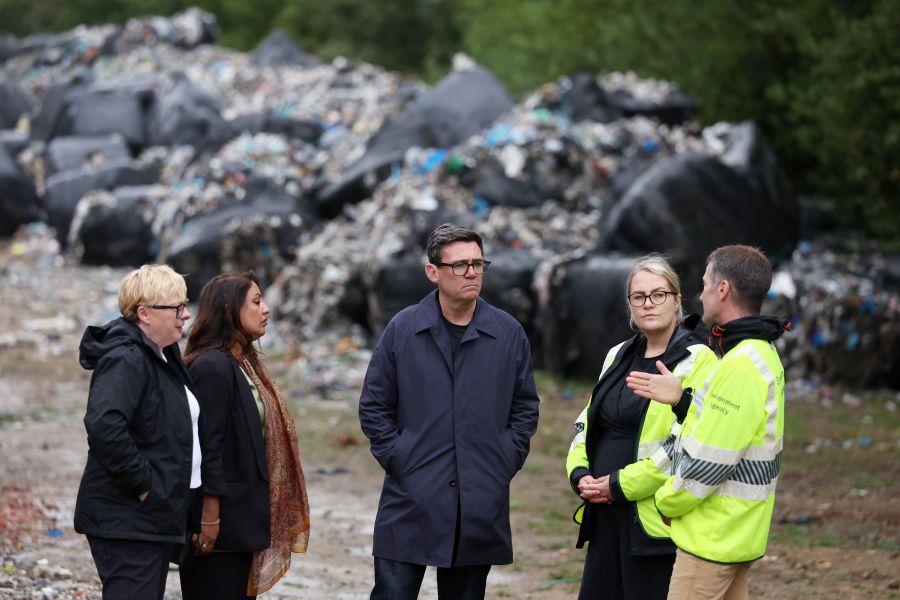
What a load of rubbish: Andy Burnham visits an illegal rubbish dump in Bradford on Thursday as part of his pledge to crack down on the issue © PA Images / Alamy Stock Photo
Andy Burnham has sought to emphasise his domestic policy credentials since becoming Prime Minister a month ago, and this week was no different, with policies on drought funding, waste crime, homelessness, and the PM’s favourite topic: buses. £65m of additional funding is going to farmers to help them mitigate the impact of this summer’s heat, a new funding package will help the police and enforcement agencies deter illegal waste dumping and clean up three of the worst illegal waste sites, and disabled people will be granted free bus travel all day, every day. The next step in Burnham’s aim to eliminate rough sleeping has been taken, with £442m to ensure every homeless person is offered a route off the streets at Christmas. Keeping the focus up, the Government announced there’ll be a national summit on tackling rough sleeping in the Autumn.
Marking a month since the opening of No.10 North, the Prime Minister rounded out his week by convening mayors from across the country for the office’s first “virtual situation room”, where he announced a package of measures to put more Whitehall capacity behind local leaders. These include temporarily assigning high-performing civil servants to mayoral authorities in an effort to build local capability, alongside a new Civil Service Fast Stream pilot in Yorkshire and the Humber, which will aim to provide more opportunities to build successful careers. Before signing off for the weekend, Burnham attended a ceremony to mark the inaugural National Day for Victims and Survivors of Terrorism, which will be observed annually on 21 August.
£345,000 – value of donations Andy Burnham has registered receiving over the past year, including £164,347 from businessman Lord Sainsbury alone.
185 – potential crossings the French authorities have intercepted this summer, preventing around 4,300 migrants from reaching the UK.
117 – years, Ethel Caterham, the world’s oldest living person celebrated turning today.
£1.8bn – amount borrowed by the Government in July 2026, £2.3bn above the OBR forecast.
0.2 – percentage point improvement in the proportion of 16-year-olds achieving grade 4 or above in their GCSEs this year.
2.9% – UK inflation in July, up from 2.6% in June.
$40tn – US national debt, which has doubled since Trump first entered the White House in 2017.
Talking about the weather is a national pastime at the most typical of times. So, it's unsurprising that this summer, on course to be the hottest on record, weather chat has gone into overdrive. And I'm not letting elections sit out of that conversation.
A poor election turnout is often blamed on the weather, and in fairness, it's an ideal excuse. Plausible, blameless, and in the moment, unfalsifiable… That was until this week, when I decided to check.
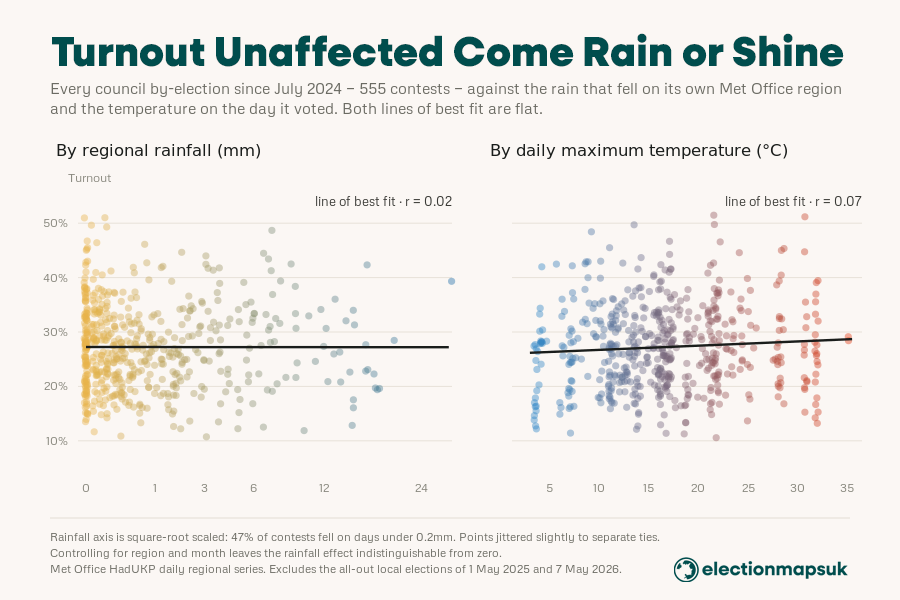
I analysed the 555 council by-elections held since the 2024 general election, matching each to daily national temperature and regional rainfall measurements from the Met Office. So how does rainfall affect turnout? The short answer: it doesn’t.
Turnout on dry days: 27.9%. Turnout on properly wet ones: 28.2%. Slice it at any threshold you like and those two figures stay within a whisker of each other. Account for where in the country the vote was held, and what time of year it took place, and the answer doesn't budge.
And temperature? Surely the cold keeps people indoors, while a glorious day sends them to the seaside rather than the polling station. Both would show up as a slump at the extremes. Neither does.
Polling days above 25°C averaged 27.5% turnout, against an overall average of 27.2% - completely unremarkable. Days below 10°C came in at a very similar 26.7%.
The trend runs barely uphill - about 0.8% for every ten degrees increase in Centigrade - small enough to be indistinguishable from chance. Even that effect all but disappears once you account for the fact turnout has been rising across the board since 2024.
The lowest council by-election turnout since July 2024? 11%. The Highest? 50%. Something is causing that gap, but it isn't the sky. Campaigners are going to have to find a better excuse...
Key Movements
Henry de Zoete has been appointed Director of the AI Security Institute. The former Special Adviser, tech entrepreneur and angel investor takes over from Interim Director Adam Beaumont who returns to GCHQ. Nate Burnikell has also been promoted to Chief Strategy Officer
Bayo Alaba MP has had the Labour Whip suspended following a newspaper report which alleged he may have attempted to avoid repaying a Bounce Back Loan issued during COVID-19.
Robbie Butler MLA has been appointed the new Northern Ireland Health Minister after Mike Nesbitt MLA resigned, amid a row with UUP leader Jon Burrows MLA over the withdrawal of emergency general surgery services from Causeway Hospital.
The Building Safety Regulator appointed Gill Kernick as Independent Chair of its statutory Residents’ Panel. She is currently Director of Strategy and Culture Realisation at Arup and lived in Grenfell Tower a few years before the fire.
Megan Lee-Devlin was named the new Chief Executive of HM Courts and Tribunals Service.
Dan Rodenhurst has been appointed as the new Chief Digital and Information Officer (CDIO) at the Ministry of Defence, leading the MOD’s digital and data teams.
The Agriculture and Horticulture Development Board has appointed Enrique Fernandez-Pino to the Board for a three-year term.
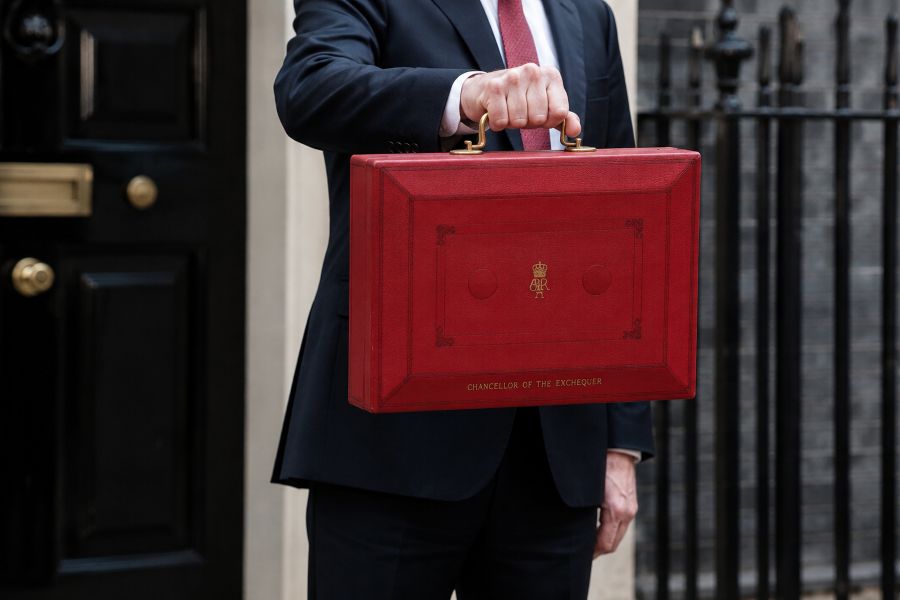
This week, to mark a month since John Healey entered Downing Street as Andy Burnham’s first Cabinet appointee, Navigate’s Emily Oldham has taken a look at what his appointment might mean for the upcoming Budget, and beyond:
In a pick that certainly came as a surprise to most of Westminster (although perhaps shouldn’t have), the new Prime Minister chose fellow northerner and former Defence Secretary John Healey as his new Chancellor. Speaking to his new team at the Treasury, he set out his five priorities as: fiscal discipline; growth in every postcode; backing Britain including through apprenticeships, jobs and procurement; wealth creation; and making life more affordable. So, as Healey settles into No. 11, we’ve taken a look at what this might mean in practice…
DEFENCE…
It might be the obvious one, but given the manner in which Healey resigned as Starmer’s Defence Secretary just 10 weeks ago, it seems difficult to imagine a scenario in which he fails to address the very gripes he himself had with the Treasury. Quick refresher: Healey resigned as Defence Sec in June over what he deemed insufficient funding for defence, accusing the Treasury of being ‘unwilling’ to commit the resources needed to defend the country. So, a pathway to 3% by 2030 is something many people are expecting to see at the Budget.
But where could this money come from? After Healey’s resignation and the subsequent publication of the DIP, Keir Starmer confirmed some capital projects, on energy for example, would no longer go ahead and that DESNZ would find an additional £2bn of savings. Andy Burnham has also already set out that his cap on single bus tickets to £2 from January will be funded through reprioritising DESNZ’s budget, switching funding for international climate finance projects into loans. So could we see further cuts to DESNZ spending – with Miatta Fahnbulleh now leading the Department instead of Ed Miliband? Announcements out of DESNZ so far have primarily focused on reducing energy costs rather than any new renewable energy projects, and come amid rumours the PM is set to approve the Jackdaw and/or Rosebank oil and gas fields.
FINANCIAL INCLUSION…
If we take a bit of a stroll down memory lane, Healey’s first ministerial role in 2001 was as Adult Skills Minister, and if we go back even further before his election, he spent time working in the voluntary sector including at MIND and the Royal Association for Disability and Rehabilitation. This could certainly indicate a personal interest in ensuring greater financial inclusion and education, so could this end up being translated into forthcoming policy? Indeed, it was when Healey was last in the Treasury between 2002 and 2007, as Economic Secretary and then Financial Secretary, that he oversaw the creation of the Financial Inclusion Fund, providing £120m over three years as announced at the 2004 Spending Review. This included money for increasing the provision of face-to-face financial advice and £3m for a new Financial Inclusion Taskforce to promote access to bank accounts and affordable credit; and came alongside the Government’s shared goal with the banking industry of halving the 2.8 million adults without a bank account. With an updated Financial Inclusion Strategy published towards the end of last year, we could expect to see Healey set out some clearer implementation timelines on this at the Budget, including:
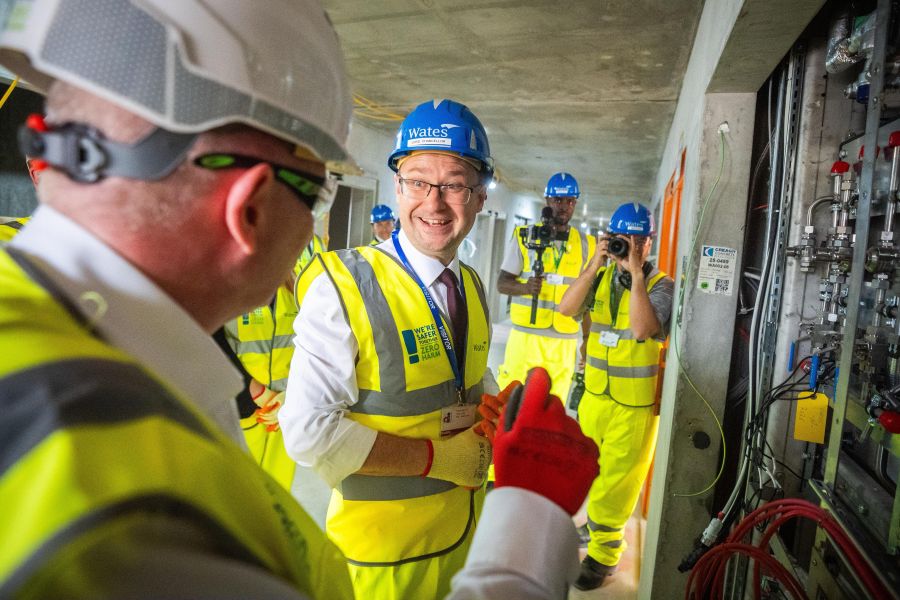
Banking Hubs: This has been a commonly debated topic in Parliament, especially among MPs representing more rural areas, amid concerns that closing bank branches across the country will see vulnerable and financially excluded people unable to access cash or face-to-face monetary advice. The Government’s target of 350 banking hubs across the country by the end of this Parliament is on track for delivery, with recent data showing around 275 have been announced and 235 are open… in fact, Healey personally and successfully campaigned for a banking hub for Wath in his constituency, which opened in March of this year. However, many MPs have been calling on the Treasury for some time to look at the ATM network operator LINK’s assessment criteria, given they are responsible for assessing which communities need a hub yet have been criticised for failing to account for public transport, journey times, geography and the cumulative effective of multiple nearby closures. The Government’s independent access to cash review is due to report in October, so we could see something on this shortly, for example a reassessment of LINK’s criteria and process, or an increase to the 350-hub target.
Digital Inclusion: HMT launched a consultation on the Government’s approach to modernising payment services regulation following Rachel Reeves’ final mansion house speech as Chancellor, and published the Payments Forward Plan earlier this year too, setting out a roadmap for the payments sector over the next three years. Coming later this year, according to this timeline, will be the establishment of a standards body capable of becoming the Open Banking ‘Future Entity’, an FCA consultation on open banking regulation and stablecoin final rules. Efforts to modernise payments and make them easier for people and businesses would not only tackle digital exclusion and likely be relatively low cost for the taxpayer, but such steps would also align with Healey’s aims to ensure fiscal discipline, increase wealth creation and create greater confidence in investment and innovation.
Financial Education: The Financial Inclusion Strategy also includes making financial education compulsory in primary schools in England from September 2028. Given that previous attempts to embed financial education in the secondary curriculum have seen limited traction, could we see further announcements on this to ensure sufficient teacher training on the topic? Is there also scope for greater financial education beyond the classroom, supporting entrepreneurs and aspiring business owners with greater financial literacy?
Debt: Regulation of the debt enforcement sector has been a topic of concern for some time, with the sector lacking any kind of legally binding oversight. However, the Government have set out an intention to move towards a legally mandatory regulator accountable to Parliament, instead of the current voluntary industry-backed scheme. With a consultation on this having closed over a year ago, could movement on this be expected soon?
SAVINGS AND ISAS:
Back during his last stint in the Treasury, Healey confirmed the extension of the existing higher ISA limits to 2010 during the 2005 Budget, and has since reiterated his support for ISAs as a way to help people on lower incomes to save – including speaking up on the need for long-term structural changes to encourage savings during Labour’s time in opposition. With Rachel Reeves’ changes to ISAs lowering the cash ISA allowance for under 65s from £20,000 to £12,000 due to come into effect next April, could we see any adjustments to this in a bid to encourage savings? It certainly seems unlikely he would adjust the new cash ISA limit, but in light of his desire to see increased investment, especially domestically, is there a case to be made for upping the threshold for non-cash or stocks and shares ISAs?
TAX:
The PM has already made clear he will stick by Labour’s manifesto commitment not to raise income tax, employee NI or the main rate or VAT, but it feels somewhat inevitable that some form of tax will need to be raised to fund his promises so far, in particular on social care. This comes as economists have warned the Government could face a £24bn funding gap before the end of the decade, although there has obviously been no official OBR forecast yet. While there’s been some talk of a universal 10% levy payable by all households on death (on top of existing IHT), this has to feel pretty unlikely: Burnham has not explicitly mentioned this at all (just speculation and Reform calling on him to rule it out); it would be hugely unpopular; and such a flat rate would likely disproportionately impact lower income households. What seems more likely then is a rise in Capital Gains Tax, perhaps towards income-tax levels. Although this hasn’t been spoken about by either the PM or the Chancellor, First Secretary of State Louise Haigh has reportedly called for CGT to be more closely aligned with income tax, and for an end to the CGT uplift on inherited assets. Additionally, former Labour leader Neil Kinnock (who Burnham personally praised at his acceptance speech as the new leader) has called on the Government to launch a Capital Gains Tax raid at the first Budget.
And so, we await 28 October to see what the new Chancellor has in store…
The new National Planning Policy Framework was published this week, setting out the Government’s policies for plan-making and development decisions in England. The changes include a stronger ‘default yes’ approach to development near well-connected stations, support for higher housing densities, greater flexibility on parking standards, clearer backing for telecommunications infrastructure, and stronger protections for landscapes and community facilities.
Bringing back all sorts of memories to the Navigate team, GCSE results day this Thursday saw outcomes for 16-year-olds rise by 0.2 percentage points at grade 4 and above (the old C grade for those born before 2001). More than 6,000 additional students achieved a grade 7 (old grade A) or higher in maths compared with last year. The DfE also reported growing uptake of vocational qualifications, with nearly 8,000 more Technical Award Level 2 passes than last year.
New AI software will ‘slash waiting times for reporting crimes’, the Home Office announced this week. Designed to reduce waiting times on the 101 non-emergency service, the new software uses AI to identify the reason for a call and redirect non-policing enquiries, such as noise complaints, fly-tipping reports or power outage issues, to the appropriate organisation before callers join a queue, and is expected to save police forces up to £8.5m each year.
Reform’s Treasury spokesman Robert Jenrick outlined the party’s ‘Making Welfare Work’ plan at a press conference on Monday. The new plan will restrict most benefits to British citizens, introduce a Netherlands-style ‘return to work cover’ system for long-term sickness absence, and replace current assessments with a single disability needs assessment. The party claim the plans will help 241,000 people into employment and reduce annual welfare spending by £51bn.
Shadow Energy Secretary Claire Coutinho delivered a speech on the “true cost of Net Zero”, arguing that UK energy policy has prioritised emissions reductions over affordability. She claimed high electricity prices are harming households, industry and investment, and criticised the Government’s Clean Power 2030 target, repeating the Conservatives’ calls for a greater role for gas and nuclear generation to lower costs while maintaining an 80% clean electricity system.
The Green Party would introduce a 38% windfall tax on bank profits above £80m, claiming this will raise at least £19 billion. The party proposes using the revenue to double the Employment Allowance for small and medium-sized enterprises, reducing their National Insurance bills by up to £10,500.
Suella Braverman outlined Reform’s apprenticeship proposals in their second presser of the week, arguing that the UK faces significant skills shortages in sectors such as construction, manufacturing and social care. The party’s Education Spokesperson criticised what she described as an overemphasis on university education and called for greater support for vocational routes, announcing Reform would introduce an ‘Apprenticeships Wage Credit’ for SMEs hiring apprentices and a £2,000 retention bonus for apprentices who remain with their employer for two years after qualifying.
10 Downing Street condemned the Israeli Government’s decision to publish construction tenders for the E1 settlement project in the West Bank. The joint statement, published alongside the leaders of France, Germany, Italy, the Netherlands, Canada and Norway, argued the development would undermine the viability of a two-state solution by affecting territorial continuity in the Palestinian Territories. It urges Israel to withdraw the plans, and warned businesses of potential legal and reputational risks associated with the project.
The Home Office has extolled the benefits of the deal with France to prevent boat crossings, revealing that French officers prevented 185 small boat events in the three months since the deal was struck, representing 61% of all small boat events in the period.
Crazy to think that just last month Westminster was waiting with bated breath to see whether a certain brother would be making a return to the UK… And, as the tabloids have now confirmed, it looks like Prince Harry (sorry, Miliband) and Meghan Markle are returning to life in the UK. While the Prince has returned several times since officially moving to America, notably for the Queen’s funeral and his High Court privacy case, he has often done so without his family, citing security concerns after losing his taxpayer-funded protection. Prime Minister Andy Burnham commented on the matter in the wake of the news, calling the security arrangements a “private matter” for the couple
The new Farming Minister Stephen Morgan took a bit of flack this week after it emerged he felt faint when being shown cuts of beef in a meat refrigerator during a tour of a meat processing plant in the Lake District. The MP for Portsmouth South put the incident down to “moving between the extreme heat and cold storage” but it’s safe to say it wasn’t a great look, and doesn’t seem to have gone down well in the farming community…
Some photos are just asking the AI treatment, and this week’s candidate was Hertsmere MP Oliver Dowden, whose ‘concerned MP in field’ picture, to accompany criticism of the Government’s planning reforms, was immediately seized upon by one X user to show what the developed field might actually look like, complete with still-frowning local MP.