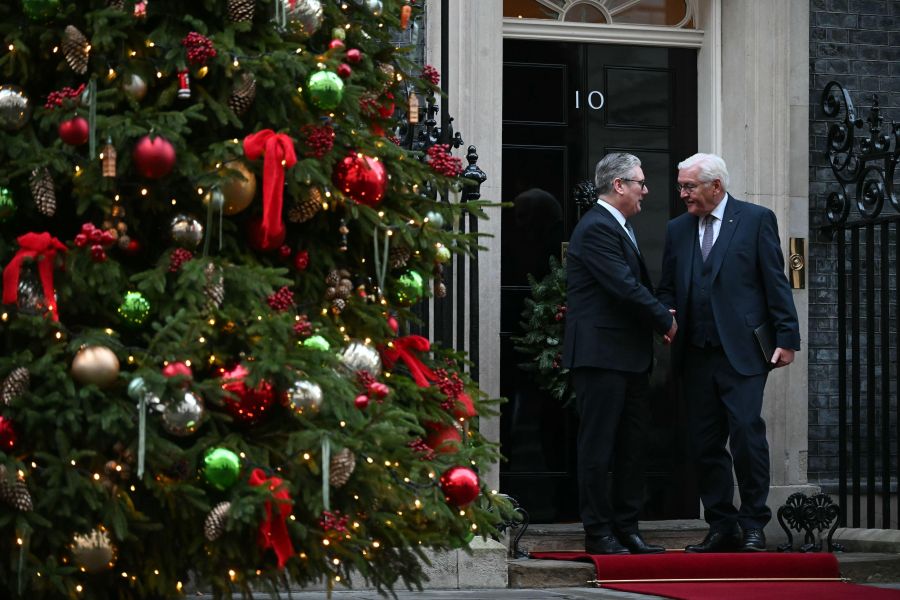
The Prime Minister welcomes German President Frank-Walter Steinmeier to a Christmassy No.10, for the first day of his state visit to the UK on Tuesday © PA Images
The Government had no let up from the Budget permacrisis this week, as accusations flew that the Chancellor misled the public in the run-up to the fiscal event. Rachel Reeves was accused of underselling the economic headroom she had to play with ahead of the Budget, when it came to light last week that she would actually meet her borrowing rule by £4.2bn, despite having hinted at (and then dumped) plans to raise income tax. Despite a valiant rescue from the OBR, which denied she had been misleading, the watchdog’s chief, Richard Hughes, eventually (and perhaps inevitably) took the fall for the Budget chaos when he resigned following the OBR’s accidental early publication of its response to the Budget – an act which, in distracting political opinion, the Government may be somewhat thankful for. However, relations between Reeves and Hughes were already strained, especially after he refused to credit the Government’s ‘pro-growth’ policies in his analysis. The hunt is now on for his successor, should anyone actually want it.
Shuttle diplomacy provided the Government with a useful distraction, as all eyes turned to whether Ukraine might be buffeted into a defeated peace. As President Trump increased pressure on Ukraine to accept his peace plan, talks opened in Geneva between US Secretary of State Marco Rubio and Ukraine’s powerful chief of staff to the president Andriy Yermak – before Yermak suddenly resigned following a domestic corruption probe. Meanwhile, Trump’s special envoy Steve Witkoff and son in law Jared Kushner jetted to Moscow for direct talks with Putin (who kept them waiting for three hours while he delivered a speech in which he threatened wider war against Europe). In a now familiar pattern, the peace talks ultimately failed when Putin rejected the terms, stating that Ukraine still needed to cede territories. European leaders breathed a sigh of relief, although they must be wondering, between a stalemate on the battlefield and an American president determined to impose peace, how much longer this tightrope can be walked.
1.4% – the OECD’s growth projection for the UK in 2025, below the OECD average of 1.7% and well below the G20 average of 3.2%.
100 million – annual entries and exits to the UK at London Liverpool Street, making it Great Britain’s busiest railway station for the third year running.
10% – the increase in guest nights spent at short-term lets in the UK since last year.
£9m – the largest ever donation to a UK political party, given by businessman Christopher Harborne to Reform in August
20% – proportion of all UK political donations since the General Election, given to Reform, who currently have just 0.7% of all MPs.
3 – number of ex-Tory MPs who lost their seats at the last election to publicly defect to Reform this week
9 – sitting days until the Commons and Lords rises for Christmas (we’re almost there folks – just hold on a little longer…)
The Prime Minister tried to tried to take back control of the narrative on Monday after a torturous week of headlines following a chaotic period leading up to last week’s Budget. In a speech entitled ‘Britain built for all’, he gave the Chancellor his full backing and praised the Budget for taking the “necessary choices” and for not following other means that had been “tested to destruction”, such as cutting public services or “rolling the dice” with extra borrowing. He used the speech to outline measures in the Budget to support the cost of living, such as freezing rail fares and prescription charges, and reducing energy bills by £150; and argued public finances and public services are “moving in the right direction”, expressing confidence the Government had “walked through the narrowest part of the tunnel”.
The UK and Norway announced a new defence agreement that will see British and Norwegian navies operating side-by-side in the North Atlantic in an attempt to monitor and deter Russian submarines. The new Lunna House Agreement, named after the Scottish headquarters of the Norwegian resistance during the Second World War (no subtlety spared on that one) will see the Royal Navy and Royal Norwegian Navy operate an interchangeable fleet of British-built Type-26 frigates, following a 30% increase in Russian vessels threatening UK waters in the past two years. Keir Starmer welcomed Norwegian Prime Minister Jonas Støre to RAF Lossiemouth to announce the deal whilst Defence Secretary John Healey took his Norwegian counterpart to Portsmouth.
The Government did not deliberately sabotage the alleged China spy case that collapsed shortly before trial in September. The Joint Committee on the National Security Strategy report published this week concluded that whilst the process was at times “shambolic”, there was no evidence of a coordinated high-level effort to collapse the prosecution or deliberately obstruct it. It has recommended the Government work at pace to review all the processes and protocols in place for national security prosecution cases. In good timing, the Prime Minister also delivered a speech on foreign policy on Monday at the Lady Mayor’s Banquet in London, in which he argued that China "poses real national security threats" to the UK, but that the Government wouldn't "trade off security in one area, for a bit more economic access somewhere else".
President Putin personally authorised the attacks in Salisbury in 2018, an independent report concluded this week. The assassination attempt led to the death of Dawn Sturgess who sprayed herself with the discarded perfume bottle containing Novichok, with the report concluding the Russian President is “morally responsible” for her death. The Government responded to the report with further sanctions on the Russian military intelligence agency the GRU, and on 11 people behind Russian state sponsored hostile activity.
Mayoral elections in four areas will be delayed for a further two years the Local Government Secretary announced this week. Elections for new mayors were due to take place in Greater Essex, Norfolk and Suffolk, Hampshire and the Solent, and Sussex and Brighton in May next year, but will be delayed until 2028, as the Government believes that more time is needed to complete their local government reorganisation. Shadow Local Govt Sec James Cleverly has criticised the Government of “subverting democracy”, whilst even Labour’s own former Local Government Minister Jim McMahon criticised the Government for postponing the elections again.
Labour MP Markus Campbell-Savours had the Labour whip suspended after voting against a Budget motion on the Government's plans to amend inheritance tax on family farms. The rarity of a lone Government MP voting against a Budget motion was enough to overly excite a number of opposition MPs who whipped out their phones to capture the moment in the No Lobby. Suffice it to say none of these photographs have yet to surface after the Deputy Speaker swiftly warned of “severe repercussions” should they do.
In a state visit that received a little less press attention than a fellow President earlier this year, President Steinmeier of Germany took part in first State Visit from a German President to the UK in 27 years this week. Visits to Downing Street and banquets in Windsor and London were followed by a visit to Coventry Cathedral for a memorial service for those who died in the Second World War. The Government also announced a new UK-Germany electric vehicle technology project led by Mercedes to mark the occasion.
The UK has become the first country to sign a zero percent tariff on pharmaceuticals to the US with the Government arguing the deal cements the UK's 'place as a world leader for life sciences investment'. In exchange, the Government agreed to up the base threshold at which the National Institute for Health and Care Excellent (NICE) can approve medicines for use by 25%, enabling higher cost medicines to be considered for use in the NHS.
The Government published its Environmental Improvement Plan, which sets out a framework for improving the natural environment. The plan – one of several the Government has previously pledged to publish by the end of this year – includes measures to reduce harmful pollutants in the air with revised interim targets, tackle ‘forever chemicals’ with a new PFAS Plan, reduce greenhouse gas emissions and ensure resilience of the natural environment including through £1bn for tree-planting, complete the King Charles III England Coast Path next year, tougher measures to tackle waste crime and commits to publish a Green Paper on measures to ensure everyone has access to nature close to home.
New judge-only courts are to be introduced to fast-track cases, after the Ministry of Justice confirmed plans leaked ahead of the Budget last week. The new ‘swift courts’ will remove the right to a jury trial from cases with a likely sentence of three years or less, which will be heard by a judge alone - estimated to take 20% less time than a jury trial. The proposals have been heavily criticised by MPs on both the opposition and Government benches as well as barristers and human rights organisations.
The Government failed to reach an agreement on participation in a key EU defence fund this week. EU Relations Minister Nick Thomas-Symonds confirmed the “disappointing” news that despite negotiations, agreement couldn’t be reached on the Security Action for Europe (SAFE) fund. According to media reports, EU officials believe talks can continue but have suggested it is up to the UK to move on their current position to enable this to happen, with one unnamed UK Government official telling Politico the EU needed to “get f**king real” and recognise the benefit to the bloc of involving the UK’s strong defence industrial sector in the fund.
The Child Poverty Strategy was also launched, pledging to lift around 550,000 children out of poverty by 2030. The Strategy includes measures such extending eligibility for upfront childcare costs to those returning from parental leave, ending the unlawful placement of families in Bed and Breakfasts beyond the six-week limit, funding for Emergency Accommodation Reduction Pilots in 20 local authorities, up to 5,000 high-quality homes for better temporary accommodation by 2030, and allowing parents to use loyalty points and gift cards to buy infant formula.
Former Economic Secretary to the Treasury Tulip Siddiq MP has been sentenced to two years in prison by a court in Bangladesh, after it found her guilty of corruption in relation to her aunt, Bangladesh’s ousted former leader Sheikh Hasina. Siddiq insisted she had ‘done nothing wrong’ and will ‘respond to any credible evidence’ that is presented to her.
Debate over the Budget continued this week, unsurprisingly, with scrutiny of the Treasury’s decisions carrying through the first half of the week into a pointed PMQs. Monday was also marked by a statement on OBR forecasts, which was followed shortly afterwards by the resignation of Richard Hughes as OBR Chair. On Tuesday, Justice Secretary David Lammy delivered a statement on reform of the criminal court system, confirming changes to the use of trial by jury, before VAWG Minister Jess Phillips set out the Government’s response to the publication of the Angiolini Inquiry. The Pension Schemes Bill completed its remaining stages, while Westminster Hall hosted debates on gambling regulation, catapults and anti-social behaviour, local media, and the Oxford to Cambridge Growth Corridor.
Over on the red benches, members also got their chance to press Ministers in the Budget, and in true Lords fashion, got stuck into a range of legislation. They continued committee stage of the Sentencing Bill, held the second reading of the Biodiversity Beyond National Jurisdiction Bill, had the third reading of the Dogs (Protection of Livestock) (Amendment) Bill, and today returned to committee stage of the Terminally Ill Adults (End of Life) Bill.
Meanwhile, four bills received Royal Assent this week: the Public Authorities (Fraud, Error and Recovery) Act 2025; the Property (Digital Assets etc) Act 2025; the Animal Welfare (Import of Dogs, Cats and Ferrets) Act 2025; and the Border Security, Asylum and Immigration Act 2025.
Policymakers have the opportunity to make savings in the education budget or use existing resources more intensively as the number of children in the UK is expected to decline in the next decade, according to a new report from the Institute for Fiscal Studies. The report sets out the expected changes in pupil numbers across the UK and how past declines have translated into the numbers of schools and teachers.
The abolition of NHS England and the merging of its functions in the Department of Health and Social Care could lead to increases in policy incoherence and blame culture, warns a new report from the Institute for Government. The paper identifies five key “factors” that will determine whether the process will be a success, which stress the need for a clear vision and establishing a unified culture early in the transition.
The success of the Government’s New Towns Programme depends on introducing a ‘radical’ upgrade to the concept of ‘citizenship of place’, according to a new report from Demos. The paper investigates delivering social infrastructure, governance and stewardship models alongside new homes and ‘poses key questions that must be resolved to design a new model of citizenship of place.’
Britons are more likely to view Reform UK as pro-Russia (28%) than anti-Russia (13%), according to a new YouGov poll. Overall, 64% of Britons describe themselves as anti-Russia and 24% as neutral, a pattern reflected among voters of the main parties, with 79% of Conservatives, 74% of Liberal Democrats and 71% of Labour supporters identifying as generally anti-Russia. In contrast, only 48% of Reform UK voters see themselves as anti-Russia, while 43% remain neutral.
It’s Your Party and they’ll cry if they want to, as the Jeremy Corbyn / Zarah Sultana founded group held its inaugural conference last weekend and saw members vote to officially name the party…. Your Party, which it had been its placeholder name since July. The event itself saw Sultana boycott the opening day after some members were refused access due to their membership of the Socialist Workers Party. Sultana (who still held £200,000 raised by membership payments) said the party was being run by “faceless, nameless bureaucrats”, while Corbyn argued that the SWP was registered with the Electoral Commission and Your Party rules were clear that members couldn’t be in multiple parties…(it was later clarified the SWP are not registered with the Commission).