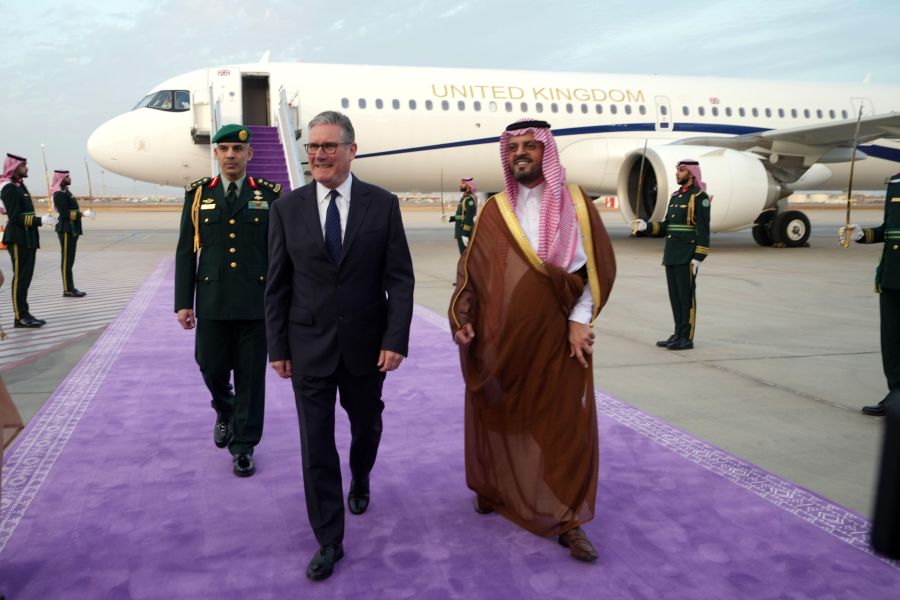
Keir Starmer receives an official welcome in Jeddah, Saudi Arabia, for the first leg of his trip to the Gulf following the announcement of a ceasefire between the US and Iran © PA Images / Alamy Stock Photo
The Prime Minister donned his statesman shirt once again as he travelled to the Gulf during a lull in the fighting. Following continued attacks across the region, President Trump issued a chilling (and even by his standards, shocking) threat that he would destroy the entire Iranian civilisation by attacking its energy infrastructure if it failed to reopen the Strait of Hormuz. With a healthy portion of Trump TACO (Trump Always Chickens Out, for those who are less terminally online), the president then announced a ceasefire just two hours before his self-imposed deadline. Into this semi-peace stepped Starmer, who visited British troops stationed in region and met with the leaders of Saudi Arabia, the UAE, Qatar and Bahrain. However, few expect the ceasefire to hold for its two-week duration: Iranian missiles continued to fly even after it was announced, and Israel immediately declared that Lebanon, where it is battling Iranian-backed Hezbollah, was not included in the ceasefire, with a huge wave of Israeli strikes over the course of just 10 minutes killed 300 people on Wednesday, an act condemned by Western nations as well as Iran, all of whom demanded Israel cease its operations. Alongside the actual war, Trump’s attacks against allied nations barely stopped: he continued to lash out at NATO members for not supporting him in the conflict, musing about withdrawing American troops from such countries (Britain included) and threatening again to pull out of the alliance in a reportedly testy meeting with NATO leader Mark Rutte. Starmer also managed to bag a call with the big dog, while also comparing his destabilising actions to Putin’s in an interview with Robert Peston. With the Government buoyed by public backing for its decision not to support the US and Israel in the conflict, perhaps one of Europe’s most successful Trump-whisperers has decided he’s had enough.
With under four weeks to go until voters in England, Scotland and Wales go to the polls, all 7 (yes seven) main parties have been hitting the streets and airwaves looking to outline just what change they would implement if elected, with manifestos continuously being dripped out. 7 May has been touted as a key day in the premiership of Prime Minister Keir Starmer, as Labour look on course to lose a large number of councillors, control of the Senedd, and a number of MSPs in Scotland, while many in Labour fear serious damage could be done in their London heartlands. The Tories are also predicted to be hammered in the elections, with over 1,000 councillors up for re-election.
On the other side of the coin, Reform UK are looking to repeat what we saw last year and double the their number of local councillors, while also fighting to become the largest party in Wales and main opposition to the SNP in Scotland, who themselves are taking advantage of a weaker Labour Party nationally and look on course to remain in Government… a major turnaround from when John Swinney became First Minister in May 2024 just two months before the SNP lost over ¾ of their MPs. Plaid Cymru hope to become the largest party in Wales, buoyed from the by-election victory of Lindsay Whittle at the end of 2025. Finally, Zack Polanski launched the Green Party’s local election campaign this week, focusing on housing and the cost-of-living. The Greens are looking to make serious inroads across England, notably in London, while they’re also aiming to increase their number of elected representatives in Scotland and gain their first MS in Wales. While so much remains uncertain, 7 May is looking like a time when the relative political consensus gets firmly upended once more.
For those interested, the manifestos that have been published so far are: Reform UK Scotland, Scottish Conservatives, Plaid Cymru, Reform UK Wales, Welsh Labour, Welsh Conservatives, and the Welsh Green Party.
$1 – Tariff Iran reportedly plans to charge on every barrel of oil (42 gallons) to pass through the Strait of Hormuz
6% – maximum interest rate to be charged on student loans from 1st September under a new cap
26.6C – highest temperature of the year recorded so far: at Kew Gardens on Wednesday
33 – days until the King’s Speech
32% – increase in the price of diesel in the UK since the start of the year
17 – Government Bills currently active in Parliament, with just…
14 – maximum number of days Parliament will sit for Government business before proroguing ahead of the State Opening and King’s Speech on 13th May
157,800 – cups of tea and coffee sold in the Scottish Parliament café since the 2021 election (h/t BBC News)
< 4 – weeks to go until the Scottish, Welsh and local elections
The Government YEeted Kanye West’s visa application to visit the UK, citing his history of antisemitic statements and concluding that "his presence would not be conducive to the public good." The American rapper was due to headline this summer’s Wireless Festival, which has now been cancelled, and has since put out a statement saying that he would be “grateful” to meet with members of the UK’s Jewish community, acknowledging that words “aren’t enough”.
Multiple measures under the Employment Rights Act took effect on 6 April, including expanded day-one family-related rights, changes to statutory sick pay, strengthened Collective Redundancy protections, a simplified trade union recognition process, and strengthened whistleblowing protections. Under the measures, 32,000 new fathers and partners gained the right to paternity leave from the first day of a new job, while new day-one rights to unpaid parental leave also began.
The Government’s entrepreneurship tax relief package also came into force earlier this week, set to unlock £100m of additional investment a year. Changes implemented include a significant expansion of the number of companies eligible for the Enterprise Management Incentives (EMI) scheme, and a doubling of the amount a company can raise through the Enterprise Investment Scheme and Venture Capital Trusts. The package sits alongside the British Business Bank's new Five-Year Strategic Plan and follows measures to encourage scale-ups to list in the UK.
Reform MPs made good use of their time off, as the party held multiple press conferences during the two-week recess, further outlining its policy. The party’s Treasury Spokesperson, Robert Jenrick, announced that the party would continue to back the Triple Lock for state pensions and that it would review the long-term sustainability of continuing to permit new entrants to defined benefit pension schemes in the public sector. Meanwhile, its Energy Spokesperson, Richard Tice, stressed the need for the UK to have its own supply of energy in the wake of geopolitical circumstances and announced the party’s four-point plan for the sector, which includes removing net zero “in entirety”, including the Emissions Trading Scheme, and will scrap the Energy Profits Levy in favour of an exploration refund scheme like Norway.
Passengers across England will be able to track their buses in real time via Google Maps under the Department for Transport’s newly published ‘Better Connected’ national transport strategy. The plan sets out eight priorities, including simplifying payments, improving reliability, boosting accessibility and affordability, and making greater use of data and technology. Alongside real-time tracking, the strategy includes expansion of the National Parking Platform to allow drivers to use any app across participating car parks, and a ‘Mini Switzerland’ pilot in the Peak District’s Hope Valley to better integrate rural bus and rail services.
Knife homicides have fallen by 27%, with knife-point robberies and hospital admissions for stabbings also down by 10% and 11% respectively, which follows the removal of 63,000 knives from the streets. Alongside the data, new measures have been announced as part of the Home Office’s new plan to halve knife crime, which includes a £1.2m ‘Safety In & Around Schools Partnership’ to provide specialist training for schools in high-risk areas, with up to 50 schools receiving intensive support based on hyperlocal mapping of knife crime during commuting hours. A further £26m has also been allocated through the Knife Crime Concentrations Fund to support the 27 police forces covering the majority of offences across England and Wales.
Homes England announced the launch of the new National Housing Bank, a government-backed institution designed to accelerate the delivery of new homes and support the regeneration of towns and cities across England. The bank will work with housebuilders, developers, investors and registered providers to deploy up to £16bn in debt, equity and guarantees, alongside closer collaboration with Mayors through a new regional model aimed at strengthening delivery on the ground. Its launch was also accompanied by a new Investment Prospectus setting out how Homes England will deploy its capital, land, powers, and technical expertise, as well as a £100m partnership with Aviva to build up to 3,300 new rental homes in underinvested urban areas.
Karl Turner MP has lost the Labour Whip following supposed ‘uncollegiate’ comments about colleagues. Turner has been a frequent critic of the Government, particularly as a vocal opponent of proposed jury trial reforms, though party sources point to a broader ‘pattern of behaviour’ rather than his policy positions alone.
Consumers will find it ‘simpler and far less painful’ to exit unwanted subscription contracts under new rules announced by the Department for Business and Trade, aimed at stopping people being ‘silently rolled onto expensive deals.’ Set to come into force next September, the measures will require companies to provide clear information upfront, send reminders before trials end or long-term contracts renew, and ensure cancellations are straightforward, including online for digital sign-ups. A new 14-day cooling-off period will also be introduced after trials finish or contracts renew for 12 months or more.
Simon Dudley has been sacked from his role as Reform UK’s housing spokesperson following backlash over comments he made about the Grenfell Tower fire, in which he described the disaster as a “tragedy” but said that “everyone dies in the end”.
As Scottish elections fast approach and North Sea oil and gas continues to divide politicians from all sides, a new YouGov survey shows that 45% of Scots oppose the current ban on North Sea oil and gas developments, with 37% supporting the ban. This opposition spans most parties in Scotland, with only those intending to vote Green in May in favour of the ban (54%), whilst the Tories and Reform leading the way with a 59% opposition apiece. Meanwhile, across the rest of Britain, opinion is more evenly divided, with opposition to the ban (39%) just edging ahead of support for it (38%).
More from Scotland, and a new Ipsos poll has found that the SNP has extended its lead over Scottish Labour and Reform UK to 39% of the constituency vote, up three points ahead of the election. By contrast, Labour’s support has slumped, falling five points to 15% which brings them level with Reform UK. The poll highlights a fluid race as 42% of voters say they may still change their minds before polling day. While Reform UK voters appear the most certain, the Scottish Green Party could benefit most from late shifts, with a quarter of undecided voters saying they may switch to the Greens.
This energy crisis is not a repeat of 2022, according to a new report from the Institute for Government, due to its focus on oil rather than gas as was the case following Russia’s invasion of Ukraine. Disruption to oil has bought ‘wider impacts on global trade’ such as jet fuel and agricultural fertiliser, and whilst its caused higher prices in UK, there hasn’t been an immediate shortage of supply. The report congratulates the Government for resisting temptations to dish out the same universal energy support offered in 2022 but called for coordination of the short, medium and long-term plan to ensure they reinforce each other, not undermine. The report does also however criticise the Government for being ‘slow off the mark’ and leaving space for an ‘auction’ on the future of oil and gas in the North Sea by opposition parties.
Stella Creasy unveiled her new gig with GB News on 1 April, announcing she’ll be presenting a new current affairs show with Patrick Christys ‘Dancing with the Devil’ on Sunday mornings… in case you couldn’t work out from the grainy AI image, April Fools! And Stella wasn’t the only MP with time on her hands this 1 April (recess, eh), as Dawn Butler went to the effort of repeating last year’s joke that she was appointed as Minister for Hope and Positivity, while Ben Obese-Jecty went to the actual effort of AI-ing a scarily realistic image of the Defence Investment Plan’s publication… wonder how many people that one fooled!