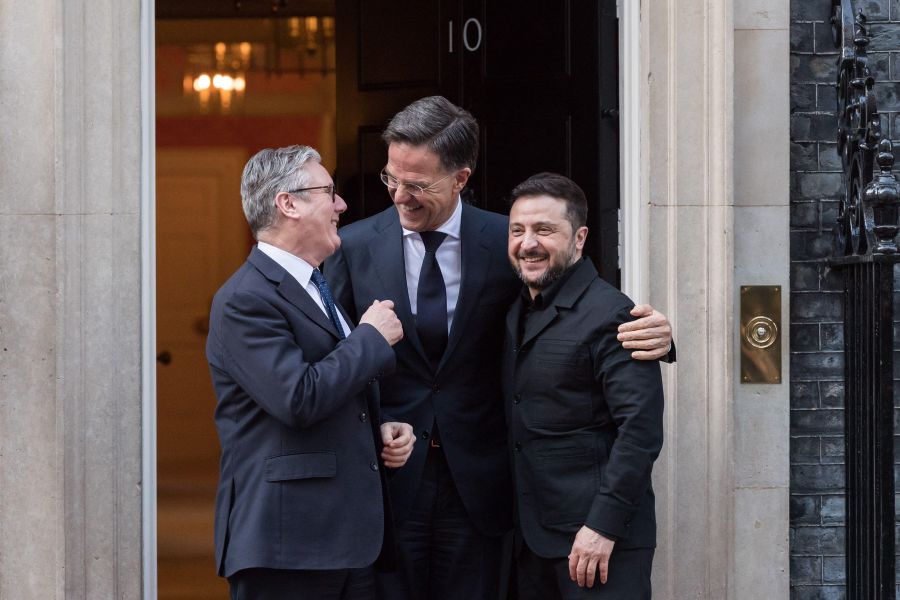
Keir Starmer, NATO Sec Gen Mark Rutte and Ukrainian President Zelenskyy share a brief moment of respite after meeting to discuss a new military partnership and the effects of the war in the Middle East on the conflict in Ukraine © ZUMA Press, Inc. / Alamy Stock Photo
Efforts to re-open the Strait of Hormuz are intensifying, with the UK aligning itself alongside key allies while continuing to tread carefully on direct involvement in the Middle East. A joint statement published on Thursday by leaders of the UK, France, Germany, Italy, the Netherlands, Japan and Canada condemned Iran’s attacks on commercial shipping and what they described as the ‘de facto closure’ of the Strait of Hormuz, confirming that participating countries are prepared to contribute to ‘appropriate efforts’ to ensure safe passage, while welcoming ongoing preparatory planning by partner nations. This caution, however, is increasingly being tested, as Donald Trump demonstrated on Friday afternoon that he has little patience for nuance. In a characteristically blunt intervention on Truth Social, Trump openly criticised NATO allies, branding them ‘cowards’ and arguing it would be ‘easy’ for them to ensure safe passage through the strait. He went further, claiming the alliance is a ‘paper tiger’ without US backing, that the fight has been ‘Militarily WON’, and that reopening the route would amount to ‘a simple military manoeuvre’ with ‘so little risk’, adding pointedly that he will not be forgetting this hesitation any time soon. In London, Downing Street is, for now, holding the line, after officials insisted the UK is ‘not getting drawn into the wider war’, while confirming that US forces have been authorised to use British bases for a ‘specific defensive and limited purpose’; a position which has already drawn warning from Tehran, following recent talks between Iranian Foreign Minister Abbas Araghchi and Foreign Secretary Yvette Cooper.
As the UK Government navigates its response to the ongoing situation in the Middle East on the international stage, ministers have also been grappling with the knock-on effects on the domestic economy, most notably, rising energy costs. The topic was the focus of a Ministerial Statement, a Conservative Opposition Day debate, and multiple questions during DESNZ oral questions. The Government announced a series of measures aimed at protecting consumers and maintaining energy security, with Keir Starmer having kicked off the week with a press conference unveiling a £53 million support package for low-income households in rural communities at risk of losing access to energy due to rising bills. He also confirmed that energy bills would be capped by the end of June, stating that the Government had issued a legal direction to energy companies to ensure that every penny of savings delivered through last year’s Budget is passed directly on to customers. Responding to the Government’s approach, Reform UK’s Treasury Spokesperson Robert Jenrick set out an alternative proposal: cutting VAT on domestic energy bills and removing “green taxes and levies”, which he argued largely benefit energy companies. The party also adopted an eye-catching campaigning tactic, launching a prize draw in which it pledged to pay the energy bills of the winner and their entire street for one year….
5.01% – Current yield on the UK’s 10-year government bond, after it soared to levels not seen since the 2008 crash, making Government borrowing the most expensive it has been in almost 18 years.
£6bn – the amount set to be cut from the overseas aid budget by 2027, in order to fund an increase to defence spending.
30 – number of Labour backbenchers said to have signed a letter to Home Secretary Shabana Mahmood urging her to rethink the Government’s reforms to immigration, part of a group of over 100 MPs, Peers and trade union representatives.
3.5% – inflation figure forecast by the Bank of England for Q3 of this year, partly driven by the war in the Gulf.
£80,000 – the amount that Reform UK leader Nigel Farage has earnt filming video messages on Cameo since the last General Election.
29 – number of cases of Meningitis B so far confirmed following an outbreak in Kent.
One – number of votes by which the leader of Warwickshire Council, Reform UK’s George Finch, survived a vote of no confidence on Tuesday.
£100m – amount Rwanda claimed it is owed by the UK at an arbitration court in the Hague for walking away from the previous Conservative government’s deal to process asylum seekers.
8,452 – number of people currently imprisoned in Scotland, the highest on record.
Closer relations with the EU, a focus on AI, and more control for regions will give the UK the economic growth it wants, or so argued the Chancellor this week as she delivered the Mais Lecture. A few weeks after a Spring Statement lacking in announcements, the Chancellor set out increased funding for the major city regions, confirmed a new AI Economics Institute would be launched to monitor the impact of AI on productivity and the labour market, and emphasised that “no partnership is more important than that between the UK and our European neighbours” and that closer alignment was the right aim.
The Prime Minister welcomed President Zelenskyy and NATO Secretary General Mark Rutte to Downing Street as the UK tries desperately to not let the war in Ukraine slip from the headlines. The UK and Ukraine also signed an enhanced security and defence industrial collaboration declaration, leveraging Ukraine’s ‘defence, resilience, and extensive operational experience’ to support the development of ‘future European defence capabilities.’
This was preceded by a visit to Ireland, where the Prime Minister was hosted in Cork by Taoiseach Micheál Martin. There they agreed the ‘Shared Prosperity, Shared Seas, Shared Ties’ memorandum, setting out practical measures to ‘nurture our vibrant economies, protect our seas, and strengthen our friendships and partnerships for the generations to come.’ Starmer’s legwork appears to have paid off as Martin came to his aid following President Trump’s tongue-lashing in the Oval Office (See more from the Oval Office this week in You’ve Got To Laugh below…)
Nigeria’s President Bola Tinubu also paid the Prime Minister a visit in the first state visit of the year. At the reception at Windsor Castle – attended by former Lioness Eni Aluko, space scientist Dame Maggie Aderin and Nigerian pop superstar Tiwa Savage – the King praised Nigeria as an “economic powerhouse, a cultural force and an influential diplomatic voice.”
The first ever Land Use Framework for England has been published, outlining how to use land more effectively and support the delivery of new homes, nature restoration, clean energy, and food security. A dedicated Land Use Unit will be established to support delivery of the Framework and produce a single map of national spatial priorities.
The Government will levy a 50% tariff on steel imports under the new Steel Strategy as it takes a few notes from Tariff Trump. It will also seek to increase domestic steel production to 50% of consumption as it attempts to level the playing field against subsidised imports. About £2.5bn will also be spent supporting domestic producers, including the effectively nationalised British Steel.
Cuts to the international development budget will proceed, the Foreign Secretary confirmed. However, several nations including Ukraine, Palestine, Sudan and Lebanon will have their development funding ringfenced, and the BBC World Service will have its funding boosted by £11m a year.
DCMS published the Media Literacy Action Plan, which will ‘help people across the UK think critically about online content, find trustworthy information, and make the most of digital opportunities.’ Some might say the boat has sailed on that front…
The Scottish Parliament narrowly voted against legalising assisted dying, with the Bill rejected at its final stage by 69 votes to 57 following an emotional debate. Liberal Democrat Liam McArthur, who introduced the legislation, stated he was “deeply disappointed” at the result but does not intend to reintroduce the Bill again.
The race to succeed Derry/Londonderry, Hull, Coventry and Bradford as the UK’s City of Culture took a step forward this week, with nine locations longlisted for the 2029 competition. From Portsmouth to Wrexham, Ipswich to Middlesbrough (no this isn’t a list of the weekend’s Championship fixtures), the nine longlisted bids have received £60,000 to develop a full application.
The green benches had a heavy week, beginning with urgent questions on the Strait of Hormuz, Peter Mandelson and changes to the GP Contract for 2026/27. Ministerial statements followed on the Meningitis outbreak, heating oil support, the Middle East, youth employment and the UK Steel Strategy. There was no let up as Conservative leader Kemi Badenoch used Prime Minister’s Questions to repeatedly grill Starmer on Pater Mandelson’s appointment, questions he batted away with criticisms of her initial eagerness to enter the war in the Middle East and Shadow Justice Secretary Nick Timothy following his description of Muslim prayers in public as “an act of domination.” The Tories weren’t done yet though, as Wednesday also bought opposition debates on fuel duty and student loans.
The Lords focused on legislation once again as they revisited the Pensions Schemes Bill as it hit its report stage, voting to remove the ‘investment mandation’ that would have given the Government the power to tell private pension companies where to invest their savers’ money. They also backed to end the criminalisation of women having abortions outside of the legal framework in the Crime and Policing Bill. There was also the third reading of the Victims and Courts Bill and the final stages of the Finance (No.2) Bill. The Terminally Ill (End of Life Bill) returned once more, for day 12 of the committee stage on Friday. Monday also bought a Private Notice Question on the prevalence of anti-Semitism on university campuses, whilst Thursday bought one on sourcing energy sources and reducing costs following military strikes in Iran and Qatar.
More people support the Assisted Dying Bill than oppose it, according to a poll conducted for ITV News by Ipsos, which found that 65% of respondents either ‘strongly support’ or ‘tend to support’ the Bill passing into law. It showed that women are slightly more likely to be supportive than men, with a 69% net support rate compared to 61% for men. Interestingly, Gen X have the highest level of “strong” support at 38%, compared to just 19% for Gen Z, who are the least supportive overall.
Is Russia the biggest winner with the conflict in Iran? Higher oil and gas prices will boost export revenues, enable the regime to ease pressure on the Russian economy and continue pumping money into the war with Ukraine according to a report from the Centre for European Reform. Meanwhile, the think tank highlighted that the war is straining Europe, driving up energy costs and exposing its dependence on US military support just as Ukraine faces shortages of key defensive systems – clearly not ideal for NATO, nor Ukraine.
Children today could face working until 75… but not just due to fiscal pressures. A new study from the Centre for Social Justice warns that Britain’s record low birth rates and rising life expectancy, could push the state pension age higher to maintain today’s worker-to-pensioner ratio. It also noted that without action, younger generations will face mounting pressure to fund pensions, healthcare, and social care for an ageing population.
at PMQs… Rarely do we include an entire piece of parliamentary procedure in our ‘You’ve Got to Laugh’ section, but we were unsurprised this week when PMQs was followed by a slew of Tory MPs raising points of order on the eye-rolling half hour the Chamber had just sat through. PMQs has been a back-and-forth of performative praise and criticism [delete as appropriate] for years… but this week’s exchange between the Prime Minister and Leader of the Opposition was particularly frustrating to watch, with Keir Starmer firing back questions to Kemi Badenoch completely unrelated to the questions that had been asked. In opposition, the Prime Minister was regularly one to criticise his opposite number at the dispatch box, for failing to “answer the question”, but this occasion was so bad even the Speaker had to chip in to remind him it “is certainly not Opposition questions”. A combination of the dwindling numbers of members of the public who actually watch PMQs live and the advent of clipped up content for social media has seen PMQs morph into, possibly, the most pointless half hour of parliamentary debate each week. You can watch the whole exchange and make your own mind up here…
Trump continued his stunning form with world leaders in the Oval Office this week (who can forget his gag at Türkiye’s President Erdogan’s expense last year). Only two days after Ireland’s Taoiseach Micheál Martin pushed back on the US’ President’s criticism of Keir Starmer, it was the turn of Japan’s newly elected Prime Minister Sanae Takaichi to get the Trump treatment. Asked why he didn’t inform allies ahead of the strikes against Iran, Trump emphasised the importance of surprise, before turning to Takaichi and adding “who knows better about surprise than Japan? Why didn't you tell me about Pearl Harbor?” Japan’s ‘Iron Lady’ masterfully maintained her composure as the press corps broke into awkward giggles before giving way to stunned silence.
Sometimes the jokes are just written for you… and this week was no different when the Conservative Party launched their local election campaign at an event in Westminster, streamed on YouTube. Tasked with warming up the crowd, James Cleverly took to the stage to heap praise on Kemi Badenoch and whip attendees into a state of frenzy at the Conservative Leader’s achievements and credentials, culminating with a video reminder of her “best bits”. Unfortunately, undoing all his work, a technical fault left the room in silence, and a black screen flashed up ominously stating ‘End of slide show, click to exit’… an unfortunate gift to sketch writers across the land.
And finally… we know we’re falling into the trap of doing exactly what the Lib Dem press team intended here – giving it airtime – but we can’t work out whether to fold into a giant cringing heap or just say fair play to Lib Dem leader Ed Davey over this clip from the Lib Dem Spring Conference stage last weekend. Walking on to ‘Daddy Cool’ blaring out the speakers, aviators on, hip thrust, double point and an opening “Bonjour!”… it’s fair to say no one is able to laugh at themselves quite as well as the Lib Dem Leader.