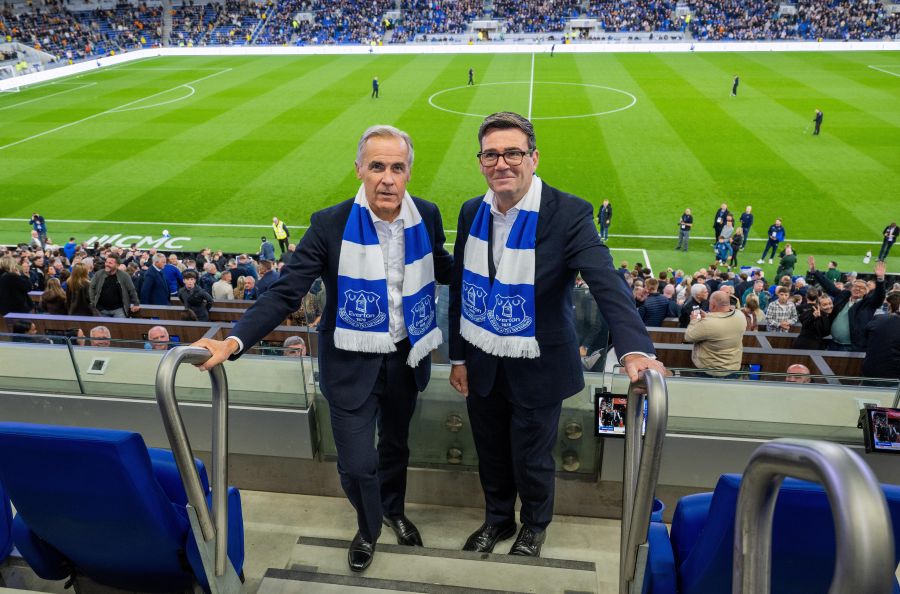
Prime Minister Andy Burnham hosts fellow Toffee Canadian Prime Minister Mark Carney at Everton’s Carabao Cup home match against Wolves © Associated Press / Alamy Stock Photo
Jaws dropped across Westminster and the nation when the news broke late last week that Reform had netted a jaw-dropping £36m donation from a solo donor (more than Labour’s entire 2024 general election budget). No sooner had said jaws been picked up off the floor than it was reported that a second donation matching the first had been secured, bringing the total to an astounding £72m – the kind of numbers one might associate with American politics. Despite the champagne corks popping in Reform’s HQ, the Government soon poured cold water all over the news with the reminder that the Representation of the People Bill, which ironically underwent its second reading in the Lords the day after the donations were made public, is set to cap political donations from those living abroad to £100,000, and that this change will be backdated to 2025. Both of Reform’s cryptocurrency mega-donors claim to have recently returned to the UK after stints living abroad, and the circumstances are unlikely to help with the allegations of a lack of transparency around the party’s funding. Farage blasted back, insisting that the donations were “compliant with the law today” and warning that if the Government proceeds with the changes, he will strip trade unions of their ability to donate to Labour if he becomes PM.
12 months – new minimum residency period for donations to UK political parties under Government proposals.
67% – growth in nuclear industry jobs over the past five years.
200 – number of British people currently detained abroad for acting as drug mules, according to the FCDO.
£2.4m – amount spent by the Government on working with social media influencers since 2024.
94% – proposed increase to Band D council tax in Conservative-controlled Wandsworth Council, prompting a row over whether the council or Government is to blame.
£219 – average cost of responding to a Written Parliamentary Question.
4.9% – British unemployment rate for May-July 2026, according to the ONS.
127 – number of tour dates announced for Reform UK Norfolk Police and Crime Commissioner Colin Sutton’s true crime theatre show, prior to its cancellation in response to backlash.

For the last few weeks Westminster has been quietly obsessed with the ‘sexymp’ website. It shows you two MPs, asks which one you find most attractive, and turns the answers into a rating out of ten.
I felt I had no choice but to see whether these scores correlated with a stronger showing at the ballot box.
I created a baseline ‘expected’ result for each constituency, based on regional swing as well as the age, education and ethnicity of the electorate, and compared the actual results against that baseline.
The outcome? Looks do count (p=0.004) but the magnitude of the effect is tiny. An MP at the top of the ranking runs about 1.9 points of vote share ahead of one at the bottom.
MPs elected for the first time in 2024 were (perhaps unsurprisingly given their comparative youthfulness) rated higher than those returning to the House – with an average score of 5.4 vs 4.5.
However, that very slight benefit is more than offset by the incumbency factor. Holding everything else equal, a new face ran 2.3 points behind a returning MP, which is more than the entire beauty premium is worth.
Given that, even in seats the Conservatives held at the last election, they collapsed by an average of 24.9 points. So it’s safe to say that whilst the attractiveness effect does exist, it is ultimately a rounding error beside the weather of national politics.
Al Carns’ well documented runs and lifting sessions might have netted him a vote share 0.6 points ahead of expectation in Selly Oak, but it turns out he’d probably be better just delivering leaflets (which still counts as cardio, surely).
The Prime Minister welcomed Canadian Prime Minister Mark Carney to Liverpool, as part of Carney’s love-in with EU leaders. As fellow Everton fans, they also conveniently managed to catch the Toffees squeak past Wolves at the Hill Dickinson Stadium. Later in the week, he hosted Irish Taoiseach Micheál Martin at No.10 North, the first foreign leader to visit the UK’s new political centre of gravity.
Martin’s visit marked the culmination of a week of Irish engagement, with Chancellor John Healey and Exchequer Secretary Lucy Rigby attending a meeting of EU finance ministers in Dublin and holding bilateral talks with their Irish, Greek, Dutch and Ukrainian counterparts, while Defence Secretary Wes Streeting spoke with his Irish counterpart, as a row simmers in the Republic of Ireland and Northern Ireland over the UK’s provision of security for the island. Meanwhile, Scottish First Minister John Swinney hosted Ireland’s leftist President Catherine Connolly for a chat that was presumably less in favour of the status quo.
The Prime Minister, Foreign Secretary Ed Miliband and Wes Streeting also hosted NATO Secretary General Mark Rutte, who praised the UK’s role in NATO but emphasised that a “credible path” on increasing defence spending is needed.
Following increased threats from the Iranian-backed Houthis in Yemen, Ed Miliband spoke to his Saudi counterpart to reassure him of the UK’s support. With a focus on the Gulf, the Defence Secretary and Defence Minister Luke Pollard also met with the Qatari Defence Minister to discuss defence ties.
Foreign Minister Chris Elmore flew to New York to speak at the UN and mark the 25th anniversary of 9/11.
Energy Minister Michael Shanks has been in Canada to discuss nuclear energy cooperation at the (aptly named) Canada-UK Nuclear Day. Hot on his heels was Creative Industries Minister Ian Murray, who signed a film and TV cooperation agreement with his Canadian counterpart at the Toronto International Film Festival.
The full field for the Holborn and St Pancras by-election has now been confirmed, with 15 candidates standing to replace Keir Starmer. Sagal Abdi-Wali is standing for Labour, Zack Polanski for the Green Party, Ewan Cameron for the Conservatives, Peter Newman for Reform UK and Patrick Thomas Stillman for the Liberal Democrats. The rest of the candidate list is made up of Barmy Brunch, Tom Darwood, Clare Fischer, George Galloway, Tyler Kurtis Johnson, Briony Anne Lonbay Kapoor, Ketankumar Pipaliya, Jonathan Silberman, Helen Spiby-Vann and Ben Walker. The by-election will take place on 8 October.
There are new chairs for three Select Committees, following elections which saw Abena Oppong-Asare elected Chair of the Housing, Communities and Local Government Committee, Catherine Atkinson elected Chair of the Justice Committee, and Olivia Bailey elected Chair of the Women and Equalities Committee.
There have also been some changes at the Bank of England, with David Craig, Paul Nowak and Hanneke Smits appointed as new non-executive directors to the Court of Directors. Craig and Nowak will serve four-year terms from 2026, while Smits will begin her term in January 2027. Lord Jitesh Gadhia and Tom Shropshire have also been reappointed for second four-year terms.
The responsibilities of ministers at the Department for Digital, Culture, Media and Sport have now been confirmed. Lisa Nandy is Secretary of State, with Ian Murray as Minister for Creative Industries, Media and Online Safety; Vicky Foxcroft as Minister for Youth, Gambling, Digital Inclusion, Civil Society and Loneliness; Stephanie Peacock as Minister for Sport, Tourism, Place and Digital Government; Baroness Twycross as Minister for Heritage; Baroness Mackenzie as Minister for Arts and Museums; and Baroness Lloyd of Effra as Minister for Space, Cyber and Regulatory Reform.
Dan Thomas MS resigned as leader of Reform UK in Wales after being arrested over the weekend. Thomas said he had been released without charge and had “done nothing wrong”, but did not want the subsequent headlines to distract from the work of the party’s Senedd team. Helen Jenner, the party’s interim Welsh leader, has been tipped as the favourite to replace him. Sarah Cooper-Lesadd MS has also defected from Reform UK to Plaid Cymru, saying that Reform was more interested in “division, opposition and headlines” than finding solutions.
Joe Fortune has been elected as the new General Secretary of the Labour Party, taking over from Hollie Ridley. It marks the first time in Labour’s history that Co-operative Party members have simultaneously held the roles of Labour leader, deputy leader and general secretary.
Greater Manchester deputy mayor and ex-MP Kate Green has been appointed Expert Adviser on Youth Justice Devolution, with responsibility for advising ministers on how greater local leadership could improve youth justice and crime prevention.
Alan Lovell has been appointed Chair of British Steel. He is currently Chair of the Environment Agency and will take up his new role in December.
The Lib Dems are kicking off Conference Recess this weekend down in Brighton, as MPs, members and lobbyists alike get stuck into four days’ worth of fringe events and policy motions, as well as speeches from politicians including Deputy Leader Daisy Cooper and the Party’s Welsh and Scottish Leaders, Jane Dodds and Alex Cole-Hamilton. The Conference will conclude on Tuesday with a speech by Leader Ed Davey.
Despite being one of the US’ few recent Presidents with no known Irish ancestry, Donald Trump was keen to stick his foot in it regardless on Saturday after he met with Ireland’s Taoiseach Micheàl Martin and President Catherine Connolly in Dublin – where he predicted a united Ireland would happen and he would “love to see it”. The UK Government and unionist politicians were quick to criticise this “unhelpful” intervention, as termed by Shadow Foreign Secretary Tom Tughenhat, while Housing Sec Angela Rayner commented “the President will speak his mind as he sees it, but we’re really serious about the Good Friday Agreement.” Luckily for them, when asked about his own comments later, Trump… doubled down, stating “you have Northern Ireland and you have Ireland and it would seem to me that one of the 'naturals' of all time is to put them together.” Speaking of those living on another planet, it reminds us of the banned 1990 Star Trek episode that discussed Ireland’s “2024 unification”.
The First Ministers of Scotland, Wales and Northern Ireland met on Monday to sign an agreement, declaring that no Westminster Government had the right to “block democracy”, adding that “Westminster’s time is coming to an end”. This comes as all three nations have First Ministers who want to leave the UK for the first time since devolution began. Scotland’s John Swinney and NI’s Michelle O’Neill both called for referenda on independence, while Wales’ Rhun ap Iorwerth would not set out a timetable for Wales – although he later joined Swinney is signing a separate agreement (the Cardiff Agreement) to work together on pressing the UK Government on fairness in funding and powers.
Top executives at three of world’s leading AI labs are calling for a slowdown in the development of advanced AI, in a moment of rare consensus as they grapple with growing alarm over AI’s capabilities. Anthropic CEO Dario Amodei, Open AI Chief Executive Sam Altman and xAI CEO Elon Musk all agreed on the need to slow the pace at which AI models’ capabilities are improved – coming after both Anthropic and OpenAI recently disclosed a number of incidents in which their most advanced AI models carried out cyberattacks without the companies’ knowledge.
Tory leader Kemi Badenoch is reportedly considering pledging to scrap inheritance tax if her Party wins the next General Election, a policy she would likely announce in her party conference speech in a few weeks’ time. Reform UK’s Robert Jenrick called the suggestion a “desperate play” as he instead pledged to raise the tax-free personal allowance to £15,000 – adding that he would resign if he failed to introduce this within the first 100 days of a Reform Government.
The TUC held their 2026 congress this week, at which First Secretary of State Louise Haigh stepped in for the Prime Minister following his dad’s passing. In her speech, Haigh highlighted the need to “heed the warnings of those at the forefront of AI development” amid increasing concern. She also celebrated the Employment Rights Act and confirmed the Government would strengthen the right to flexible working. Also speaking at the congress was Housing Secretary Angela Rayner, who discussed employment rights too, welcoming the stronger protections workers are enjoying under the ERA and affirming “we will take our plan to Make Work Pay forward in full” including banning exploitative zero-hours contracts and action on employment status.
Healthier school dinners are on the way, as the Government updated school food standards for the first time in over a decade. The changes, due to come into effect from next September, will see more fresh fruit and vegetables, fibre-rich foods and nutritious balanced meals ‘that help children stay focused, energised and ready to learn throughout the school day’ – backed by campaigners and experts including school dinner campaigning veteran Jamie Oliver.
The days of carrying physical ID are (nearly) over, as new rules around digital proof of age entered into force this week, meaning that pubs and shops in England Wales no longer require physical ID to purchase alcohol. The news rules mean that through officially certified apps you can now prove you’re over the age of 18, and will work differently for each app, with the Government not setting out in exact detail how each app must work.
Defra announced the publication the first Environmental Delivery Plan under the Nature Restoration Fund, set to support up to 15,780 new homes and improve rivers and wetlands in Norfolk. The Government described the plans as a ‘win-win’ approach to both housebuilding and nature restoration. Developers who join the scheme will pay a flat-rate levy, with the money set to be ringfenced for conservation measures, long-term monitoring and maintenance in Norfolk.
The Home Office announced that five hundred new officers will be recruited in a £500m crackdown on money laundering, with the officers recruited to track dirty money, disrupt organised crime networks and seize criminal assets. The crackdown is part of the new Anti-Money Laundering and Asset Recovery Strategy that aims to make it harder for criminals to hide, move or profit from crime, and comes alongside new figures that that nearly £350m of ‘dirty money’ was stripped from criminals in a yearlong crackdown.
MPs are set to scrutinise the UK’s ‘dismal’ Eurovision song choices following Look Mum No Computer’s last-placed finish at Eurovision in May this year. Chair of the Digital, Culture, Media and Sport Committee, Caroline Dinenage, told the BBC that MPs want to “get to the bottom of who chooses” the UK’s entrant as they seek to find out whether repeated bad results are a result of bad song choices, weak performances or another issue.
The Youth Parliament looks set to be axed, with the Government no longer committed to funding it beyond March 2027. The Youth Parliament started in 2000, and once a year elected members aged 11-18 hold a debate inside the Commons on a day Parliament is not sitting – at an estimated cost of £435,000 a year. The Government have assured that it is working with young people and youth organisations to design a new scheme that increases youth participation in democracy and decision-making.
Just two days in the Commons this week before MPs returned to their constituencies ahead of conference season. This meant there was no PMQs for Andy Burnham to face, but enough time for ministers to be questioned on topics such as the Overnight Visitor Levy, English whisky, and the proposed acquisition of Speciality Steel UK. There were also two debates led by MPs on Tuesday on fracking and on Sepsis Awareness Month.
The House of Lords had a fuller week, concluding its examination of the Financial Services and Markets Bill and passing it over to the Commons for when they return. Peers also considered the Commercial Payments Bill, Railways Bill, and the Representation of the People Bill, while finding time to debate topics as wide-ranging as prison and probation, impartiality in the civil service, empty homes, and partnerships between UK, African and Asian hospitals.
A series of reports have been published by Select Committees this week, including the Energy Security and Net Zero Committee suggesting ways for the Government to build support for the energy transition; the International Development Committee criticising the Government’s efforts to provide climate finance for poor nations; the Scottish Affairs Committee arguing more needed to be done to address defence skills shortages; the Public Accounts Committee warning that the Government doesn’t have a plan for British Steel; and the Environment, Food and Rural Affairs Committee demanding that Thames Water be put into Special Administration.
Launching inquiries this week were the Home Affairs Committee on work-based immigration, the Work and Pensions Committee is looking at pension adequacy and auto-enrolment, the Lords Financial Services Regulation Committee is exploring regulatory sandboxes in financial services, and the Liaison Committee wants to know more about the core tasks of Select Committees.
But one report that the team at Navigate Politics took a particular interest in was the Procedure Committee’s report on Written Parliamentary Questions. With the number of WPQs tabled by MPs increasing from around 45,000 in 2018 to over 80,000 in 2025, the Committee called for limits to be introduced during Recess periods, while also warning there are a ‘small number of MPs submitting a disproportionate number of questions, which could be construed as an abuse of the system.’
Setting off on the campaign trail for the Holborn and St Pancras by-election, Zack Polanski introduced himself in Urdu in a campaign video, prompting many to point out that it is the first language of only around 0.3% of the constituency’s residents. Polanski responded to the criticism by releasing another video, this time in French, which fares slightly better at 2.2%. The multilingual exchange continued at Mayor’s Question Time, where Sadiq Khan, whose parents came to Britain from Pakistan, replied to the Green Party leader in Urdu before remarking in English: “I thought, as the Member is so proficient in Urdu, that I would speak in Urdu.”
Turning to the TUC Congress, Angela Rayner reportedly took several jabs at her Cabinet colleague Wes Streeting during a dinner speech, joking that Louise Haigh had advised the Prime Minister to appoint him as Defence Secretary “because he’s the one Cabinet member we know can’t organise a coup”, and that, although Streeting had wanted the education brief, he “unfortunately can’t count to 81”. Thankfully, a spokesperson later confirmed that Streeting made it home safely after being “murdered” by Rayner in her speech.