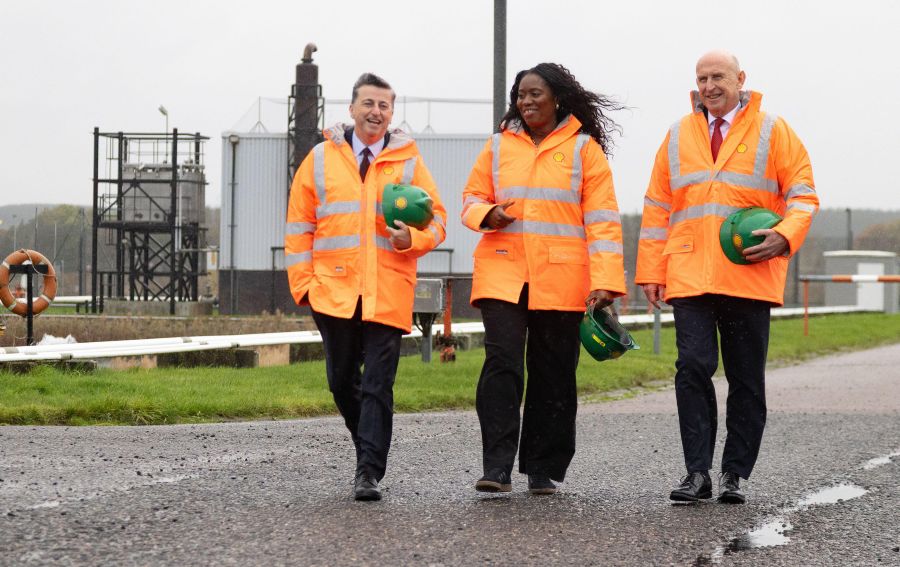
The Chancellor, Energy Secretary and Scotland Secretary visit St Fergus Gas Terminal in Aberdeenshire following approval granted to Jackdaw gas field © PA Images / Alamy Stock Photo
Westminster is about to go into overdrive, as rumours of what will, and won’t, be in next Wednesday’s Budget begin to swirl. In terms of what we can expect, it is rumoured that AI Minister Kanishka Narayan has an AI package up his sleeve for this weekend, which would be timely given the 5,000 jobs that Barclays have cut this week as part of an AI-led efficiency drive, as well as the many others fearing job cuts (or worse!). Housing has also been a prominent feature this week, with reports that the revived Help to Buy scheme, rebranded as ‘Your First Home’, could be extended to households earning up to £110,000 jointly, or £140,000 in London, following concerns that teachers, nurses and other middle earners risked being excluded. There are also rumours of an end to the Local Housing Allowance freeze, which seems likely to be discussed at the Number 10 Summit on homelessness on Monday. This is on top of what has been announced this week, as Healey has already confirmed plans to slash red-tape and ‘pointless paperwork’ in a bid to save up to £800m for UK businesses. So, what isn’t likely to be announced? An increase to Capital Gains Tax appears to be firmly off the table, with Healey ruling out any such measure, despite previous calls to do so from cabinet colleagues. It is likely, therefore, that this decision could mean the Chancellor’s main revenue raiser might be raising tax on banks’ profits. Additionally, and perhaps one of the biggest challenges for Healey given that he resigned as Defence Secretary over the DIP only months ago, is that any announcement on defence spending is not looking likely at the Budget…
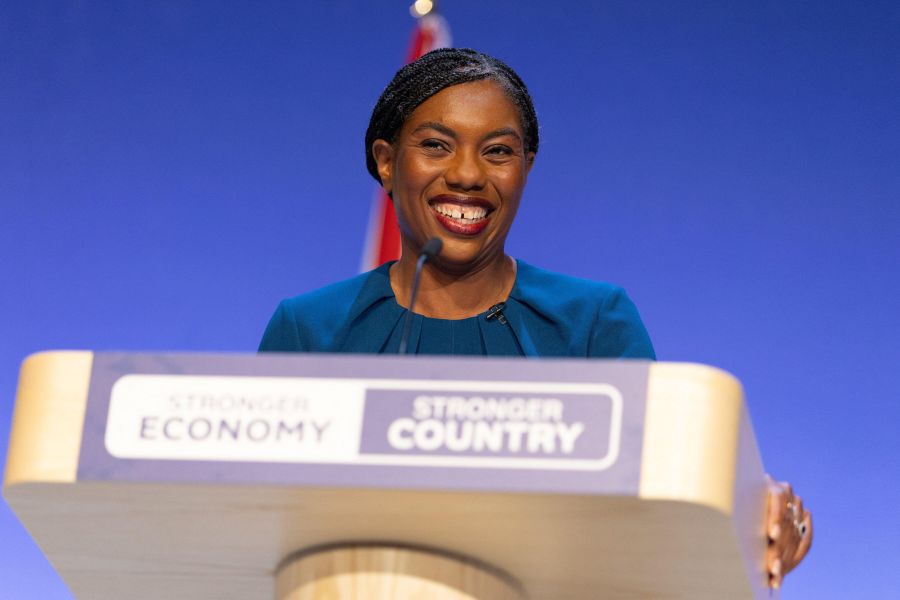
Outside of Downing Street, the Scottish and Welsh Governments have jointly called on the UK Government to scrap the benefit cap and bedroom tax, as well as to adopt a social tariff in the form of targeted energy bill discounts. As expected, criticism has already been rife from the Opposition, with Kemi Badenoch using her pre-Budget speech this week to argue that Labour won’t make public spending cuts. Meanwhile Daisy Cooper delivered a speech, outlining the Lib Dem’s support for windfall taxes on major banks’ and calling for VAT on hospitality to be reduced to 15% for the next 18 months. With national debt surpassing £3 trillion for the first time and inflation rising to 3.5% this week, however, the economic backdrop has seemingly left Healey with limited room for manoeuvre.
The Budget is still to come, but the Government has already offered a glimpse of its North Sea calculations. Energy Secretary Miatta Fahnbulleh announced that the Jackdaw gas field could begin operating. The decision has been made in the name of energy security, with the field expected to increase domestic gas production by 6%. It’s also expected to add £2.9bn to the UK economy over its lifetime. The decision won’t help cut bills though, as Energy Minister Michael Shanks confirmed to the House of Commons that “no new oil and gas drilling will ever take a penny off bills”. Alongside the announcement came an Energy Wealth Fund (better late than never), backed by an initial £2bn, which will use tax revenues from North Sea oil and gas to invest in renewable and low-carbon energy projects. With Jackdaw approved, attention now turns to the other controversial fossil fuel project awaiting its fate: Rosebank. One North Sea announcement down, another closely watched decision to go…
£2.9bn – estimated contribution that drilling in Jackdaw gas field could add to the economy
4.7% – current UK unemployment rate, with job vacancies falling by 2.9% in the three months to September
9.7m – incidents of headline crime in the year ending June 2026, up slightly from the 9.3m recorded a year earlier
10% – the Greens’ latest vote share according to YouGov, down eleven points from their March peak, and their lowest share since September 2025
51 seconds – Burnham’s average answer length at PMQs, a third longer than Starmer and Sunak, and up to 50% longer than Truss.
5 days – length of time Katie Zacharia lasted as White House press secretary
60% – proportion of Jewish students who have experienced antisemitism at school, according to David Bell’s review into antisemitism.
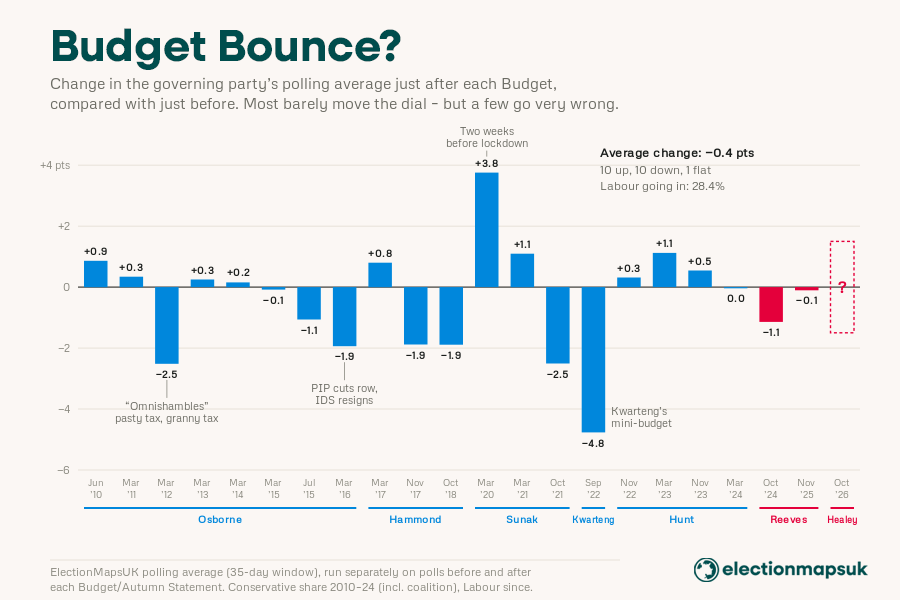
On Wednesday John Healey will deliver his first Budget as Chancellor. Some commentators have touted it as a potential derailing event for the ‘Burnham Bounce’, which has thus far propelled the party from 19% earlier this year to 28% today.
But do budgets really have a big effect on voting intention? To find out, I analysed polling on either side of every budget since George Osborne in 2010.
The short answer is: not much. Across all 21 events, the governing party’s average change is −0.4 points, with ten up, ten down and one flat – and the gap almost disappears without the mini-budget.
The magnitude of the moves is similar too. Budgets shift the governing party by an average of 1.3 points in either direction, against 1.1 in an ordinary month. Most Budgets, in other words, are indistinguishable from noise.
The 2022 mini-budget stands out, unsurprisingly, with a fall of 4.8 points. The Chancellor and the Prime Minister were both gone within a month. Osborne's 2012 "omnishambles" Budget, with its pasty tax, granny tax and cut to the top rate, cost the Conservatives 2.5 points. Sunak's October 2021 Budget fell by the same amount, although the Owen Paterson row that broke the following week probably did more of the damage. Even Osborne's 2016 Budget, remembered for the disability benefit cuts row and Iain Duncan Smith's resignation, fell by only 1.9 points.
The biggest rise, +3.8 for Sunak in March 2020, is more down to timing than tax. Lockdown started twelve days later, so much of this change is due to the ‘rally-round-the-flag’ boost. Meanwhile, Labour’s first budget in 14 years cost the party 1.1 points. Reeves’ second budget had almost zero effect on the party’s fortunes, with a statistically insignificant fall of -0.1 points.
Healey goes into next week with Labour on 28.1%, ahead of Reform on 22.8% and the Conservatives on 21.2%. History suggests a good Budget won't add much to that. A bad one, on the other hand, could do real damage.
The Sultan of Oman, Haitham bin Tariq Al Said, arrived in Britain this week for a State Visit. The Sultan was met with the usual pomp and circumstance befitting a foreign Head of State, visiting the King at Windsor Castle before sitting down with Prime Minister Andy Burnham for a more businesslike chat. The pair discussed the close alliance between the UK and Oman, particularly on regional security and defence, highlighted by the ongoing situation in the Strait of Hormuz.
Burnham also took calls with European leaders, speaking to Polish Prime Minister Donald Tusk and Finnish President Alexander Stubb on Wednesday. With Tusk, he discussed recent Russian strikes on Ukraine, as well as the need for NATO allies to increase pressure on Russia’s war effort. They also spoke about the upcoming UK-EU summit and the Government’s desire for a closer trading relationship with Europe. Speaking to Stubb, the Prime Minister similarly discussed events in Ukraine, as well as Finland’s role in supporting stronger British ties to the EU.
The Omani delegation included foreign minister Badr Albusaidi, who met with Foreign Secretary Ed Miliband on Wednesday. One of the items on the agenda was a new investment deal between the two countries, worth over £1bn, while they also spoke about progress on education and stability in the Middle East. Earlier in the week, Miliband also spoke with the Foreign Minister of Portugal, Paulo Rangel, on deepening UK-EU cooperation, the two countries’ support for Ukraine, and economic growth.
Home Secretary Shabana Mahmood hosted EU Commissioner for Internal Affairs Magnus Brunner in London for their second meeting in two months. Talks reportedly focused on migration, border management, law enforcement cooperation, and counter-terrorism.
First Minister of Scotland John Swinney was in India, promoting opportunities for Scottish trade and Indian investment. In particular, he referred to a new EY report on Scotland’s attractiveness, arguing that “our strengths – particularly in technology, financial services and clean energy – make us uniquely placed to match India’s priorities.”
Shadow Defence Secretary James Cartlidge met with Polish Chargé d'affaires Rafał Wiśniewski, discussing the alliance between the UK and Poland, reinforced through their shared membership of NATO.
Perran Moon, MP for Camborne and Redruth, has lost the Labour Party whip after investigations into (a lack of) Covid loan repayments. He becomes the second Labour MP to undergo investigation over Covid-era loans, following Bayo Alaba in August.
Jane Dodds MS (the sole Lib Dem member in the Senedd) announced that she will stand down as leader of the Welsh Liberal Democrats after nine years. The party has said that only David Chadwick (their sole Welsh MP) is eligible enough to replace her at this time.
Andrew Boff AM resigned from the Conservative Party after 53 years, having been blocked from running as the Conservative candidate for Mayor of London over his support for the ECHR.
Simon Ridley has been appointed as the new Permanent Secretary of the Department for Education, taking over from Susan Acland-Hood who has led the Department for the last six years.
At the Treasury, David Sturrock has been reappointed as Economic Adviser to the Chancellor for a further year, taking his term to 20 October 2027.
Michelle Jarman-Howe has been appointed Director General of Prisons after serving in the role on an interim basis. She joined the Prison Service as a prison officer in 1995 and will lead prison operations across England and Wales.
James Carroll has been promoted to Head of Business and Public Voices Communications in No. 10. He has worked in Downing Street since 2024, most recently as the PM’s Special Adviser for Business Relations.
The King has approved the appointment of Reverend Dr Jitesh Krisnakant Patel as the next Bishop of Jarrow in the Diocese of Durham, succeeding Sarah Clark following her translation to the See of Ely.
Sue Sharp’s appointment as interim Chair of the Disabled Persons Transport Advisory Committee has been extended until 31 October 2027, or until a permanent chair is appointed, with recruitment already underway.
There are two changes at the Marine Management Organisation: Annie Hind joins the Board for a three-year term in November, while Professor Dame Judith Petts steps up to Deputy Chair in February, replacing Tony Delahunty.
Ahead of Budget week, the Prime Minister focused on Common People with a slew of announcements on ‘everyday fixes’. Policies to crack down on people playing music out loud, littering and vaping on public transport were announced, as well as plans to liberalise private parking charges. The Tories and Lib Dems jumped in to say they had both already called for the former; and it remains to be seen quite how it will be policed.
The pitch-rolling ahead of the Milburn Review continued with an article by the PM on the NEET crisis, which he said amounted to ‘an economic catastrophe and a moral failure.’ He described today’s welfare offer as “an assessment, a payment and, after that, goodbye” (which also neatly sums up most graduate job applications, just without the payment), and pledged that ‘benefits will become the backstop, not the starting point’ for young people.’ Despite these promises, the Milburn Review will not be published as part of the Budget.
The SNP wrapped up conference season, although Burnham crashed the party with a speech in which he cheekily called on First Minister John Swinney to join him in devolving powers from the political centre (be that Westminster or Holyrood). Not the only ones to use their political opponents’ sentiments against them, the SNP retorted that Burnham’s subtle undermining of the Brexit referendum also brought the result of the 2014 independence referendum into question.
Nigel Farage held a press conference in Plymouth, using the opportunity of speaking in the naval city to hammer home his party's messaging on stopping small boat crossings by deploying the Royal Navy in the English Channel, and also addressed other familiar themes, such as unemployment, the ECHR, and in a Brexit blast from the past, fishing rights. Looking to their own naval defences, the Lib Dems announced they would expand UK shipbuilding with four new shipyards and six frigates delivered by the mid-2030s.
Serious offenders detained under hospital orders will lose their entitlement to benefits, ending the so-called “double provision” where people detained under a hospital order can receive benefits despite already receiving NHS accommodation and treatment. It is estimated the changes will impact approximately 2,500 people detained in hospitals. File that one under ‘why was this happening in the first place.’
The Bell review into antisemitism in schools landed, finding that three in five Jewish students aged 16-19 have experienced antisemitism, indicating the issue is ‘unacceptably casual’. The Government accepted all 27 recommendations made in the report and Education Secretary Lucy Powell promised the Commons that “change will come.” The headline measures include plans to write to schools and urge them to adopt the IHRA definition of antisemitism, plus tougher safeguarding guidance that treats antisemitism as a distinct risk.
Job plans were published for the construction, clean energy, digital and technology, and professional and business services sectors, meaning that plans for five of the eight sectors (plus construction) identified as priorities in the Industrial Strategy have been published. The defence sector jobs plan was reportedly also ready for release before an eleventh hour intervention by Unite which protested its lack of involvement in the plan’s development, and was pulled.
Households should stock up on three days' worth of bottled water and tinned food, according to new Government guidance through the new 'Be Ready' campaign. It is the first step in a campaign to (gently) try and guide British households to some semblance of resilience, and was developed in collaboration with nations such as Finland which have more advanced societal resilience plans.
The internet suffered a mini meltdown after a flaw was discovered in PHP programming language, which underpins about 70% of the world’s websites. 32 UK Government services and multiple council websites were rendered unavailable. As one Peer remarked, “when both the “Traitors” website and the Office for Budget Responsibility website go down, we can see how widespread an issue this is.”
Blackpool, Milton Keynes, Sheffield and Wrexham have been shortlisted for UK City of Culture 2029. Each will receive at least £125,000 to take forward elements of their bid, with the winner taking home a prize fund of £10m. The result will be announced early next year.
The Lib Dems enjoyed one of their three Opposition Day Debates of the parliamentary session this week, choosing the topic of farming, following last month’s somewhat chaotic Sustainable Farming Incentive 2026 window 2 rollout (whereby applications closed within 6 hours). The Lib Dems’ motion criticised both the current Labour Government – for slashing the core Defra budget, accelerating direct payment cuts and changes to APR – and the previous Conservative Government – for designing SFI on an unfair first come, first served basis, signing trade deals with Australia and New Zealand that undercut British standards, and their £358m agricultural budget underspend.
On legislation, the Commercial Payments Bill, seeking to clamp down on late payments to small businesses, completed its passage through the Lords and will now head to the Commons for consideration. Meanwhile, Peers also considered the Microplastic Filters (Washing Machines) Bill, the Public Office Accountability Bill and the Railways Bill in committee, while the Armed Forces Bill underwent report stage. Over on the green benches, the Northern Ireland Troubles Bill also completed its remaining stages and will head to the Lords.
Somewhat incomprehensively, the Government did not allow certain changes to Select Committee memberships by failing to move a series of motions to approve changes including for Mark Garnier to replace John Cooper on the BIST Committee, for Saqib Bhatti to replace Rebecca Paul on the Education Committee and for Greg Smith to replace Katie Lam on the Transport Committee.
On Committee corridor this week, the Defence Committee urged the Government to address serious military capability gaps in the High North, citing uncertainty over US support for NATO; the ESNZ Committee stressed the importance of reducing energy costs, suggesting all energy policy costs should be moved off the price of electricity and onto the price of gas on UK energy bills; the Health and Social Care Committee called on the Government to overhaul the NHS’ support for people to lose weight and for greater NHS access to weight-loss drugs; the Lords Financial Services Regulation Committee published its report on home and travel insurance, finding that consumer understanding remains low; the EFRA Committee argued the case for new aircraft, a ban on disposable barbecues and a new public awareness campaign in a bid to improve the UK’s preparedness and response to wildfires; the Public Accounts Committee urged the Government to be bolder in its approach to R&D; and the Business, Innovation, Science and Trade Committee called on the CMA to launch a full market investigation into the UK’s live music industry before the end of the year.
And if you’re looking for new inquiries to sink your teeth into, the Business, Innovation, Science and Trade Committee has launched a call for evidence on the Government’s export support services, whilst the Lords Built Environment Committee wants to know how Britain’s public spaces can be improved. And finally – forget the Traitors, Rivals or the Strictly Come Dancing final… the Liaison Committee put out their own teaser this week for what will be this winter’s box office event: Andy Burnham’s first committee grilling. Date tbc but when it’s out… clear your diaries.
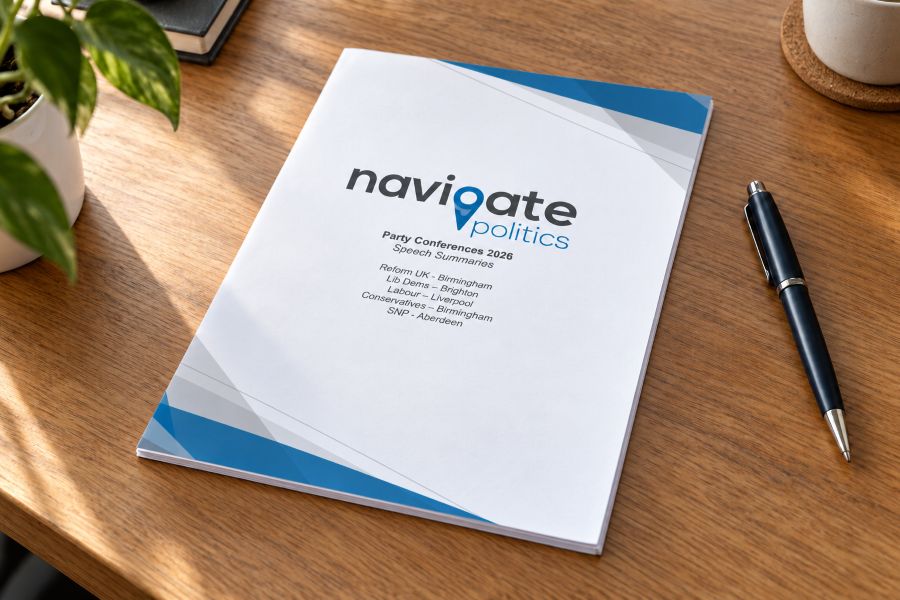
Party Conference season has finally come to an end, and after a busy few weeks there’s plenty to catch up on beyond the headline announcements. Navigate Politics’ clients received detailed, searchable write-ups of every speech and session from the main stages, delivered live – from Brighton to Aberdeen – and collated into packs at the end of each conference.
As the parties begin to expand on their announcements and develop their policy positions, our packs are an invaluable resource for understanding their priorities, the detail behind the headlines and the debates shaping their direction. If you’re looking for a complete conference overview, please get in touch and we’ll ping it across.
All eyes in Westminster are turning to one thing next week, and one thing only. No, not the Budget, but former Prime Minister Liz Truss’s new book. Entitled Bank Job: A Short Book on How the Bank of England Broke the Bond Market and Brought Down the Government, it revisits the 2022 mini-Budget and subsequent gilt-market crisis, promising to expose the “immense influence wielded by unelected institutions” such as the Bank of England and Office for Budget Responsibility. At just 99 pages, it works out at roughly two pages for every day Truss spent in Downing Street. It’s also her second book since leaving office, meaning she’s now written more books about politics than she served full months as Prime Minister. The book may be short, but the list of people Truss holds responsible certainly isn't.
One thing we didn’t have on our political bingo card this week was a row over Celebrity Gogglebox. The unlikely controversy erupted after it was revealed that Prime Minister Andy Burnham would appear on tonight’s Stand Up To Cancer special alongside Mayor of the Liverpool City Region Steve Rotheram. Kemi Badenoch questioned how Burnham had found the time to take part, while Reform UK wasted no time offering up Nigel Farage as an alternative guest. Farage, of course, is no stranger to the Gogglebox sofa, having appeared on the programme back in 2014.
Robert Jenrick may have slightly misjudged his audience this week while attempting to demonstrate that Reform UK is on the side of working people. Speaking at one of the party’s rallies, Jenrick asked the crowd to “stand up if you’re a person that works”, only to be met with a rather underwhelming smattering of people rising to their feet. To be fair, when he followed up by asking those who had worked but were now drawing their pensions to stand, the response was considerably more enthusiastic. Perhaps asking a room full of people attending an event in the middle of a Monday afternoon whether they were currently working was always going to be a bit of a gamble… H/t Politics UK for the clip