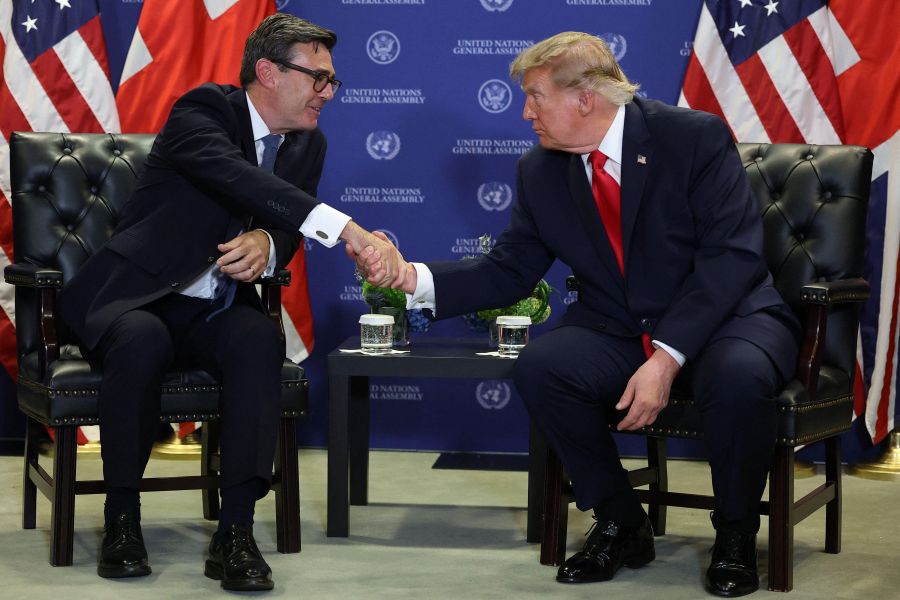
Prime Minister Andy Burnham met with US President Donald Trump at the UN General Assembly in New York, marking their first face-to-face meeting © PA Images / Alamy Stock Photo
Andy Burnham had his first in-person meeting with The Donald this week, as nearly 130 heads of state and government gathered for the 81st session of the UN General Assembly (UNGA) in New York. It felt like a somewhat positive first interaction, with the president calling Burnham “a man you can do business with” and stating that relations between the UK and US were “more up” now than they were under Keir Starmer, although it’s hard to put any real stock in that given how well Starmer’s first meeting with Trump initially appeared to go (regardless, it will be a painful comment for Starmer to swallow, having put considerable effort into cultivating ties with Trump). The sticking point, however, was the Chagos Islands deal, which Trump termed “terrible” and “ridiculous”; the PM later affirmed “we will work to find that resolution between the different sides.”
Later that same evening, the PM addressed the UN General Assembly, where he declared “Britain is back” following Brexit, pledged to “keep investing in our defence” including meeting NATO commitments, announced he had instructed security chiefs to begin work on a new National Centre for Information Defence to detect and disrupt hostile state information attacks, unveiled a new AI defence partnership with the US, asserted he would “put AI at the heart of the UK’s G20 presidency next year” and said he would bring forward new legislation on AI if necessary, and pledged to “stand firm” against any challenges to international law, including with regard to the Falkland Islands.
Ed Davey led the Liberal Democrats into their seventh conference under his leadership, warning delegates that they were in “the fight of our lives” as “dark forces” on the far right try to “destroy” British values. In his closing speech, he announced plans to raise the tax-free personal allowance to £15,000, which the party said would take a further 2 million people out of income tax and give most taxpayers a £680 tax cut, and pledged to raise the higher-rate threshold to £56,000. He explained that these tax cuts would be funded by economic growth from joining the EU single market and a customs union. Meanwhile, Treasury spokesperson Daisy Cooper introduced her “Plan to Get Britain Growing Again” and outlined plans for a growth and defence partnership with the EU. The hard right weren’t the only dark forces threatening Davey, as questions about his leadership of the party, which has stalled in the polls amidst spikes in support for the Greens and Reform, bubbled into the media. The Lib Dem leader of Devon County Council warned the party was “sleepwalking into irrelevance” under Davey, while Lib Dem MP Roz Savage urged the party to rediscover its “insurgent spirit.” Davey’s defenders, perhaps fairly, simply pointed to the party’s success in the last general election.
12–15 – cups of tea Andy Burnham revealed that he drinks every day
123 – seats projected for Reform UK in the latest YouGov MRP, placing the party third behind Labour and the Conservatives
£680 – tax cut the Lib Dems say most people would receive under their proposal to raise the income tax personal allowance and NI Insurance threshold to £15,000
11% – increase in drug-related deaths in Scotland in 2025 compared with 2024, with 1,133 deaths recorded
£8.8bn – interest payable on government debt in August, the highest August level since records began
3.2% – increase in MOD spending with UK industry in 2025/26, taking the total to £34.1bn
13,464 – number of reported assaults against passengers and the public on the mainline railway, an increase of 36%
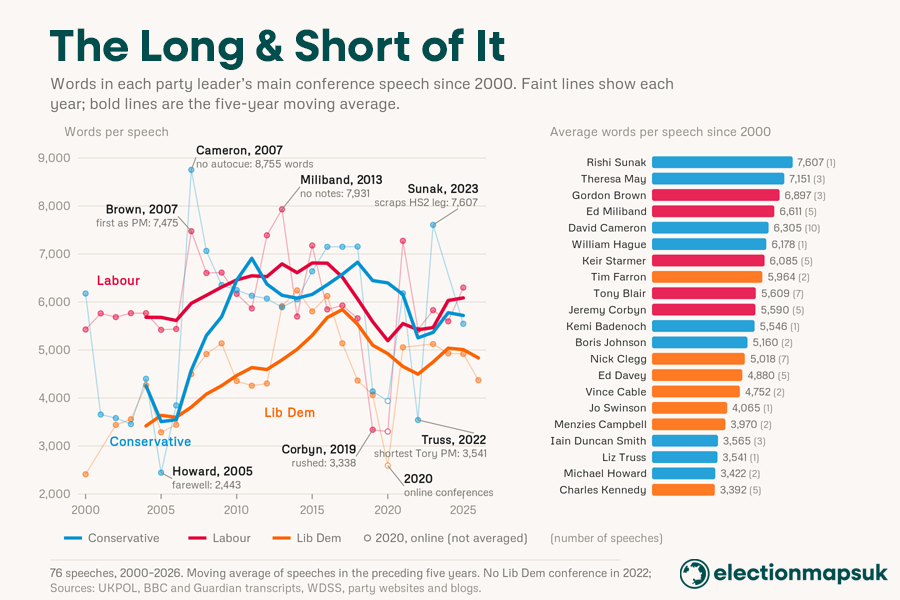
On Tuesday Andy Burnham will give his first conference speech as both Labour Leader and Prime Minister. If he follows recent Labour form, his speech will be around 6,000 words in length.
We counted the words in every Labour, Conservative and Lib Dem leader's conference speech since 2000. Labour leaders tend to go on the longest, averaging 6,055 words. Conservatives are next on 5,635 and the Lib Dems typically shorter at 4,580.
Speeches grew steadily longer through the 2000s and peaked in the mid-2010s. Every party has trimmed their word-count since: the Conservative average is almost 1,200 words below its peak, the Lib Dems' about 1,000 and Labour's about 700.
The longest 21st century conference speech came from David Cameron in 2007: 8,755 words, with no autocue, ending with a dare to Gordon Brown to call a snap election. Miliband spoke without notes in 2013 and managed 7,931 words. The next year he tried it again and forgot the section on the deficit. Rishi Sunak's solitary conference speech of 7,607 words in 2023 means he tops the leaderboard for average length.
Prime ministers average 6,100 words, versus 5,600 for leaders of the opposition. Interestingly though, opposition leaders who become Prime Minister tend the shorten their speeches somewhat. Cameron averaged 6,500 words in opposition and 6,200 as Prime Minister; for Keir Starmer the figures were 6,200 and 5,900.
As is often the case with stats on Prime Ministers, Liz Truss is a bit out an outlier. Her 2022 speech came to just 3,541 words, the shortest by any sitting Conservative prime minister since 2000. Fifteen days later she resigned.
Ed Davey's speech in Brighton last week came to 4,371 words, a little under the Lib Dem norm.
I’m sure, like me, you’ll be waiting with bated breath whether Kemi Badenoch goes above or below her 5,546 word speech last time out, and where on the leaderboard Burnham slots in.
Alongside his highly anticipated meeting with President Trump, the Prime Minister also met with European Commission President Ursula von der Leyen, Ukrainian President Volodymyr Zelenskyy and Turkish President Recep Tayyip Erdoğan at the UN General Assembly. Prior to jetting off to New York, he also spoke to the leaders of Denmark and Mauritius, with the latter focusing on the stalled Chagos Islands deal, which Trump further slammed into the coffin during his bilateral with Burnham.
It was a busy week for Foreign Secretary Ed Miliband at UNGA as well, hosting a meeting on the security risks of the climate crisis, delivering speeches on the two-state solution and protection of civilians in Sudan, speaking at the UN Security Council on both the conflict in Ukraine and AI and international security, and joining a meeting with France and Mexico on the use of the UN Security Council veto in cases of mass atrocities.
Chancellor John Healey held a call with Treasury Secretary Scott Bessent to discuss ‘stepping up pressure on Iran’ and driving growth in both nations, although it seems the UK is rather more in need of the latter than the US.
EU Relations Minister Hamish Falconer met his French counterpart to discuss UK-French cooperation and security, while Middle East Minister Stephen Doughty spoke to his Saudi counterpart to reiterate the UK’s military support for the nation in the face of ‘appalling’ Houthi attacks. Americas Minister Chris Elmore met with Venezuela’s foreign minister to discuss the country’s ‘democratic transition and human rights’ (presumably avoiding discussion of the kidnapping of their former head of state), and Overseas Territories Minister Uma Kumaran met with the leader of the Cayman Islands.
Home Office Minister Lord Hanson jetted off to Cambodia for the International Conference on Combating Online Scams. Southeast Asia has become a hub for scam centres in recent years, many operating out of war-torn Myanmar using borderline slave labour.
Following Dan Thomas’ decision to stand down as Leader of Reform UK Wales after his arrest last week, Reform moved swiftly to appoint a replacement, with Deputy Leader Helen Jenner taking up the role. This left a vacancy for the no. 2 job, which was filled by Laura Anne Jones.
Meanwhile in Scotland, Michael Marra was elected the new Labour leader in Holyrood, following Anas Sarwar’s elevation to the House of Lords in order to serve as Trade Minister. In addition, Christine McLaughlin was appointed Chief Executive of NHS Scotland.
With all kinds of speculation about humanity’s future relationship with AI (or lack thereof) continuing to circulate this week, Dr Jade Leung was appointed Vice-Chair of the AI Security Institute. She had previously served as the Prime Minister’s chief AI adviser, and was Chief Technology Officer at the AISI.
The Government set up its new National Cancer Board, with Anita Charlesworth joining the body alongside Mark Cubbon, Dr Rob Metcalfe, Dr Diane Addei, and Ashley Ball-Gamble. Five new commissioners were also appointed to the Commission on Human Medicines, with Dr Andrew Hitchings, Dr Nigel Beckett, Dr Wajid Hussain, Professor Elvira Bramon and Professor Sarah Danson being selected.
The Prime Minister appointed senior judge John Saunders as the new Deputy Chair of the Security Vetting Appeals Panel, overseeing cases where individuals try to overturn rejections of applications for security clearance. Assuming, of course, that it wasn’t already overruled by the Foreign Office…
Northern Ireland Secretary Chris Bryant appointed John O’Hara KC to lead an independent review of the decision-making and organisation of the Parades Commission, the body which governs public parades and processions in Northern Ireland in order to avoid contention between unionists and nationalists.
Finally, Digital, Culture, Media and Sport Secretary Lisa Nandy selected Charles Donald, Dominic Field, Anna Keay, Georgina Lynch, Claire McColgan, Lukman Patel, and Moira Sinclair to join the Historic England Commission. Additionally, new members were appointed to the board of the Wallace Collection, including Kate Cheetham, Elizabeth Kennedy, Amelia Pan and Lord Smith of Finsbury.
Andy Burnham heads to Liverpool this week for his first Party Conference as Labour leader, under the slogan ‘Hope Again’. Burnham will deliver his leader’s speech on Tuesday, with Chancellor John Healey taking to the main stage on Monday and Deputy Leader Lucy Powell on Sunday. With Labour edging ahead in recent polls, the party will hope a strong few days in Merseyside can cement the ‘Burnham Bounce’.
Burnham and Manchester are an iconic combination, and one we’ll likely see again in November 2027 after it was confirmed the UK would host the G20 Leaders’ Summit in the city. The Government said the summit will be used to ‘reinforce global economic stability’… well it’s good to be ambitious.
The school system is set for another shake-up, with new Vocational GCSEs replacing Technical Awards and sitting alongside existing GCSEs. Expected in some subjects from September 2029, they could include Digital Tech, Creative Media Production, and Building & Construction. A National Mission on Work Experience has also been launched, aiming to provide an extra 200,000 placements.
A ‘final offer’ of £1.5bn over three years is on the table for the Northern Ireland Executive, with NI Secretary Chris Bryant giving ministers until next Thursday to respond. The Executive is already six months overdue in setting its budget, while the funding offer has faced criticism from several NI parties. The package includes an additional £150m for the transformation of public services, £100m for social housing and £75m to address fraud and error in the benefit system.
The NHS, cost of living, child poverty and education were at the heart of the Welsh Government’s Programme for Government, published this week. Other key policies include establishing a National Development Agency; increasing procurement from Welsh suppliers; reforming business rates to support the high street; and publishing strategies covering areas including skills, energy, food, housing and public health. Welsh independence featured less prominently, with only a commitment to ‘formally request the devolution of the right to decide on the timeline, question, and process for an independence referendum’.
The second application window of the Sustainable Farming Incentive opened on Tuesday with £233m up for grabs, including a £50m boost announced by the Prime Minister to help farmers facing low yields and rising costs. The fund, however, ran out in… six hours, drawing cross-party criticism and commotion across the farming sector, with farmers reportedly not warned the application process was opening and some describing the scramble as being akin to trying to get tickets for Glastonbury Festival.
Employment rights had a renewed focus this week, with changes to bereavement leave announced that will give employees a legal right to time off to grieve from April 2027. The new rights will cover spouses, partners, parents, children and siblings, including step, adoptive, kinship care and foster relationships. Women and their partners will also be entitled to up to two weeks’ unpaid leave following pregnancy loss before 24 weeks.
Specialist rape courts are set to be rolled out across every Crown Court in England and Wales, with rape cases to be prioritised and given fixed trial dates to reduce delays. The new courts will also provide private entrances and waiting rooms for victims, alongside trauma-informed training for court staff. The Government also launched a new National Taskforce for Tackling Misogyny, bringing together ministers, experts and local leaders to look at preventing harmful attitudes towards women and girls across workplaces, communities and online.
A new Workplace Health System is being developed to help people with health conditions or disabilities stay in or return to work, with around 300,000 people currently leaving work each year due to health conditions. A new report from Sir Charlie Mayfield sets out the latest plans for the system, which will bring together employers, the NHS and local authorities to provide earlier support and prevent people falling out of work unnecessarily.
The Government announced a major recruitment drive across the defence sector, pledging to create 40,000 opportunities and jobs in skilled defence careers for young people every year by 2030, rising to 50,000 by 2035, as part of a new agreement with industry. The deal will expand apprenticeships and work experience, including at least 14,000 defence apprenticeships by 2035, alongside a ‘no-wrong-door’ approach to help unsuccessful applicants find other opportunities across the sector.
Bentley confirmed it has invested £350m in its Crewe plant to produce its first fully electric vehicle. The investment is set to support around 4,000 jobs at the site and strengthen the UK automotive supply chain. Following £500m and £170m investment announcements from McLaren and Nissan, it’s been a much-welcomed week for the UK automotive sector.
Despite Parliament being in Conference recess, the Treasury Committee issued a report suggesting the OBR must be ‘protected rather than castigated’, and launched an inquiry into the Bank of England’s monetary independence. Other inquiries launched include an examination of the National Youth Strategy by the Digital, Culture, Media and Sport Committee and analysis of public transport ticketing and pricing by the Transport Committee.
Rory Stewart was on Newsnight this week and successfully revitalised the internet in the process. The former Conservative MP appeared on the show alongside former Labour leader Neil Kinnock and New Statesman political editor Ailbhe Rea, who was subjected to what can only be described as the longest four seconds in history. After declaring the race to develop AI between China and the US as “terrifying,” Stewart directed his own unintentionally terrifying stare towards Rea, evidently eager to hear what she thought Westminster could do about the development of AI. As expected, the internet has gone wild, and you can see some of the best reactions here. Rory Stewart – having been off grid for most of the week – responded to being plunged back into the limelight, with customary humour, on Friday.
And former Prisons, Probation and Reducing Reoffending Minister James Timpson has noticed a 680%! Increase in the number of free holes in customer belts this year, which he put down to the popularity of Ozempic and Mounjaro…