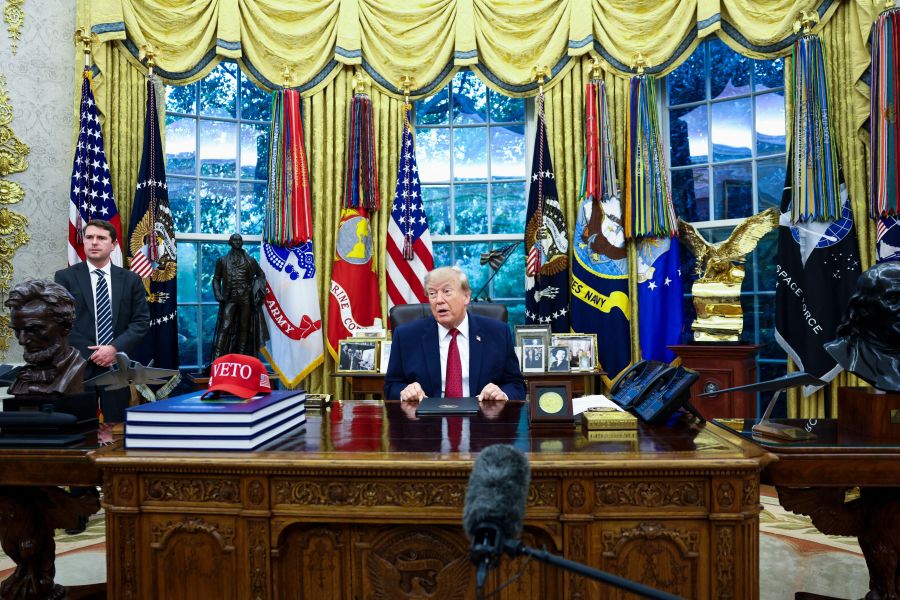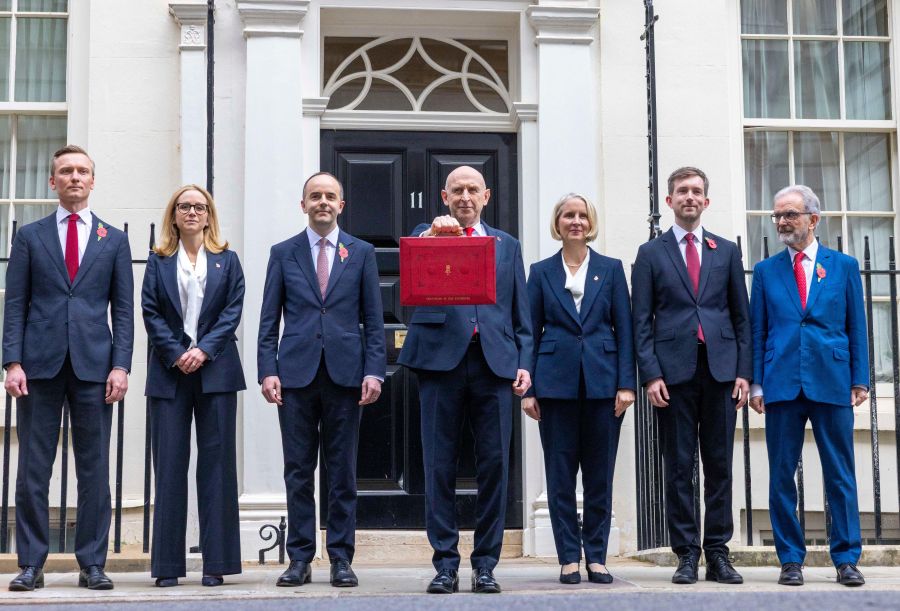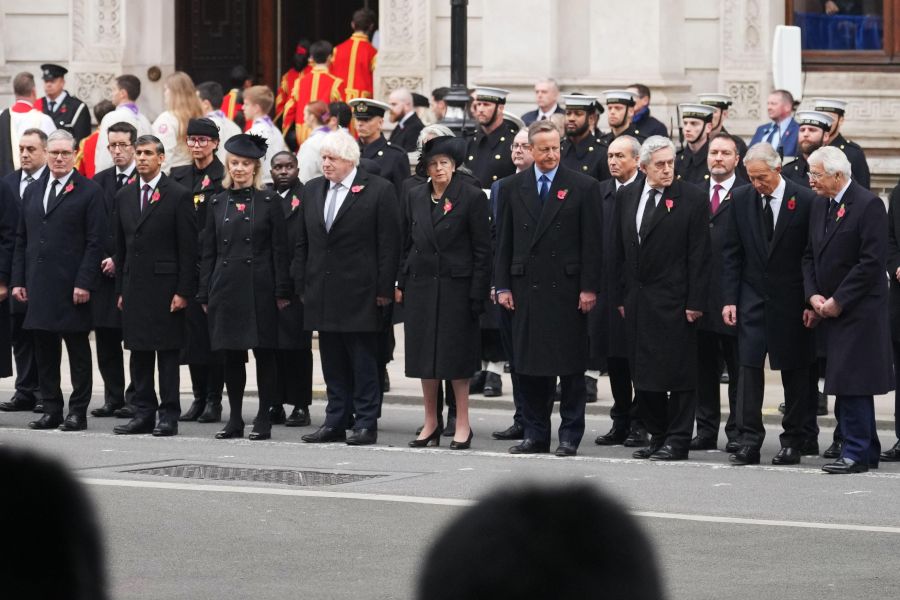
A record nine former Prime Ministers, spanning 35 years in office, paid their respects at the Cenotaph on Remembrance Sunday last weekend © Associated Press / Alamy Stock Image
Andy Burnham swapped the quiet carriage for the world stage this week, trading his recent procession of domestic announcements for an itinerary covering climate change, European security and Ukraine. The Government’s international push also extended to Oslo, where Wes Streeting attended the Atlantic Future Forum aboard HMS Prince of Wales. The Defence Secretary argued that NATO needed to turn technological innovation into military production at scale, presenting higher defence spending as an opportunity to rebuild British industry and create jobs. Burnham, meanwhile, headed to COP31 in Antalya, declaring that “Britain is back” and describing climate change as a national security issue. Alongside promises of cleaner energy, lower bills and British leadership, came a new climate security representative and support for a programme targeting £5bn in private investment in clean energy internationally. A rather bigger policy focus than asking someone to turn their TikToks down.
Two summits in one day still left plenty of challenges to bring home, as Thursday took Burnham from Turkey to Dublin for the European Political Community summit, where he co-chaired discussions on Ukraine alongside President Zelenskyy. The PM promised continued backing for Kyiv and pressed for European representation in peace negotiations, while warning against reading too much into the latest US-brokered talks. Britain also announced further sanctions, bringing all ten of Russia’s largest oil producers under UK restrictions: a reminder that diplomatic activity has yet to remove the need for economic pressure. Back home, Kemi Badenoch supplied a less diplomatic assessment of Burnham’s leadership at PMQs, questioning whether Boston Consulting Group had been commissioned to work out his plans for him, challenging delays to defence funding and attacking the Government’s position on North Sea drilling. Burnham pointed to Jackdaw’s approval and investment in renewables as evidence of big decisions being taken, before promising to unveil his plan for Britain ahead of the Christmas recess. The Milburn Report, at least, is due rather sooner: next week.
The departure lounge beckons again next week, with Dublin also offering Burnham an opportunity to meet Ursula von der Leyen ahead of next Friday’s UK-EU summit in Brussels. Both sides are seeking to get an agreement over the line, with food and farming, emissions trading and youth mobility among the areas under discussion as the PM attempts to turn his enthusiasm for closer European relations into something tangible. After a week of international meetings and declarations of British leadership, attention now turns to what comes home in the diplomatic luggage.
20 – hours that Microsoft’s global outage lasted, with email queues approaching normal levels at the time of writing
74 – countries were impacted by the outage
83,000 – number of days the launch of GTA 6 is set to cost British businesses through employees booking time off to play the game, according to BrightHR
28% – amount retail spending has increased year-on-year in Oxford Street since its pedestrianisation on 26 October
67% – increase in sales of bottled water in the ten days following the Government’s ‘Be Ready’ campaign, according to data from retail research firm Worldpanel by Numerator
10 – current or former Prime Ministers who joined the King for the National Service of Remembrance at the Cenotaph this year
$430bn – amount the Nvidia’s share value plummeted in two days following the scandal involving CEO Jensen Huang
1.26 million – Liberal Democrat’s warning for the potential number of NEETs by 2031, if current trends continue
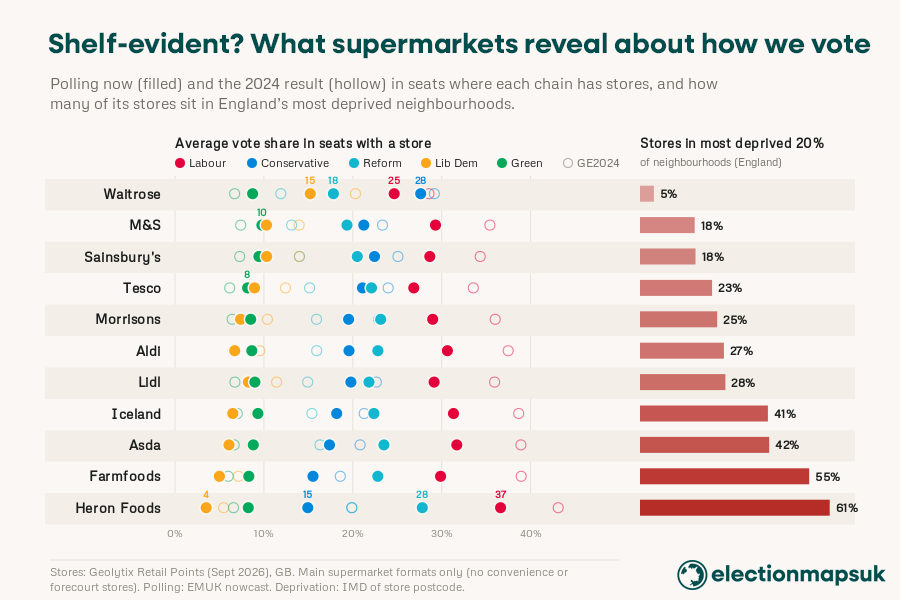
As an Elephant & Castle resident, I was thrilled to see an M&S open yesterday. With all the modern high-rise development around Elephant Park in the last few years, it felt inevitable that Percy Pig would come to town soon enough. But it got me thinking. Few things say more about a place than its supermarket, so how much does party support differ depending on which ones an area has?
To find out, I took the location of around 6,900 stores across 11 chains, and looked at how their constituencies voted in 2024, and how they’re polling now.
5% of Waitrose stores are in England’s most deprived fifth of neighbourhoods, while a third are in the least deprived fifth. Next come M&S and Sainsbury’s, with around 18% of their stores in the most deprived areas, then Tesco (23%) and Morrisons (25%). Aldi and Lidl are at 27-28%, while Iceland and Asda break into the low 40s. At the opposite end of the Waitrose spectrum lie Farmfoods (55%) and Heron Foods (61%), where more than half of all stores are in the most deprived fifth of the country.
Waitrose is the best supermarket indicator of Conservative support. It’s the only chain where the Tories lead, on 28% to Labour’s 25% in seats with a store. It’s also the Lib Dems’ best, at 15%. From there, the Lib Dems fade steadily as you move down the list: 10% in M&S and Sainsbury’s seats, 6-7% around Aldi, Iceland and Asda, and just 4% around a Heron Foods.
Reform runs the opposite way, from 18% in Waitrose seats to 23–24% at Morrisons and Asda and 28% at Heron.
Labour leads at every other chain, thanks to its healthy seven-point lead in current opinion polls. Its vote is strongest where shops are cheapest, reaching 37% in Heron Foods’ constituencies. But that's also where it has fallen furthest since 2024: down up to nine points at the budget stores, versus four at Waitrose.
The Greens are the exception. They poll 8-10% wherever you shop. That fits a party whose support is driven more by age than anything else.
So, does the new M&S mean Elephant & Castle is about to get a lot more Tory and Lib Dem? Probably not. Supermarkets don’t change how a place votes; but are a great indicator of what drives it. Percy Pig didn’t make Elephant Park, Elephant Park made Percy Pig.
Beyond COP31 in Turkey and the EPC meeting in Dublin, the Prime Minister found time for a call with President Macron on AI, discussed Middle Eastern security with the Egyptian President and the Emir of Qatar, and spoke to the President of Finland about support for Ukraine. Foreign Secretary Ed Miliband and Climate Minister Katie White joined the PM for COP, with Miliband in his element delivering speeches on climate security, the clean energy transition, green industrial opportunity and the value of forests. Sadiq Khan also popped up at the conference, where he met with the UN Secretary General, the President of the World Bank, President Lula of Brazil, the governors of California and Minnesota, and the Prime Minister of Barbados.
Between his Caribbean jaunt last week and Turkish speaking tour this week, Miliband also attended the rather more grey G7 Foreign Ministers' Meeting in Paris, where Ukraine and the Middle East were top of the agenda, but ministers also discussed China and instability in the Horn of Africa, Sudan and Haiti.
Back in London, the Chancellor hosted Canadian Foreign Minister Anita Anand for talks on defence, security, energy and critical minerals.
Scotland Secretary Douglas Alexander and Defence Industry Minister Luke Pollard accompanied the Defence Secretary to the Atlantic Future Forum and the International Sea Power Conference in Oslo. Alexander held a variety of meeting with Norwegian and Danish ministers, with the forum culminating with the UK procurement of three mine-hunting ships for the Royal Navy.
Shadow Defence Secretary James Cartlidge and his junior associate David Reed visited Berlin to discuss UK-German defence ties with MPs from the Conservatives’ sister party, the CDU. Attorney General Elie Reeves was also in Germany, although for rather less friendly talks. She delivered the UK's opening statement at the International Tribunal for the Law of the Sea, after Argentina lodged a legal challenge over oil exploration around the Falkland Islands.
Security Minister Dan Jarvis visited Pakistan for talks with the country’s Deputy Prime Minister and Interior Minister on regional security, including stability in Afghanistan, and cooperation on counter-terrorism and serious organised crime.
International Development Minister Kirsty McNeil was in Geneva for talks on the education of women and girls, while fellow Foreign Minister Uma Kumaran met with the Qatari Communications Minister at the International Telecommunications Union summit in the country. European Relations Minister Hamish Falconer put in some legwork ahead of the much-anticipated UK-EU summit next week, meeting with his Dutch counterpart Tom Berendsen and European Trade Commissioner Maros Sefcovic to discuss energy prices and youth mobility.
AI Minister Kanishka Narayan met with Australia’s Industry, Innovation and Science Minister to discuss the ‘shared ambition to build domestic AI capability’.
Economic Secretary to the Treasury Lucy Rigby met with her Singaporean counterpart, with discussions touching on areas of close collaboration such as digital finance. She also delivered a variety of speeches in Anatalya during COP’s Finance Day.
Scotland Minister Melanie Ward hosted a delegation of Massachusetts state legislators, during which, among other areas, they discussed ‘the Tartan Army's memorable stay in Boston’ during the World Cup.
A number of changes to House of Commons Select Committee memberships were approved, with Chi Onwurah replacing Derek Twigg on the Joint Committee on the National Security Strategy; Sean Woodcock replacing Chris Bloore on the Northern Ireland Affairs Committee; Al Carns replacing Catherine McKinnell on the Public Accounts Committee; Steve Yemm replacing Alison Gardner of the Science and Technology Committee; and Neil Duncan-Jordan replacing Lee Barron on the Work and Pensions Committee. And breathe…
Following Charlie Maynard’s departure from the Lib Dem front bench (and Ed Davey’s good books) in October, the Liberal Democrats announced a reshuffle this week, with Ian Roome appointed the party’s spokesperson for Veterans and Service Personnel, having previously served in the RAF before entering politics. Meanwhile, Bobby Dean has taken up the role of Shadow Chief Secretary to the Treasury, Lee Dillon has been appointed Shadow Leader of the House of Commons, and Paul Kohler will serve as Immigration and Asylum spokesperson, in addition to his current role as spokesperson for Northern Ireland.
Chair of the Joint Intelligence Committee Madeleine Alessandri has been appointed as the UK’s first Special Representative for Climate Security, advising the Government on risks related to climate change. In her previous role, she oversaw the operations of MI6, MI5, GCHQ and Defence Intelligence.
Joceyln Ledward KC was appointed First Senior Treasury Counsel by Attorney General Ellie Reeves, in which capacity he will manage highly serious and complex criminal prosecutions.
Lieutenant General Phil Prosser took up the role of Chief of Defence Logistics and Support, within the National Armaments group.
Fiona Blyth was made British ambassador to Chad, taking up the appointment in December succeeding Helena Owen.
Friday the 13th claimed its first victim, and it’s Outlook. A major Microsoft outage took down Microsoft 365 services, including Outlook, Teams, and Copilot, for users around the world, and it stretched into a second day on Friday. In the UK, the NHS cancelled some operations, since much of its calendar runs on Microsoft systems, and reported possible problems with electronic systems. Microsoft said there is no indication it was a result of a cyber-attack. Presumably someone did try turning it off and on again?
Buoyed by polls putting the Conservatives ahead of Reform UK, Kemi Badenoch held a press conference to put more flesh on plans to cut welfare spending by £36bn. Measures include ending Disability Living Allowance for families of children with “milder conditions” in favour of a “support-based model”; tightening eligibility for sickness benefits; ending welfare payments for foreign nationals; and strengthening the Household Benefit Cap.
The Government’s own welfare plans also began to take shape, as reports emerged of recommendations in Alan Milburn’s review, due next Tuesday. Aimed at reducing the number of young people not in employment, education or training, it will reportedly propose replacing the health element of Universal Credit and Personal Independence Payment for under-25s with an additional allowance covering daily costs related to their conditions, alongside billions in investment in youth employment support. So far, Labour MPs appear to be keeping their powder dry, raising the prospect that Andy Burnham might navigate welfare reform without the backbench battle that engulfed his predecessor.
Reform UK, meanwhile, turned its attention to ‘reviving’ the industrial heartlands, announcing plans for ‘Industrial Strongholds’ modelled on special economic zones. Businesses would benefit from tax breaks including reduced National Insurance contributions, deductions for new factory construction costs from taxable profits, and business rates exemptions for extensions to existing premises. Wolverhampton-born Robert Jenick announced the Black Country would host the first, with four more locations to come.
With Armistice Day falling this week, the Prime Minister pledged to mark it by writing personally to councils in England, asking each of them to draw up a specific plan to offer accommodation to any veterans sleeping rough ahead of Christmas. Councils were expected to use part of an extra £874m fund for rough sleeping, which bring the total to a record £4.4bn. Nearly £9m also went to eight organisations across the UK, funding housing, health, addiction, and employment support for veterans with complex needs. In a week given over to remembering those who served, the focus this time was on veterans who still need help today.
The Government has finally worked out that a bottle only needs recycling once, as the Department for Environment, Food & Rural Affairs announced that packaging for recycling will no longer be charged twice, with savings estimated up to 6p per beer bottle and 10p per wine bottle. From April 2027, glass drinks containers sold directly from producers to pubs, restaurants and other licensed venues will no longer be liable for packaging waste fees. Businesses will also be consulted on cutting fees for easy-to-recycle materials like glass and paper by up to 40% a year, while hard-to-recycle materials like plastics would cost more. It’s not quite a free round, but it’s a start!
Leaseholders in England should soon find it easier to see where their money is going, after the Government confirmed stronger powers to ‘demand’ information about service charges from 1 April 2027. They will also gain greater protection when challenging charges, with landlords needing court or tribunal approval to pass on legal costs. The Government will go even further from 1 November 2027, with leaseholders to automatically receive clearer information about charges they are asked to pay.
The Prime Minister had a front-row seat for plans to rewire the state this week, as Cabinet Secretary Antonia Romeo outlined five ‘imperatives’ for reform, including AI, global threats and public sector productivity. She confirmed an updated Civil Service Code would be published in the spring and announced recruitment reforms to simplify hiring and end ‘generic interviews and slow processes’. In a nod to Burnham’s presence, she also confirmed the ‘Review into the Organisation, Performance and Transformation of the Permanent Civil Service’ would be published next summer.
Shoppers could soon enjoy their chocolate with one less thing to feel guilty about, as Environment Secretary Angela Eagle launched a consultation on rules to stop goods sold in Great Britain contributing to illegal deforestation overseas. Timed to coincide with a forest event at COP31 in Antalya, the proposals would require businesses dealing with soy, palm oil, cattle, cocoa, timber, coffee and rubber to carry out supply chain due diligence, covering products from cooking oil to cosmetics.
The Prime Minister was given some food for thought ahead of next Friday’s UK-EU summit, as new Scottish Labour leader Michael Marra called rejoining the European Union to become the UK’s ‘long-term objective’. Pointing to challenges including climate change, AI and national security, Marra argued that relationships with other nations ‘matter more than ever’.
Britain has never been short of wind, and it seems investors have noticed. The Prime Minister welcomed £12bn from RWE and KKR in what is believed to be the biggest investment of its kind in UK history, giving the green light to the Vanguard West and Vanguard East offshore wind farms. Expected to be operating by 2030, the projects would power the equivalent of around three million homes and support 2,400 jobs, with £1bn backing from the National Wealth Fund marking its largest offshore wind investment to date.
Lockdown is back, though only for anyone with feathers as the UK’s Chief Veterinary Officer, Christine Middlemiss, ordered a mandatory housing order across England after a rise in confirmed bird flu cases in kept birds and findings in wild birds. Keepers with 50 or more birds must keep them housed, as must anyone or sells or gives away eggs, poultry products or live birds, whatever the size of their flock. Defra does not expect any overall impact on Christmas turkey supplies, and the risk to human health is described as very low.
The independent state of Piddington was back in the news this week, after the Housing Secretary approved planning permission for a development at MOD Bicester intended to house more than 1,200 asylum seekers. The Parish Council Chair warned the Government to ‘absolutely’ be ready for a court challenge.
Lisa Nandy announced a four-year partnership at the National Theatre, to reach more than 100,000 young people who might miss out on the theatre because of costs or location. Twelve regional theatres will run workshops in acting, playwriting and backstage roles, with productions touring 400 schools and thousands of £10 tickets on offer. The National Lottery Community Fund still has to approve the plans, so the funding isn’t guaranteed yet. At £10 a ticket, the interval ice cream may now be the priciest part of the night!
Phone-free school days took another step towards reality this week as Children’s Minister Josh MacAlister announced strengthened mobile phone guidance in a Statement to the House. The guidance, which will come into effect from next September, will make clear that schools should adopt strategies that keep phones out of use and inaccessible to students throughout the day. Alongside this, a consultation was launched on establishing independent safety certification of education technology in schools and colleges across England – in a bid to reduce the risks posed by technology on children.
The Commons underwent one of its sitting Fridays today, which saw Andrew George’s Homes and Planning Bill debated. The Bill Seeks to support local people’s housing needs via provisions on affordable housing and second homes. Clive Jones’ Cancer (Reporting and Strategy) Bill, which aims to require the Government to publish a strategy on improving cancer outcomes and report annually to Parliament, was also given time. The Government confirmed it would not support either Bill. This week also saw the Financial Services and Markets Bill pass its second reading in the Commons; whilst in the Lords, both the Health Bill and the Courts and Tribunals Bill underwent committee stage and the Church Appointments (Repeal of Discriminatory Provision) Bill was read a second time.
On Committee corridor, the Lords European Affairs Committee reported that dynamic alignment with EU law in certain areas would ‘increase the demands on Parliament for scrutiny and on the Government for engagement with the EU institutions in Brussels’; the EFRA and Environment Audit Committees endorsed the Government’s intention to appoint Lisa Tennant as the Environment Agency Chair, having questioned her in a pre-appointment hearing earlier this week; and the Lords Industry and Regulators Committee called for a ‘culture change’ within the Ministry of Defence to improve procurement processes. The Public Accounts Committee also announced its latest slate of upcoming inquiries, covering areas including defence reform, digitising NHS patient records, local roads, reducing energy bills, the quality of social housing, and the high education sector’s financial crisis.
Jon Trickett MP is airing his beef with Google’s Gemini chatbot, claiming it had ‘sought to mislead’ him while he was trying to verify his research. After what one imagines was a stern telling-off, he shared a screenshot of the bot apologising and admitting it had ‘completely broke[n]’ his trust. Just how intensely you have to interrogate a chatbot to extract a confession remains unclear, but Google’s public affairs team can take comfort in only having to apologise to one man. We imagine their counterparts at Microsoft have a rather longer mailing list today…
The Conservative Shadow Home Secretary Chris Philp and Reform’s Zia Yusuf offered a masterclass in presenting a disunited front on Friday afternoon, turning up to oppose asylum accommodation plans near Piddington before promptly turning on each other. Yusuf demanded an apology for the Conservatives’ immigration record, while Philp urged him to “read the room” and “pipe down” to applause from assembled residents. Philp also insisted he wasn’t there to give Yusuf comms advice, before helpfully adding “buddy… stop digging”. Having already voted symbolically to leave the UK, residents could perhaps be forgiven for considering an extension to the exclusion zone.