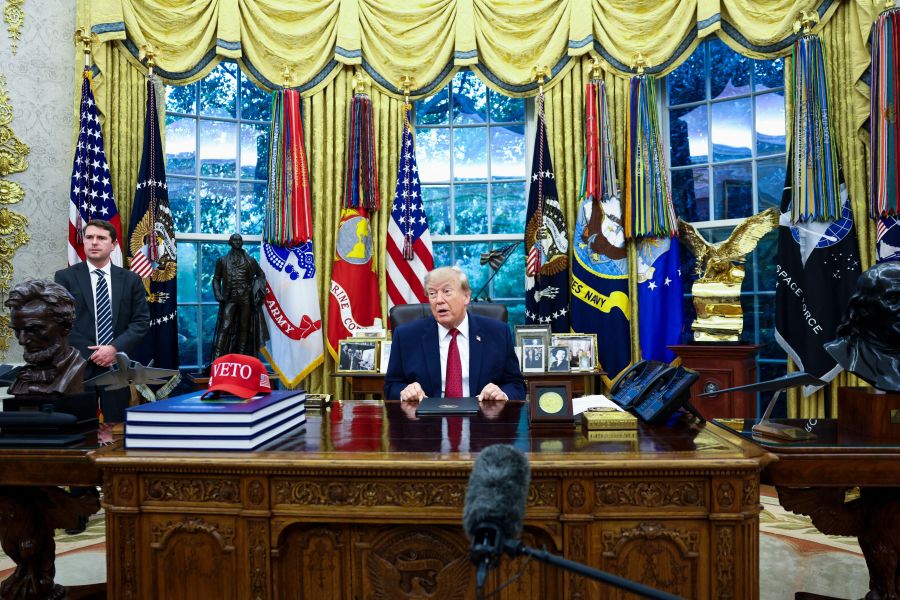
US President Donald Trump signing an executive order aiming to designate the Oval Office a national monument, with his new ‘VETO’ hat prominently displayed, a power that he will undoubtedly use in the coming months... © dpa picture alliance / Alamy Stock Photo
Across the pond, Donald Trump’s final two years in office are set to become considerably more difficult after Republicans lost both the House and the Senate. Just two years after his 2024 victory saw even reliably blue states shift towards red, Democrats have delivered a striking reversal, with Senate breakthroughs including in Texas and Kansas. So, what went wrong? Trump himself acknowledged that the war in Iran played a part, while Vice President JD Vance offered a sharper, more pointed assessment on X, highlighting the war, the cost of living and voters’ demands to put America first and rethink relations with Israel, with this intervention fuelling speculation about his ambitions for a 2028 presidential nomination. With Democrats set to adjust to their comfortable majority in Congress in January, the remainder of Trump’s presidency could be defined by legislative gridlock and renewed scrutiny. They will have the power to block new legislation, shape spending decisions and launch investigations into the administration, with potential subjects including the war in Iran, the Epstein files and allegations of corruption involving the Trump family. Another looming question remains whether the Democrats will look to impeach Trump for a third time. But as Democrats celebrated, Trump reminded everyone of the power he retains, as he’s already posted a photograph on Truth Social of a MAGA-esque red cap bearing a single word: ‘Veto’.
Time to focus on the cost of living was the Prime Minister’s response to the results in the US, as he watched the blue tsunami unfold from the Commonwealth leaders summit taking place in Antigua and Barbuda. He told reporters that the midterm elections presented “an opportunity now to unite around the issue that is affecting us all, and that’s the cost of living,” adding that he could not ease cost of living pressures until the US’ conflict in Iran had been resolved, as he pledged to push for a resolution to both this conflict and the war in Ukraine. Very diplomatic then… and unsurprisingly so, as while these results will massively knock President Trump’s power on the domestic front – with a Democrat controlled Congress able to block legislation and open investigations into Trump’s conduct amid allegations of corruption – he still remains almost exclusively in control of setting foreign policy. Some fear that the lack of control in other areas could see Trump become increasingly unpredictable on the international stage (if possible), especially in the context of him continuing to insist that his decision to go to war in Iran was the right one, despite accepting this was a key reason for this week’s Republican defeat.
4% – the Bank of England’s new interest rate, the first increase in more than three years
1 – abandoned run by Burnham when playing cricket in Antigua, ending with him on the ground
3,145 – honour-based abuse offences recorded by police in England and Wales in the year ending March 2026, up 7% on the previous year
86.48 – the current value of the pound on the Bank of England’s index against 18 major currencies, the highest since the 2016 Brexit referendum
32 years – how long Democrats had gone without a statewide win in Texas before this week
11 – number of councils where Labour has ended power-sharing agreements with the Green Party over the party’s “Zionism is racism” policy
24% – the Conservatives’ share in YouGov’s latest poll, up by two points on last week
81,000 – Night Tube journeys made on an average night, as the service marks its 10th anniversary
2 – number of Dan Sullivans on Alaska’s Senate ballot, one the Republican incumbent and the other, a retired teacher
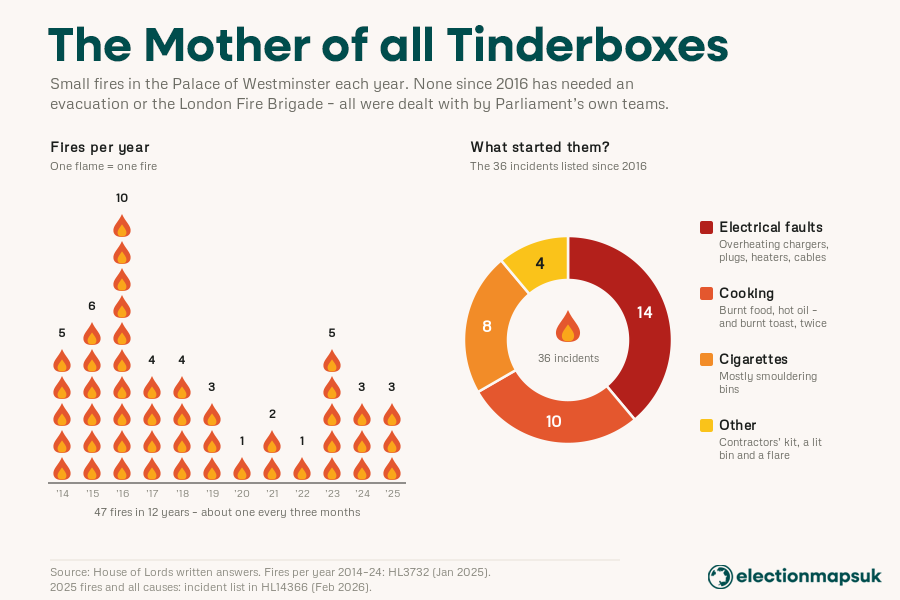
421 years after Guy Fawkes was caught beneath the House of Lords with 36 barrels of gunpowder, the threat of fire in Parliament is rather less dramatic. In 2018, the cause of one small fire was a vape charger…
Parliament has of course burned down before. In 1834, an over-stoked furnace burning old Exchequer tally sticks set off the fire that destroyed most of the palace. Astonishingly, 47 small fires were been recorded in the Palace of Westminster between 2014 and 2025, about one every three months. 2016 saw ten alone, including three in a single November.
Electrical faults have the biggest culprit of the 36 incidents since 2016, accounting for 14 cases. Cooking scores 10, among them hot oil, food left in the microwave, a plastic tray in an oven and, on two separate occasions in 2017, burnt toast. Cigarettes caused eight, mostly smouldering bins, plus a plant pot full of peat that went up in 2018 after some unauthorised smoking.
The more unusual entries include a flare fired over the perimeter in 2021. A 2024 bin fire put itself out, because it had been placed to catch water from a leaking roof. It's hard to think of a better summary of the state of the building.
Thankfully, none of these incidents required an evacuation or the Fire Brigade. But the Palace has been patrolled around the clock by fire safety staff for years, because much of its fire detection system is so dated. It's one of the main arguments behind the Restoration and Renewal programme. However, February’s costed proposals put the bill at up to £15.6bn over 24 years if MPs and peers move out. If MPs stay put while the Lords moves out, it’s up to £39.2bn and 61 years, finishing in 2086…
The Prime Minister and Foreign Secretary joined the King in escaping the Autumn gloominess for the Commonwealth Heads of Government Meeting in Antigua for a meeting which was overshadowed by the re-emergence of the debate on whether the UK should pay reparations for the transatlantic slave trade. Burnham met with the leaders of Australia, Antigua and Barbuda, Barbados, Ghana and Mauritius, as well as the Indian Foreign Minister and the President of the World Bank. For now, he appears to have threaded the needle on reparations – proposing to issue a formal apology for slavery, but without any money being provided. Meanwhile, Ed Miliband delivered a speech on ocean finance and climate resilience, signed a partnership with his Jamaican counterpart to support its recovery from Hurricane Melissa last year, and joined the PM for a go on the steel drums.
Defence Secretary Wes Streeting took a tour of Europe, meeting with EU High Representative Kaja Kallas and Defence Commissioner Andrius Kubilius in Brussels for talks on UK-EU defence ties before meeting with his German counterpart in Berlin for the second Defence Ministerial Council under the Trinity House Agreement, which set the course for closer UK-German defence relations. He then rushed back to Liverpool for a royal visit, as the Dutch King and Dutch Defence Minister took a tour of the Cammell Laird shipyard to discuss collaboration in maritime engineering and manufacturing.
Junior Foreign Minister Stephen Doughty toured the Gulf states, meeting with the Crown Prince of Bahrain, the President of Yemen’s internationally recognised government and Saudi Arabia’s Vice Minister of Foreign Affairs. Meanwhile Development Minister Kirsty McNeill welcomed Turkey’s Deputy Foreign Minister to London for talks which focused on development and peace in Sudan, Somalia and the wider Horn of Africa.
Shadow Defence Secretary James Cartlidge had a sit-down with the Australian High Commissioner to discuss AUKUS and defence cooperation.
Scotland Minister Melanie Ward welcomed a delegation of Canadian MPs to ‘celebrate the deep friendship between Scotland and Canada and share experiences on devolution.’ No doubt salmon was on the agenda (and the menu) as well.
Welsh Government Enterprise, Connectivity and Energy Secretary Adam Price returned from the Disruptive & Emerging Technologies Alliance (DETA) 2026 Ministerial Summit in Boston, where he hosted a dinner to celebrate the links between Wales and Boston.
The DUP has lost Carla Lockhart, MP for Upper Bann, after a falling-out over its handling of the Drumcree parading dispute. She will sit as an independent unionist, having failed to persuade the party to force Michelle O’Neill from office by withdrawing its deputy First Minister.
From the RAF to Reform: Angus MacIntyre has become the party’s armed forces spokesman. The former Wing Commander resigned his commission after 40 years in uniform to join Nigel Farage’s ranks, with the move following months of criticism over the party’s lack of a defence brief and ties to Russia.
At the Treasury, Shriti Vadera has been appointed External Adviser to the Chancellor on delivery of the G20 and other international innovative finance issues. The unpaid appointment runs until 31 July 2027, having begun on 21 October.
The Ministry of Defence has recruited technology entrepreneur Dr Ewan Kirk as Director Innovation. He takes over from interim director John Cunningham to lead UK Defence Innovation within the National Armaments Director Group.
Baroness Alison Garnham, Chief Executive of the Child Poverty Action Group, has been appointed Commissioner and interim Chair of the Social Mobility Commission, succeeding Alun Francis. She will also advise the government’s new Class Unit as the Commission prepares for closure.
After a spell in the interim seat, Luke Jensen has been confirmed as Chair of National Savings and Investments for three years from 2 November. A Board member since 2024, he stepped in following Lord Lemos’s departure for the Lords Whips’ Office.
Erin Robinson and Helen Mills have joined the Government Property Agency as joint Chief Operating Officers, sharing responsibility for corporate services and operational delivery. The pair previously worked together as People and Transformation Directors at DSIT.
In other property news, Professor Nick Hopkins has succeeded Martin Boyd as Chair of the Leasehold Advisory Service, with an expected three-year term.
The Home Secretary unveiled long-planned changes to indefinite leave to remain rules, although proposals drawn up under Keir Starmer’s leadership to make foreign care workers wait 15 years to qualify for settlement were scrapped amidst backbench pressure. The standard length of time migrants will have to live in the UK to qualify for permanent settlement will double from five to 10 years, although high earners, care workers and skilled public service workers will still only have to wait five years. Other requirements including speaking English to a high standard, having no unpaid taxes and a record of sustained National Insurance contributions will also be instituted.
Labour councils abruptly ended eleven power-sharing agreements with the Green Party, in the latest backlash to the party’s controversial motion that Zionism is a form of racism at its conference this year. The Prime Minister had previously made clear that Labour now seeks to distance itself from the Greens, with party Chair Bridget Phillipson also asserting that the motion “crosses a line”. Green Party leader Zack Polanski hit back, suggesting that Labour’s decision to pull the rug from under jointly-run councils would “backfire”.
In more bad news for the embattled Greens, former co-leader Adrian Ramsey offered some criticism of the party’s current direction in an interview with the BBC, in which he called on the party to return to its “core values”, rather than engage in “divisive” rhetoric. In particular, Ramsey said he was “deeply uncomfortable” with the party’s motion on Zionism, and criticised “small groups of people on the hard left” who “go around different parties to try to influence how those parties are run”. Not talking about the supporters of anyone in particular, of course.
The Conservatives and Reform UK continued to set out their stalls on defence this week, with Tory leader Kemi Badenoch holding a rally aboard HMS Wellington in London, criticising the Government for dragging its feet on promised increases to defence spending. Meanwhile, Reform UK figures have trumpeted the party’s new Armed Forces spokesperson Angus MacIntyre’s four-decade military career as a demonstration that the party is getting serious on defence.
Carla Lockhart’s departure from the Democratic Unionist Party has kicked off a crisis in Northern Irish unionism, with the party now only boasting four MPs – down from a total of ten as recently as 2017. DUP leader Gavin Robinson said he was “very sorry” about the outcome, while Lockhart suggested that “many in the DUP” shared her view on the storm over the Drumcree Orange Order parade. Traditional Unionist Voice leader Jim Allister has also stated that Lockhart would be “welcome” in his party.
The Government’s quality of life policy blitz continued this week, with the latest tweak focusing on job adverts. Citing evidence that only 41% of employers publish salary ranges on job listings, the Government has expressed its intention to make all companies include this information. The move is especially intended to support young people applying for their first job. The Government also announced proposals for national standards to tighten up rules around shared e-bike schemes, with a focus on disabled access, antisocial behaviour and requiring operators to manage fleet sizes.
Met Police Commissioner Sir Mark Rowley laid out a series of stark warnings in a speech, suggesting that policing in England and Wales was “heading for failure” unless it accepted some radical reforms. In an address essentially backing the Government’s own proposals on policing set out earlier this year, Rowley urged a restructuring of police forces, with eight to ten larger forces anchored by an overarching National Police Service, alongside hundreds of local policing teams.
The National Cyber Security Centre published its State of the Cyber Nation report, essentially reminding readers that if they aren’t worried about AI yet, they probably should be. The NCSC warned that malicious actors were “highly likely” to use the technology to increase the scale and effectiveness of cyber-attacks, and urged organisations to get on top of their own cyber defences.
Wary of the midterms fallout across the pond, there was a decidedly domestic focus in the Commons. It was Louise Haigh’s turn to step up to the despatch box for PMQs as the Prime Minister sunned himself in the Caribbean, for a session which focused entirely on welfare spending. Meanwhile, the Energy Independence Bill and Visitor Levy Bill were introduced to Parliament, and an urgent question was granted on the future of Poundland.
In the Lords, peers slogged through the Cyber Security and Resilience (Network and Information Systems) Bill and the Health Bill, as well as two days considering the Representation of the People Bill which will extend voting rights to 16-year-olds, automate voter registration and reform compulsory voter ID requirements. Both houses then rose for a short recess on Wednesday – best to be out of Parliament on Bonfire Night!
Along the committee corridor, the Public Accounts Committee warned it is crunch time on the restoration and renewal of Parliament and said the Crown Estate should use its investments to boost growth across the UK, and also launched a new inquiry into the privatisation of the Civil Service Pension Scheme. The Energy Security and Net Zero Committee raised concerns over the UK’s lack of progress in adapting to a changing climate and suggested the Government do away with a National Policy Statement on fusion energy; while the Health and Social Care Committee highlighted the ‘cliff edge’ faced by young people transitioning from children’s to adult health and social care services. Turning to the environment, the Environment, Food and Rural Affairs Committee set out its recommendations for reforming the water sector to better protect consumers and the environment. The Business, Innovation, Science and Trade Committee said the Government has failed on its promise of a new, strategic, long-term, consistent approach to China and urgently needs to ‘de-risk’ its critical minerals supply chain. The Commons Science and Technology Committee stated that cosmetics regulation has failed to adapt to newer products like fillers, while the Lords Justice and Home Affairs Committee warned there is a high-risk of fire in prisons.
The House of Lords is often justified by allowing those with a specific field of expertise to contribute to the legislative process. As such, we were entertained to see that Lord Bridges of Headley has tabled a question on… bridges. The question, due to be taken in the Chamber on 26 November, is on the number of London bridges in need of repair and will certainly present an opportunity for some groan-worthy dad jokes from Peers.
With Andy Burnham away in Antigua and Barbuda for the Commonwealth Heads of Government Meeting, the opportunity arose for a game of cricket, where he joined local players and West Indies legend Sir Viv Richards for a friendly match. But things took a rather unexpected turn when Burnham, having set off for a quick single, suddenly changed his mind and attempted to turn back, only to lose his footing and go tumbling to the ground – a textbook political reverse sweep, let down by the footwork. Who would’ve thought that changing course and attempting a U-turn could cause so many problems, eh? Clearly, he hasn’t quite mastered the art of a well-timed spin.
Nigel Farage tried to restore some credit on Thursday evening after a rocky few months as leader of Reform UK. Naturally, the only way to do this was by attempting to ‘split the G’ on a pint of Guinness outside a pub with his fellow supporters. Farage overshot and missed the G, before confidently showing it to the camera and saying: “Have a look at that!” Hey, confidence (however misplaced) can get you far in politics nowadays…