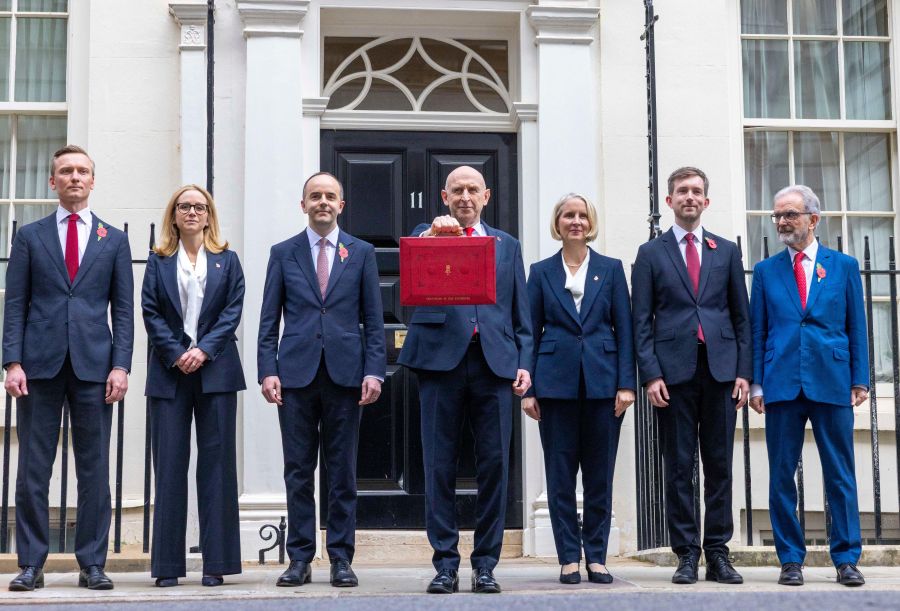
Chancellor John Healey poses with the red box outside No.11 Downing Street with his ministerial team, ahead of going to the House of Commons to deliver the Budget. © Karl Black / Alamy Stock Photo
Andy Burnham marked 100 days as Prime Minister this week, and what better way to celebrate than with a Budget? Chancellor John Healey delivered the new Government’s first, sticking to his predecessor’s fiscal rules but using up £9bn of the £24bn fiscal headroom, blaming the impact of the Iran war. With 98 measures, there was more to get through than in recent times, although fewer major tax changes than Labour has become accustomed to announcing since coming to power in 2024. Obviously, we won’t be listing all 98 in this newsletter, but we’ll give it our best shot…
Banks might take issue with any suggestion this was an insignificant Budget, facing a doubling of the bank surcharge to 6% for 15 months, while there’s also a two percentage point tax rise on savings and rental income and a rise in Machine Games Duty to 25%. Other measures included: £100 for households in Council Tax Bands A-D; work to remove gas standing charges; an extension of the electricity VAT cut; import tariffs scrapped on over 100 food products, kerosene and fertilisers; the Cash ISA limit cut abandoned; a 3.9% rise in the minimum wage and State Pension; a new allowance to keep low-income pensioners’ State Pension tax-free; parental pay extended to self-employed fathers and same-sex parents; and the business rates threshold for high street shops in England raised to £18,000. Housing measures included a First Time Buyer ISA replacing the Lifetime ISA and a reduced withdrawal penalty; £1bn extra for affordable and social housing; £432m for rough sleepers; and the Your First Home Scheme. On devolution, all business rates will be retained locally by the decade’s end, with mayors keeping 20% from next year and receiving a share of Income Tax from 2028. Finally, there was £600m for AI projects; £7m to explore a northern Olympics; £10bn for Ukraine through loans, guarantees and export finance; and £15m to tackle misogyny.
And so, the battle lines are drawn until next year’s spending review. Kemi Badenoch accused ministers of having “overspent, over borrowed, overtaxed” and left the country “drowning in an out-of-control welfare system”, while the Lib Dems, predictably, championed closer EU ties as the surest route to economic growth. With the Milburn review pushed beyond the Budget, the absence of welfare reforms was unsurprising; and the Chancellor might have got away with it, had he not told the Today programme that “we have to bring the benefits bill down”, prompting Treasury mandarins to intervene and Healey to clarify that, in fact, “it’s not correct to say that we are going to bring this welfare bill down in this parliament because we’ve not set a timetable for that.” Add a predicted £36bn increase in borrowing in 18 months, shrinking fiscal headroom, anaemic growth, inflation forecast to reach almost 4% in 2027, rising energy bills and global instability, and the Resolution Foundation’s warning that household incomes will shrink by 3% by the end of this Parliament feels unsurprising. Whisper it, but between the can-kicking of difficult fiscal choices on welfare and social care, a desire to get ahead of a living standards slump, Burnham’s insistence that he is bound by the 2024 manifesto on pledges (such as Europe) that he had no hand in writing, and Reform sliding in the polls, an early general election feels more likely than it did this time last week…
98 – individual policies in John Healey’s Budget, a new record in modern history
£431bn – the OBR’s forecast for the UK’s welfare bill by 2030/31, up from £353bn this year
3.8% – the OBR’s forecast for peak inflation in 2027
£36bn – increase in 2026/27 predicted public sector net borrowing in the 18 months since the 2025 Spring Statement – a 37% increase...
4 – number of Early Day Motions submitted by MPs congratulating Harry Kane on his Ballon d'Or win
$500bn – amount that Google’s parent company Alphabet lost in value on Thursday, after it revealed that its AI summaries on search were affecting ad revenue
9,450 – the level that Scotland’s prison population could rise to next year, 1,650 over the current design capacity
12,000 – jobs at risk amid Poundland filing a notice of intention to appoint administrators, giving the business 10 days to find a rescue deal
$6.3bn – total amount lost by cryptocurrency firm Binance in a hack, making it the most expensive hack in history

For much of the 20th century, one of the most reliable predictors of how someone voted was how their parents did. I looked into whether that effect still holds in modern Britain.
The British Election Study asks respondents how their mother and father voted while they were growing up. Same-party couples dominate: of those who could name both their parent’s allegiances, 86% said they voted the same way.
Even in Labour’s 2024 landslide, fewer than half (45%) of people raised by two Labour voters voted Labour – although that’s still well above Labour’s 35% among all voters in the sample. Of those raised by two Conservatives, 42% stuck with the party, far higher than its 24% overall share. Children of mixed Labour-Tory households leaned Labour by around 8 points, a little below Labour’s 11-point lead across the whole sample.
The upbringing effect survives controls for age, education, class, region, housing and Brexit vote. Labour children were still about 20 points more likely to vote Labour than Tory children.
The most loyal families, relative to their party’s size, are Lib Dem ones. Of those raised by two Lib Dems, 27% voted Lib Dem, twice the party’s rate across the sample, while only 8% voted Reform.
Where parents disagreed, mums have a slight advantage: 35% followed their mother and 26% their father. But it depends on who mum voted for. With a Labour mum and a Tory dad, 39% sided with mum. With a Tory mum and a Labour dad, it was a dead heat at 30% each.
Overall, it seems that party loyalty still runs in the family, but the behaviour is not as homogenous as it used to be.
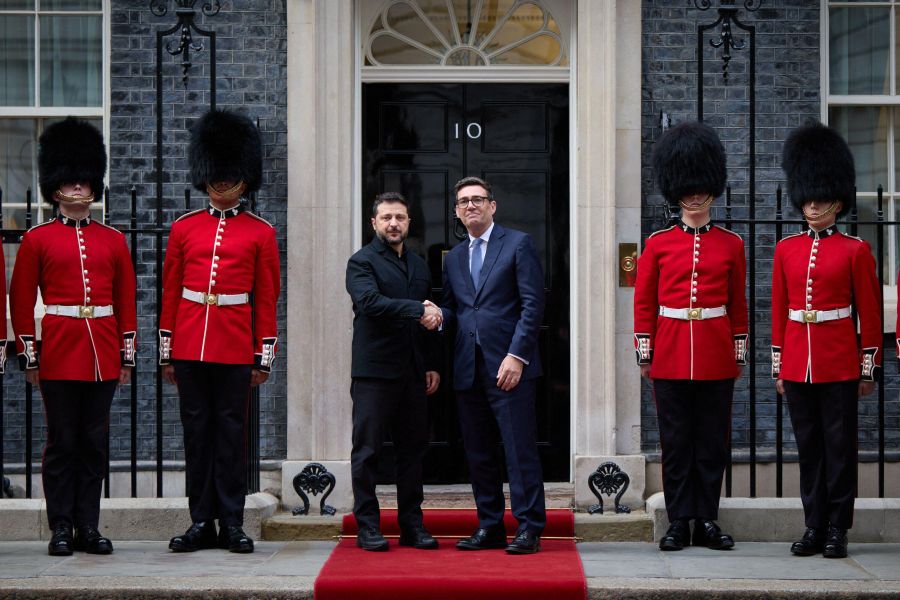
Prime Minister Andy Burnham and Chancellor John Healey spoke with President Zelenskyy after a difficult few weeks for Ukraine, reassuring the Ukrainian leader of Britain’s steadfast support against Russia’s illegal invasion – an impression which the Government was keen to reinforce following the announcement of £10bn in further aid as part of the Budget this week.
Meanwhile, Foreign Secretary Ed Miliband is currently in the city of Atlanta for a meeting of G20 foreign ministers. The meeting is on US Secretary of State Marco Rubio’s home turf, and will be chaired by him accordingly. Russia’s attendance at the meeting has caused some consternation, with questions remaining over how, or indeed if, Western delegates will engage with their representatives.
Earlier in the week, Defence Secretary Wes Streeting visited Warsaw, meeting with his Polish counterpart Władysław Kosiniak-Kamysz. He arrived in the Polish capital to discuss the new Warsaw Defence Plan agreed between the UK and Poland, setting out cooperation ‘across sea, land, air, cyber and industry to strengthen security and deterrence across Europe’s Eastern Flank’. The agreement builds upon the existing UK-Poland Security and Defence Partnership.
AI Minister Kanishka Narayan also met with his Canadian opposite number on Monday, discussing how to ‘build an AI future that puts people first’. The visit comes as Canada seeks to deepen its ties with its allies in Europe, including Britain.
On the same day, Shadow Foreign Secretary Tom Tugendhat was paid a visit by US Ambassador Warren Stephens, with the pair speaking about shared challenges facing the UK and US, and the longstanding allies’ cooperation on security.
MP for Peterborough Andrew Pakes was named the UK’s first-ever Co-operatives and Mutuals Champion in Wednesday’s Budget. Pakes will work alongside the sector to identify opportunities for, and barriers to, growth as part of the Government’s aim to double the size of the co-operatives and mutuals sector by the end of this Parliament.
In other firsts, Anthony Reeves was appointed the Ministry of Defence’s inaugural Director General Innovation. Reeves will oversee a ring-fenced £1.6bn defence innovation budget over the next four years, alongside supporting £2.1bn of investment in core science and technology.
A busy week of changes in Select Committees saw: Nesil Caliskan replace Justin Madders on the Business, Innovation, Science and Trade Committee; Graeme Downie replace Calvin Bailey on the Defence Committee; Gill German, Alison Hume, Tom Rutland and Jo Stevens replace Vicky Foxcroft, Natasha Irons, Anneliese Midgley and Jo Platt on the Digital, Culture, Media and Sport Committee; Catherine Fookes replaces Polly Billington on the Energy Committee; Helena Dollimore replaces Juliet Campbell on the Environment Committee; Zubir Ahmed and Jessica Toale replace Alan Gemmell and Uma Kumaran on the Foreign Affairs Committee; Sadik Al-Hassan and Allison Gardner replace Beccy Cooper and Alex McIntyre on the Health and Social Care Committee; Chris Murray and Jo White replaced by Matt Bishop and Preet Kaur Gill on the Home Affairs Committee; Sagal Abdi-Wali and Alan Strickland replace Maya Ellis and Sarah Smith on the Housing Committee; Tulip Siddiq replaces Janet Daby on the International Development Committee; Jon Pearce replaces Pam Cox on the Justice Committee; Elaine Stewart replaced on the Scottish Affairs Committee by Kenneth Stevenson; Samantha Dixon replaces Elsie Blundell on the Transport Committee; John Grady and Yuan Yang replaced by Andrew Lewin and Seema Malhotra on the Treasury Committee; and Andrew Pakes replaces David Baines on the Work and Pensions Committee.
Scottish Labour announced its new frontbench, with appointments including Jackie Baillie as Deputy Leader and Shadow Secretary for Health and Care, Daniel Johnson as Shadow Economy Secretary and Joe Fagan as Shadow Finance Secretary. Elsewhere, Mark Griffin takes on the housing and social justice brief, while Paul Sweeney will cover energy, climate action and transport. Jenny Young has been named Shadow Innovation, Technology, Skills and Tertiary Education Minister, with Irshad Ahmed taking on the public health and sport portfolio.
The Department for Environment, Food & Rural Affairs announced that Lisa Tennant has been named the Government’s preferred candidate to chair the Environment Agency. Tennant is currently Chair of the Scottish Environment Protection Agency, and subject to the committees’ report and the Environment Secretary’s final decision, she will succeed Alan Lovell on 1 January 2027 for a four-year term.
Dr Rachel Emma-Jane Fentem has been named the Ambassador to Seoul, taking over from Colin James Crooks, who has stepped down from the Diplomatic Service. Fentem will begin in the role during March 2027, and has previously been a Principal Private Secretary to the Foreign Secretary.
Power structures over in Northern Ireland look like they may well collapse again (or at least face a rather large wobble), nearly three years after the Executive’s two-year hiatus following DUP protests over post-Brexit trade agreements. The fallout comes in response to the Drumcree parade dispute, amid DUP anger over Sinn Féin's involvement in protests which prevented the parade from happening last month. DUP leader Gavin Robinson announced his party ‘will use the mechanisms at our disposal to thwart the Sinn Féin agenda’ and declared his ministers will stop taking part in any joint engagements with the First Minister, but pulled back from outright walking away from power-sharing. First Minister Michelle O’Neill called this a ‘reactive stunt’, accusing the DUP of being ‘unable to embrace equality [and] respected Irish identity.’
Andy Burnham took his first National Economic Council for the nations to Glasgow today, meeting First Ministers John Swinney MSP and Rhun ap Iorwerth MS, with (non-ministerial) representation from Northern Ireland. The meetings began a process to explore how the UK, Scottish and Welsh governments could develop models of regional empowerment, support reindustrialisation and ensure ‘good growth in every postcode’, with No.10 North to lead policy sprints involving officials from each government. No10 North, it seems, now stretches quite a bit further north.
Reform UK presented its Economic Rescue Plan 2 days before the Budget, setting out 64 pro-growth measures it would take in Government. These include… approving Rosebank and restarting oil and gas licensing; cutting affordable housing requirements on brownfield sites; ending the ‘boiler ban’; repealing the Renters’ Rights Act and the Employment Rights Act; legislating approval for new runways at Heathrow and Gatwick; cutting employer NI back to 13.8%; introducing a migrant worker levy; abolishing EV mandates; letting shops open until 10pm except Sundays; scrapping BBC and Channel 4 priority on streaming platforms; and (best till last) fully re-legalising Imperial units.
A busy Friday for HR as employers must now take ‘all reasonable steps’ to prevent sexual harassment at work, as the latest batch of Employment Rights Act measures came into force. The duty now covers harassment from clients and customers, as well as colleagues. Ministers can also set out specific steps for employers in future regulations. Trade unions also got a boost, with stronger rights to access workplaces and win recognition, new protections for their reps, and wider cover for workers taking industrial action. The government expects the Act to benefit more than 18 million workers.
Back at the despatch box with another update on the Government’s drawn-out Local Government Reorganisation programme, Local Government Minister Jim McMahon addressed the pause introduced in September following legal advice. Of the 14 areas where reorganisation decisions were announced in July, he shared that only five proposals would proceed, while the remaining nine would undergo further review. Struggling with his voice throughout the statement and the forty questions that followed, McMahon apologised for his croaky throat, assuring MPs that it was the result of back-to-back LGR meetings rather than a long night of karaoke.
MHCLG also published its new High Streets Strategy, ‘Hope on the High Street’, outlining six pillars of a successful high street: reasons to have confidence, visit, stay, explore, return and move in. The strategy includes four complementary funding streams to tackle vacancy and dereliction, protect valued community assets, support co-operative development and strengthen local capacity to revitalise high streets. It also introduces a ‘high streets first’ principle to increase the role of public services and workplaces in town centres; outlines measures the Government will explore to support growth, including the potential creation of Community Enterprise Zones; and sets out how it will deliver existing commitments to tackle crime and organised crime.
Water and Flooding Minister Emma Hardy MP set out the Government’s expectations for responsible water and energy use by data centres, as part of a wider package intended to protect billpayers and host communities, support reindustrialisation and strengthen UK sovereignty. She urged operators to voluntarily publish annual data on water use, energy consumption, carbon emissions and electricity-system flexibility, and to follow a water-use hierarchy prioritising demand reduction and efficient cooling.
New restrictions on the sale and promotion of vapes and nicotine products have come into force across the UK, meaning products not previously covered by existing age-of-sale rules – such as nicotine-free vapes and nicotine pouches – will become illegal for under-18s. The measures also ban promotional giveaways and substantial promotional discounts in shops and online, alongside vending machines that either sell or dispense vapes or nicotine products.
John Healey wasn’t alone this week in giving a statement to the House of Commons, as his colleagues gave updates to MPs on delays to civil service pensions, tackling rough sleeping, national preparedness (we trust everyone has their bottle of Sauvignon Blanc and tin of baked beans) and local government reorganisation, while the Prisons Minister was brought in for questioning on electronic tagging. Housing Secretary Angela Rayner (without a bottle of Sauvignon) was also in front of MPs, leading the second reading of the Building Safety (Remediation of Unsafe Cladding etc) Bill.
While MPs are set to debate the Budget well into next week, it falls to Peers to keep the Government’s legislative agenda moving along, as the Railways Bill also concluded committee stage, the Armed Forces Bill had its third reading, the Health Bill continued its committee stage, and the Representation of the People Bill began its own. One Bill they aren’t happy with is the Cyber Security and Resilience Bill, voting through amendments requiring a review of the NIS scheme within twelve months and a register of state actors posing a threat to UK cyber security as it concluded its report stage.
Away from the chambers, the Health and Social Care Committee said the Prime Minister should make tackling England’s obesity crisis his personal mission, while the Public Accounts Committee has criticised the Government for lacking a positive vision for the British Council. Meanwhile, the Northern Ireland Affairs Committee is inviting young people to share their views on reconciliation in Northern Ireland, and a call for evidence has opened on the cladding bill.
It's fair to say Emma Hardy has had a few things on her mind lately, so who could begrudge the Water Minister a little downtime? Between a summer of droughts, a water utilities crisis, warnings of potential flooding and a Budget just around the corner, there's been no shortage of work to get through. But it seems Hardy found a rather more enjoyable way to spend her last Thursday afternoon, with a fellow passenger on the 4pm train to Hull allegedly spotting her playing Candy Crush for the full two-hour-plus journey. One can only hope she made it to the next level…
And if Candy Crush isn’t quite your thing, there’s now another way for politicians to while away the hours. Enter Super Kemi, which has been launched as a sort of Westminster take on Super Mario, where players can take control of Kemi Badenoch and her frontbench team as they run, jump and “repeal” their way through six worlds of red tape, as they get to dodge £100,000 cliff tax traps and net zero subsidies along the way.
And finally, pubs had some welcome news in the Budget, and MPs were quick to raise a glass. Dr Jeevun Sandher MP celebrated the cut to business rates by sharing a photo of himself enjoying a rather sad-looking pint, in surroundings that are giving more of a chemical plant/nuclear bomb shelter vibe than a local boozer. Dan Tomlinson MP, meanwhile, has shared a great video of ‘the boss’ necking a pint of ‘Chancellor’s Choice’ in one. Now that’s how you celebrate a budget.