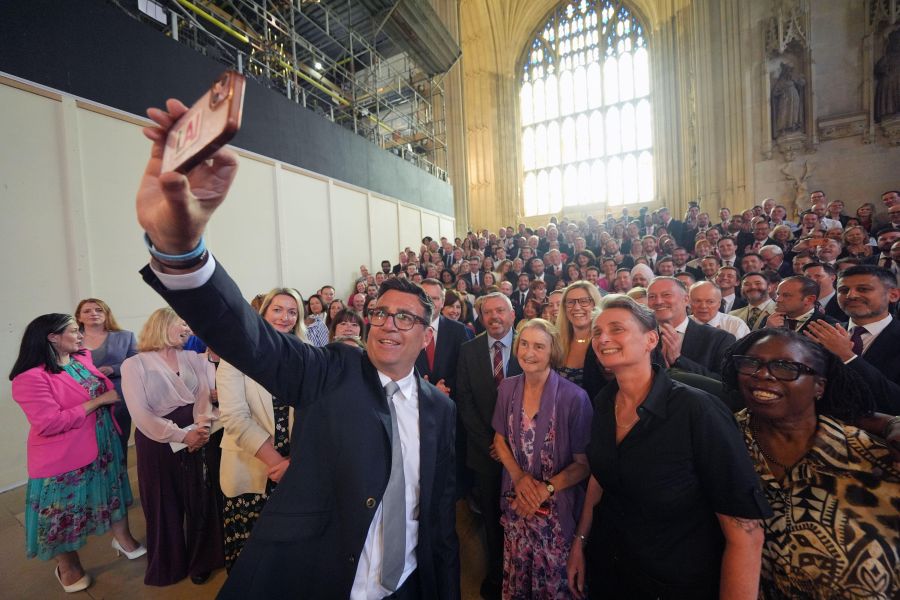
But first, let me take a selfie: Prime Minister apparent Andy Burnham celebrates his return to Westminster by taking a photo with around 200 Labour MPs. © PA Images / Alamy Stock Photo
Prime Minister Keir Starmer announced his resignation this week, less than two years since winning a massive majority in a general election and becoming the first Labour politician to win one since Tony Blair. After months of speculation, Andy Burnham’s victory in the Makerfield by-election last week was well and truly the straw that broke the camel’s back, and Starmer’s speech outside 10 Downing Street took place before Burnham had even been sworn in as an MP. Starmer defended his record as Prime Minister and said that every decision he had taken was about “putting the country I love first”, while thanking his wife and family for their support. The emotions on display from Starmer were in stark contrast to those of most Labour MPs, including members of Cabinet such as Rachel Reeves and Steve Reed, who flocked to Westminster Hall to have a joyous selfie with the returning King of the North. While Burnham confirmed he would be running to replace Starmer, Wes Streeting (who previously said he would run in a contest) swiftly got in line and gave his backing to Burnham. The only person who now appears to potentially stand in the way of Burnham’s coronation is former Minister Al Carns, who is said to still be weighing up whether to stand. Whatever happens, we’re on our way to the seventh Prime Minister in a little over 10 years, and fifth in the last 5. For context, that means there will have been as many Prime Ministers between David Cameron and Starmer’s replacement as there are between David Cameron and Harold Wilson.
All eyes have now turned to who will be in Andy Burnham’s top team, as the Ministerial jostling has well and truly begun, with briefings going on as people try to get their favoured person in as the new Chancellor. For Chief of Staff, it’s looking like James Purnell will get the role, a man who Burnham shared a Cabinet table with when Gordon Brown was PM. After leaving Government, Purnell worked for the IPPR, the BBC and most recently as CEO of Flint. Former Bank of England Chief Economist and current President of the British Chambers of Commerce Andy Haldane has reportedly been advising Burnham (and also set out his own views on the economy at the BCC Global Annual Conference). But who will be Chancellor of the Exchequer? The team of the current occupant, Rachel Reeves, have reportedly been ringing around business figures to try and get them to lobby for her to remain in the name of ‘fiscal stability’; Wes Streeting’s decision not to stand in the contest might see him rewarded with a big role, while former Labour leader Ed Miliband is the favourite choice of some, but a nightmare choice for others. With Burnham likely to arrive in Downing Street in a matter of weeks, he has a lot of very important decisions to make before then.
There is still, still a chance somebody may pop up (here’s looking at you Al Carns) and trigger a full Labour leadership competition to stop an automatic Burnham coronation in three weeks’ time.
If you’re a Navigate Politics client, you got our predicted timetable (which was about as close to spot-on as possible) the morning Keir Starmer resigned; but for those who don’t receive the UK’s most trusted political monitoring briefings to their inbox each morning – here’s the updated rundown on what to expect and when, after the Labour Party NEC confirmed the timetable on Thursday:
Nominations: In order to make the ballot paper, candidates must secure the support of 81 MPs (20% the Parliamentary Labour Party), and support from a minimum of three affiliated organisations (at least two of which must be trade unions) or 5% of local party branches (CLPs). The PLP nominations window opens on 9th July and closes at 6pm on 15th July, after which affiliated organisations have just 24 hours until 6pm on 16th July to confirm their nominations. Should an MP not get the required affiliate nominations, they’ll then have until 31st July to secure enough support from CLPs to make the ballot.
Membership ballot: Voting will be open to party members and affiliated supporters (not registered supporters), who have been members of the Labour Party for at least 6 months prior to the election timetable being approved, between 6th and 27th August.
Voting system: The leader is elected using a preferential ballot where voters rank the candidates by preference. If a candidate receives more that 50% of the vote, they are automatically elected. If no candidate receives 50%, the lowest-ranked candidate is eliminated, and the second preference votes are redistributed amongst the remaining candidates. This process is repeated until one candidate has a majority.
The big announcement: The result will be announced at an event on Saturday 29th August… unless of course, it’s just Andy Burnham, in which case he’ll be crowned the new leader on 17th July (and this entire explanation will have been for nothing!).
7 – number of Prime Ministers the UK will have had in a decade once Andy Burnham (likely) makes it to Downing Street
36.9°C – the UK’’s highest ever June temperature, for anyone that has been living under a (incredibly air conditioned) rock, recorded in Suffolk earlier today
£12.9m – tax King Charles paid in 2024-25, placing him among the top 100 UK taxpayers
29,000 – number of lightening strikes recorded across southern England during Monday night’s thunderstorms
£100,000 – average amount university graduates earn more over their lifetime compared to non-graduate counterparts
~87% – legally binding emissions reduction target in the period 2038-42 under the approved Seventh Carbon Budget
336,332 – complaints closed by train operators in the past year
Immigration Minister Mike Tapp has been accused by Home Secretary Shabana Mahmood of briefing Home Office plans as his own in a Times op-ed, with Mahmood calling for him to be sacked for breaking the ministerial code’s commitment to collective responsibility. Despite the call, Downing Street has confirmed that Tapp, a loyal Starmer supporter, is still in the job. Tapp is now restricted from accessing government documents and attending government meetings and must obtain approval from the Home Secretary herself.
The British Chambers of Commerce hosted their Annual Conference, boasting a range of speakers from across the political spectrum, including (current) Chancellor Rachel Reeves, Shadow Chancellor Mel Stride, Lib Dem leader Ed Davey, Green Party leader Zack Polanski and Reform UK Treasury Spokesperson Robert Jenrick. The Chancellor sensed an opportunity to make her pitch to remain in post, insisting she had “more to do” as Chancellor: from fiscal devolution and the visitor levy, to further business rates reforms and regulatory reform. Meanwhile, her opposite number Mel Stride called on (incoming PM) Andy Burnham to rule out any further tax rises on businesses. BCC President, and reported adviser to Andy Burnham, Andy Haldane also gave a speech, potentially giving somewhat of an idea of what fiscal policies might be on their way under a Burnham premiership – including shifting incentives towards UK investment and tapping into patient capital “reservoirs”.
Defra published a 25-year Farming Roadmap outlining the Government’s vision for a profitable, sustainable and resilient sector to 2050. The roadmap promotes nature-based approaches, such as improving soil health and water management, alongside better access to technology, skills and supply chains. An additional £53m has been earmarked for the Farming Innovation Programme, whilst the Government has pledge more targeted environmental schemes, continued seasonal worker visas to 2030, and new horticulture and poultry growth plans.
The Government published its Media Green Paper, setting out its media policy to address the challenges posed by the new digital age. It outlines plans to ensure that media, specifically TV, can continue to play a role in society and democracy by ensuring high-quality content and trustworthy news remain accessible and sustainable.
Marking the 10th anniversary of the Brexit vote, Constitution and EU Relations Minister Nick Thomas-Symonds delivered a speech at a UK in a Changing Europe discussion. While EU membership was previously mentioned by Labour Leader hopefuls in the lead-up to Starmer’s resignation, the EU Relations Minister asserted that “going forward is what matters - not looking back” and highlighted the progress made in the last decade.
The long-awaited Bill to ban conversation therapy was finally introduced to Parliament on Thursday, in an effort to protect LGBT+ people from ‘abusive acts’ aiming to change their sexual orientation or transgender identify. The new plans could see those carrying out conversion practices jailed for up to five years, alongside new civil powers (Conversion Practice Protection Orders) that will seek to pre-emptively protect those deemed to be at risk of abuse.
London Climate Action Week took place this week, as the Government set out its new approach to deforestation regulations, outlining that new rules will ensure everyday products sold in the UK like coffee and cocoa do not contribute to illegal deforestation around the world. Under the proposals, UK businesses who trade in commodities sourced from rainforests will need to check their supply chain are not contributing to illegal deforestation, with legislation expected to come into force in 2027 following a consultation later this year.
FCDO announced a new AI partnership with the Met Office too as part of London Climate Action Week, in an effort to improve global preparation for climate shocks – using AI forecasting to predict weather patterns. Also for LCAW, DESNZ issued a policy paper on the Global Clean Power Alliance, confirming that the GCPA Finance Mission is publishing new country Action Plans and that the UK is progressing work to integrate the Energy Transition Council into this Mission.
The Climate Change Committee published its annual assessment of the Government’s progress in reducing emissions, showing that overall emissions fell by 1.8% in 2025. The CCC found that EV uptake is continuing to grow, peatland restoration has increased by 26% and a record amount of new renewable energy was contracted in the latest auction; however, it also revealed that progress in other areas like heat pump installations has stalled. It set out a series of priority recommendations including removing the remaining policy costs from electricity bills, cutting costs to heat pump installations and speeding up grid connections.
A ‘new deal for young people’ was announced, seeking to tackle the ‘degree by default’ mindset by tackling poor-quality degrees and reversing the decline in apprenticeship starts over the past decade. The Government have stated that university courses must offer strong outcomes and real value for students, confirming they will draw up options for legislation to limit the growth of some courses with consistently poor returns for students.
Wales’ First Minister Rhun ap Iorwerth made his first overseas visit in the role this week, hopping over the channel to Dublin where he attended the sixth Ireland-Wales Ministerial Forum, hosted by Ireland’s Foreign Affairs and Trade Minister Helen McEntee. Pretty standard stuff as the two agreed to advance cooperation across a range of sectors, including clean energy, education, trade and sports diplomacy.
Former SNP chief executive and estranged husband of former Scottish First Minister Nicola Sturgeon, Peter Murrell, was sentenced to five years and three months in prison after pleading guilty to embezzling more than £400,000 from the party. The judge described his actions as a "significant breach of trust."
The Ukraine Recovery Conference opened in Gdansk on Thursday, with both the presidents from Poland and Ukraine notably absent following a disagreement over the naming of a military unit after the World War II-era Ukrainian Insurgent Army. Both Foreign Secretary Yvette Cooper and Deputy Prime Minister David Lammy were in attendance, with the former announcing £290 million to strengthen Ukraine's recovery and energy security.
It was a big week for ministerial statements in the Commons, with David Lammy kicking off the week addressing last week’s G7 Summit, before Transport Secretary Heidi Alexander followed on last Friday’s tragic train collision, and the Commons also heard about the Pathways trial for puberty blockers. Further statements came as the week continued, including on the independent review into Nottingham’s maternity and neonatal services and the long-awaited farming roadmap. The Chamber also heard urgent questions on Sudan and the media green paper, opposition debates on defence spending and puberty blockers as well as legislation on the Carbon Budget and Conversion Practices. Wednesday also bought us Keir Starmer’s first PMQs since announcing his resignation.
There was no let off in the Lords, as they scored (someone had to - I’m looking at you England and Scotland) through legislation on the Sporting Events Bill, the Financial Services and Markets Bill, and the National Security (State Threats) Bill. There were also questions on new dementia treatments, first time buyers, global AI frameworks, anti-Muslim hatred, and unemployment for people with autism.
Along Committee Corridor, the Work and Pensions Committee published a new report on employment support for disabled people, and the Business and Trade Committee marked 10 years since the Brexit referendum with a report on UK-EU relations, a decade on. The Joint Committee on Human Rights welcomed the proposed remedial order on judicial immunity as a step forward, but warned it needs more work, and the Public Accounts Committee assessed the financial resilience of Government-sponsored museums and galleries.
The Government Economic Service gained a new joint leader, with Alison Kilburn appointed Joint Head alongside Professor Brian Bell. Currently Director of Analysis and Chief Economist at the Department for Science, Innovation and Technology, Kilburn brings more than 30 years of experience across government, including senior roles at HM Treasury, DCMS and BEIS.
Meanwhile, the Chancellor lined up a new chair for the Office for Budget Responsibility, nominating Professor Jonathan Haskel for the role. The former Bank of England Monetary Policy Committee member will face a pre-appointment hearing before the Treasury Committee, with David Miles and Tom Josephs continuing to lead the OBR in the meantime.
On the housing front, the National Housing Bank strengthened its executive team with four senior appointments. Steve Willingham, Jennifer Murray, Barry Fowler and Conan McKenzie will lead the bank's debt, equity, guarantees and investment functions respectively, as it works to unlock more than £53 billion of private investment and support the delivery of more than 500,000 homes.
The UK's trade leadership in Africa was also refreshed, with Alastair Long appointed His Majesty's Trade Commissioner for Africa. Long is currently Ambassador to Bahrain and will be returning to a familiar brief after serving as Deputy and Acting Trade Commissioner for Africa between 2019 and 2022.
Chris Elmore MP was appointed as the UK's Special Envoy on Preventing Sexual Violence in Conflict, with the Human Rights Minister set to support international efforts on prevention and protection.
The Civil Nuclear Constabulary extended the contracts of Chief Constable Simon Chesterman and Deputy Chief Constable Stephen Martin, following a recommendation from the Civil Nuclear Police Authority. The extensions will provide continuity as the CNC develops its next three-year strategy and strengthens its specialist capabilities across critical national infrastructure.
Onto resignations, and the British Business Bank is prepared for a change at the top, with CEO Louis Taylor set to step down at the end of September after four years leading the Bank's transformation. Chief Financial Officer David Hourican will take over as Interim CEO from October.
The Information Commissioner's Office also saw John Edwards resign as Information Commissioner after stepping back from his duties in February to allow an independent workplace investigation. The investigation found there was a case to answer and that his behaviour fell short of the standards expected of a public official, with the ICO board and executive team continuing to lead the organisation.
Ten years on, Britons have their Bregrets about voting to leave the EU, a More in Common poll has found. Four in ten respondents reported that they consider Britain’s walkout from the bloc to have made their lives worse, with fewer than one in ten saying that they feel better off. Strikingly, the poll found that all but eleven constituencies would vote to rejoin the EU if a referendum was held today. However, Brexiteers may point out that the public are more divided on why they think Brexit didn’t work – 46% of respondents agreed that leaving could have been a success, but that it was mishandled by politicians. Meanwhile, trepidation remains about what rejoining could mean. 45% of people polled worried that the EU would punish Britain for having left in the first place, and only three in ten expected a favourable welcome back.
Labour shouldn’t crown Andy Burnham with indecent haste, according to a poll conducted by Public First in partnership with Politico. Based on responses given prior to the Makerfield by-election, Politico reported that while voters preferred Burnham to Starmer for Prime Minister by 61% to 39%, 54% believed that the new MP should take the long route to Number 10. Only one in five respondents were in favour of an immediate transfer of power, with 35% agreeing that a contest would be fairer, and 31% suggesting that they want a ‘proper debate’ about what Starmer’s successor should seek to do. The results may sound a note of caution from a public who have seen more Prime Ministers come and go than at any point in living memory.
What does Donald Trump’s Midas touch mean for Britain’s defence?, asks a new report from Policy Exchange. The US President is a long-time fan of the superlative qualities implied by gold, with his policy agenda taking on an increasingly gilded hue – America is entering a “golden age”, armed with a “Golden Fleet” and, apparently, a “Golden Dome” – a missile defence system intended to protect the continental United States in a similar fashion to Israel’s ‘Iron Dome’, except, presumably, even more tremendously. Looking beyond the bravado, the report warns that ‘if the UK were to be excluded from the protection of Golden Dome, this could pose problems for the viability of Trident’, requiring ‘additional investment in both existing UK nuclear capabilities and future systems’ to counter NATO’s adversaries eyeing a dome of their own.
The King of the North returned to a packed Chamber this week, as MPs crowded into the Commons to watch Burnham being sworn in as an MP. Now, any experienced Parliamentarian is used to a heckle or two from the opposite benches, so it only seemed fair to welcome back Andy in the same way. Welcomed by a sea of cheers and boos and even one MP shouting “bad luck Wes”, Burnham took the oath as MPs shouted “Rome be saved” and “water into wine”. Cool, calm and collected, the potential PM took it all in his stride, as a positively gleeful Burnham managed to even quip back at one Opposition proclaiming “he’s not the Messiah”, smirking “naughty boy” to much laugher in the Chamber. For our younger readers… that’s a reference to Monty Python.
A missed goal, a strong Ghanian defence or a witch doctor? As England fans recover from a disappointing draw on Tuesday, all thoughts turn to how England can improve as they face Panama in the final game of the group stage. While Tuchel’s focus may be on how to actually score a goal, there is an alternative route, as LBC uncovered a witch doctor who cursed Harry Kane before the Ghana game. Turns out witch doctors don’t only focus on football, though as this particular individual, who describes himself as “the most powerful spiritual in the world” told LBC that he believes Burnham is going to be a good Prime Minister. We won’t pass judgement on that one quite yet.