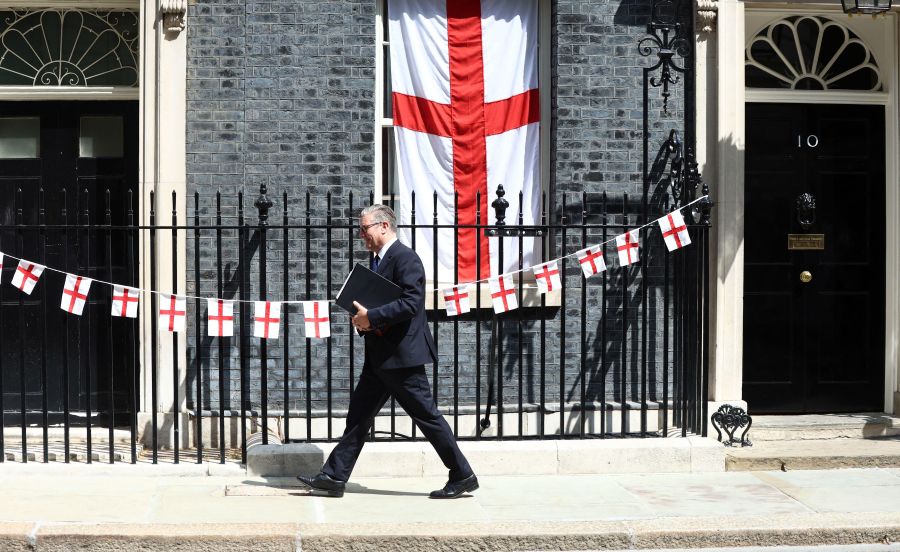
(Semi)-final curtains. Keir Starmer leaves No.10 for his last PMQs session © Sipa US / Alamy Stock Photo
For a man who genuinely loves football, Keir Starmer has always struggled to show this human side, even though it should have come naturally. And so, it is undeniably poetic that his career came to an end the same week as England’s World Cup hopes came crashing down, denying him the chance to jet out to New Jersey for the final. In a coronation so smooth and without dissent it would have made the Chinese Communist Party blush, Andy Burnham was made leader of the Labour Party today, having been nominated by 379 of the party’s 403 MPs earlier this week. The Parliamentary Labour Party suddenly begun to speak of the outgoing PM like an elder statesman, with Cabinet praising him and gifting him a carriage clock. At his final PMQs, Kemi Badenoch, slyly, acknowledged his strength when she joked that it was “a tribute to him that not a single sitting Labour MP could beat him”, while Ed Davey praised him as a “true patriot” and a fellow former carer. True to form, Starmer spent his final days as leader abroad, attending a final Coalition of the Willing summit in Paris (where President Macron bestowed the Legion d'honneur upon him) and visiting Ukraine to meet with President Zelenksyy and assure him of the UK’s continued support (where he was awarded the nation’s Order of Freedom). Starmer led Labour to an electoral victory that was unimaginable a decade ago, but in the end, as much as many people would like it, even a war with Argentina wouldn’t have been enough to save him.
In his victory speech, Andy Burnham echoed the mealy-mouthed plaudits that have been paid to Starmer, before setting out his vision of the sunny uplands that he will transform the UK into. Sadly, there was still little detail, although it is expected his new government intends to hit the ground running with announcements next week. He set out his five promises for governing: (1) stopping Labour infighting; (2) building a “new politics” by fixing the “big things" that politics has "neglected"; (3) working with other parties, but in a “distinctively Labour” way; (4) leading for all of the UK; and (5) taking power back from Westminster. Some might call it inspirational – others a continuation of the vibes-based politics that has carried him into the top job without scrutiny. The lack of detail is hardly surprising considering Burnham has yet to settle on his Cabinet, with media outlets of all viewpoints and persuasions at a loss as to who will get a seat at the table (apart from maybe the chancellorship, which is thought to be in Shabana Mahmood’s bag). Roll on a new week, and a new government.
22/30 – Number of football matches the England men's football team have won (so far) during Keir Starmer's tenure as Prime Minister
0.1% – Economic growth in May according to the ONS' latest GDP figures.
12,439 – migrants who have crossed the Channel in small boats so far in 2026, the lowest figure at this point in the year since 2021.
1 – vote cast for Catherine West MP in the Labour leadership election by Neil Coyle, despite Catherine West supporting Andy Burnham.
19% – proportion of students in England reported as being persistently absent (missing at least 10% of lessons) over the course of the last academic year.
£5,000 – new maximum fine for fly-tipping, after it was increased by 400% this week. Those littering can also be fined £750 now – double the previous penalty.
80 – written ministerial statements issued by the Government in four days this week… which could very well be a record.
8 – days in July the temperature in the UK has exceeded 34°C, more than the previous record-holding years of 1976 and 2020.
745 – days Keir Starmer will have served as Prime Minister when he resigns on Monday.
Reform UK’s Immigration and Justice Spokesperson and former Conservative Minister, Ann Widdecombe, was found dead in her home in Devon on 9 July. The cause of death has since been ruled a homicide, with the case subsequently being taken over by counter-terrorism police this week. Counter-terrorism police have said that the attack was “targeted” and a warrant has been obtained to hold a 28-year-old suspect for up to seven days, while detectives work to understand the motive. Many MPs across Parliament paid their respects to Widdecombe, including Starmer in his last PMQs, where he called for her to be honoured with a shield in Parliament, similar to Jo Cox and Sir David Amess.
While the press contemplated who the next Chancellor would be, Rachel Reeves delivered her potentially last Mansion House speech this week, in which she reflected on her achievements over the past two years in the post, suggesting that her record has shown "radical change is possible" when governments "combine radicalism with credibility". Addressing the crowd, she announced the publication of the Transatlantic Taskforce on Markets of the Future's recommendations and provided an update on progress over the last year under the Financial Services Growth and Competitiveness Strategy.
Full steam ahead with local government reorganisation plans, as the Government confirmed plans to streamline two-tier councils in a further 14 areas, with the reforms to see 134 councils streamlined into 38 unitary authorities. Additional funding to support reorganisation was also announced, as, in addition to the £63m capacity funding and £900,000 transition support funding to each new unitary, £150,000 has been committed to each new unitary as supplementary funding for Leadership Capacity and Continuity in Children’s Services, Adult Social Care and Public Health. The Government also confirmed that it still plans to hold shadow elections for unitary councils in May next year.
More leaseholder protections are on the way, as the Government confirmed it will proceed with a series of measures to increase transparency around costs and rebalance the system. The changes, which are expected to come into force as soon as 2027, include requiring landlords to provide an annual report to leaseholders on the health and condition of their building, and implementing a new service charge demand form that sets out detailed information about service charge payments and what they will cover.
British Steel has officially been taken into public ownership, after the Steel Industry (Nationalisation) Act received Royal Assent. A newly appointed team of Non-Executive Directors is expected to stabilise operations on site, manage health and safety effectively, maintain production, and work closely with management, trade unions and staff on proposals to make British Steel a commercially sustainable, low-carbon enterprise.
Mayor of London Sadiq Khan, soon to be Lord Kahn (more on that below), announced the draft London Plan, which aims 'to unlock more affordable housing, deliver good growth and support the industries that will be crucial to London’s future economic success'. The plan aims to create space for data centres and economic clusters for industries, help to strengthen the Central Activities Zone, reinforce the West End’s position as a global destination for retail, culture, entertainment and tourism through the transformation of Oxford Street, and help to deliver as many as 558,000 new homes by 2037.
The Government announced that the House of Lords will be gaining 26 new members through political peerages, including 16 new Labour Peers, 5 new Liberal Democrat Peers, 3 new Conservative Peers and 2 Crossbench Peers. Notable names on the list include Mayor of London Sir Sadiq Khan (Labour), National Chair of the Federation of Small Businesses Martin McTague (Labour), Deputy Mayor for Policing and Crime in West Yorkshire Alison Lowe (Labour), former Chief Executive of the Food Standards Agency Tim Smith (Labour), Former Chief of the General Staff General Sir Patrick Sanders (Conservatives), Former Lord Justice of Appeal Sir Brian Leveson (Crossbench), and former Cabinet Secretary Sir Chris Wormald (Crossbench).
16 and 17-year-olds will receive new protections online, with social media platforms required to introduce default overnight curfews from midnight to 6am and switch off features such as auto-scrolling by default. The measures build on the planned social media ban for under-16s, to help avoid a “cliff edge” in protections as young people get older.
Under-16s are also set to be banned from buying high-caffeine energy drinks, with drinks containing more than 150mg of caffeine per litre set to be banned in England from April 2027, following evidence that they can negatively affect children’s physical and mental health, as well as education. The ban will cover sales in shops, vending machines and online. And when they turn 16, they will be given the right to vote…
The second phase of Awaab’s Law will come into force on 30 November 2026, requiring social landlords to act faster on serious housing hazards, including electrical faults, structural defects, fire risks, extreme temperatures and pest infestations. Landlords will be required to investigate and address these issues within 24 hours, while hazards that are serious but not immediately dangerous to be investigated within 10 working days, with written findings provided within three working days, urgent safety works completed within five working days, and longer-term repairs started within 12 weeks.
The Welsh Government announced the first phase of its legislative programme, with new Bills planned on issues ranging from renters’ rights and community ownership to climate action, water control and Welsh taxation. The programme will also include measures to establish a Community Right to Buy Scheme, strengthen support for rural communities and reform Welsh Tribunals. Separately, its spending plans hit a bump in the Senedd after Labour refused to back its First Supplementary Budget 2026-27, with Plaid Cymru warning that it would delay funding for measures including NHS waiting list reduction, childcare expansion, free school meals, social housing and school repairs.
A landmark agreement between the UK and EU is set to give British defence firms access to contracts funded through the EU’s £78 billion Ukraine Support Loan initiative. The deal will allow UK companies to bid for procurement contracts, unlocking potential investment, supporting skilled jobs and strengthening the UK’s defence industry. The agreement, described as a “significant step forward” in UK-EU defence cooperation, will now require ratification by the European Council.
The UK-EU Treaty on Gibraltar has also been signed, bringing an end to years of uncertainty over post-Brexit border arrangements and setting out new measures to ease checks and delays for people and businesses. The Government said the deal will provide greater economic and trade certainty, safeguard British sovereignty and UK military operations, and open up new opportunities for flights and economic growth.
The UK and Switzerland signed a new Free Trade Agreement, with the deal expected to unlock an estimated £5.2 billion a year in additional UK services exports in the long run. The agreement will also make travel easier, with UK nationals set to access Swiss e-gates from the end of 2026, alongside plans to include surcharge-free mobile roaming and visa-free travel for UK services professionals visiting Switzerland for up to 90 days a year.
School’s out for summer in the House of Commons, but just before the doors were locked and the lights were turned off, Keir Starmer stood at the despatch box for his final ever PMQs, where he received a flurry of cheers and tributes from across the House. The week also saw a statement on the shocking death of Ann Widdecombe, as well as discussions of problems facing the energy grid and the situation in Iran. This last debate nixed a Conservative plan to use the allotted time to force a vote on making the Commons sit next week, thwarting an opportunity to grill Andy Burnham in his first days as (presumptive) PM. Despite this disappointment for the Tories, MPs found time to approve a number of Lords’ amendments to the Steel Industry (Nationalisation) Act, with the legislation receiving Royal Assent on Wednesday. In addition, the Immigration and Asylum Bill passed its second reading, and the Public Office (Accountability) Bill, also known as the Hillsborough Law, was approved by the House.
Legislation moved quickly in the House of Lords, despite Peers sitting for another week after their counterparts on the green benches have hurried off. They also signed off on the Steel Industry Bill, saw the Civil Aviation (Consumer Protection and Regulatory Reform) Bill and the Sporting Events Bill through their report stages, and completed the second reading of the Cyber Security and Resilience (Network and Information Systems) Bill. Somehow, they also found time for questions on AI, shipbuilding, and a timely discussion of setting a maximum temperature for all indoor workplaces.
Select Committees continued to publish ahead of recess, with the Justice Committee putting out a report warning that ‘access to justice in England and Wales has been severely eroded by the declining availability of legal aid’. Meanwhile, the Education Committee used a new report to emphasise the importance of reading for pleasure, arguing that it demonstrably ‘improves academic attainment, mental health and wellbeing, development of empathy and much more’. The Food and Weight Management committee also set out its recommendations for fixing the food environment, while the Public Accounts Committee released reports on unlocking land for housing and on Government shared services, and the Women and Qualities Committee addressed black people’s experiences of homelessness.
We suppose it’s only right to head up a section on key movements with the biggest political change of the last two years – the departure of Keir Starmer as leader of the Labour Party and the “coronation” of Andy Burnham as the Party’s new leader. He is set to become PM on Monday, exactly one month after being sworn in as an MP.
The outgoing PM couldn’t resist slipping out a final u-turn before his departure, as he announced 26 new Peers under his list of resignation honours, despite pledging as Opposition leader that he would never do so. Among those receiving peerages are: London Mayor Sir Sadiq Khan, FSB Chair Martin McTague, former Cabinet Secretary Sir Chris Wormald, retired senior judge Sir Brian Leveson, former Unison boss Christina McAnea and former Food Standards Agency CEO Tim Smith. The full list can be viewed here, comprising 16 new Labour Peers, 5 Lib Dems, 3 Conservatives and 2 Crossbench Peers.
Michael Dugher was announced as the Government’s Music Champion, upon the launch of its new Plan for Music. Commencing from 13 July, this will be a year-long appointment with the opportunity for extension at the end of the term.
A new Interim Housing Ombudsman was appointed to support social housing tenants, with Andrea Keenoy set to take up the role from 1 August. She will lead the service on an interim basis while the Government seeks a permanent replacement to succeed the outgoing Richard Blakeway.
Chief Executive of the Centre for Environment, Fisheries and Aquaculture Science Neil Hornby was appointed as the new Chief Executive of Natural England from Autumn, taking over from Marian Spain upon her retirement.
The Business Secretary confirmed Dame Jayne-Anne Gadhia’s appointment as the new Chair of the Financial Reporting Council for the next four years. She will bring to the role decades of experience across banking, financial services and consumer finance, having founded and chaired the fintech Snoop and previously acted as Chief Executive of Virgin Money for over a decade.
Kate Harrisson has been appointed His Majesty’s Trade Commissioner for China and Hong Kong, taking up the role in September. She joins from the FCDO, where she currently serves as Director for the Asia Pacific.
The Planning Inspectorate confirmed Graham Stallwood as its permanent CEO, having been in the role on an interim basis for six months.
Surgeon General of the UK Armed Forces Major General Phil Carter is set to take on the role of interim Chief Defence Medical, following the retirement of Air Marshal Clare Walton. The appointment is on a temporary basis while a permanent replacement is found.
DWP announced the reappointment of Brendan McCafferty as Chair of Nest, effective from 31 January 2027. Having served as Chair since February 2022, he will continue in post for a further two years beyond his initial five-year term.
The Lord Chancellor approved the appointment of Carrie Young as an Independent Member of the Judicial Pension Board, for three years from 9 June 2026; and Lynne Berry as the Chair of the Judicial Appointments Commission, for 18 months from 1 September.
Seven Non-Executive members were appointed to the Information Commission ahead of it taking over all the functions and responsibilities of the ICO to become the UK’s independent data protection regulator later this year. The new members are: former international media executive Laurie Benson, previous Interim Chair of Ofcom Maggie Carver, Stephen Cohen, Sukhvinder Kaur-Stubbs, Gary Kildare, Hilary Newiss, and former Director General at four UK Government Departments Scott McPherson.
The PM approved the appointment of Sir James Goss as Deputy Chair of the Security Vetting Appeals Panel, with effect from 7 May 2025 for a four-year period.
As the Starmer era draws to a close, there is seemingly little public sympathy for his time in Number 10, with new polling from YouGov showing that almost half of Britons (48%) believe the country is in a worse state than when Labour came to power in 2024, compared with just 21% who think it is in a better state. This came as Starmer had a busy week trying to cement something of a legacy, both abroad and at home, so it remains to be seen whether history proves kinder to Sir Keir.
Perhaps things won’t be smooth sailing for his successor either, as Britons already appear divided over the King of the North's plans to split his time between London and Manchester, according to new polling from Ipsos this week. While 45% believe Burnham should be based in London if he becomes Prime Minister, 35% agree that he should divide his time between the capital and Manchester, with just 5% saying he should be based in Manchester full time. Regional differences are particularly stark, with a small majority of those in the North (52%) supporting Burnham splitting his time between London and Manchester, compared to 58% of Londoners saying the Prime Minister should be based in the capital.
As climate diplomacy faces a continued period of uncertainty, analysis from Chatham House suggests that the global response to climate change is being reshaped rather than abandoned altogether. The report warns that slow progress in formal negotiations and limited movement at annual COP summits have led many to question their effectiveness. However, it also suggests that governments are increasingly working through smaller ‘coalitions of the willing’ alongside businesses, cities and financial institutions which perhaps goes more unnoticed. The success of COP 31 in November will therefore be measured ‘not only by new commitments, but by its ability to reinforce the international cooperation.’
Tuesday marked Day 3 of the Labour leadership nominations, and the end of unanimity towards Andy Burnham as Neil Coyle nominated backbencher Catherine West. Remember her? If you don’t, it was West who kickstarted calls for Starmer to resign way back in early May. It must be said Coyle can’t be known to be Burnham’s biggest fan, having previously described him as “King Nuisance.”
PMQs took an emotional turn as Keir Starmer stood at the dispatch box one last time, even the Opposition leader had nice words to say about him. However, with many minds firmly focused on football and the evening’s world cup semi-final, some pre-emptively asked if a bank holiday was on the cards should England win (the less said about that the better) and there was a quip from Phil Brickell to highlight that Andy Burnham’s beloved Everton finished 13th, 12 places behind Starmer’s Arsenal. But it was Graham Stuart who came up trumps, stating that Starmer had been “handed a red card by the 400 dodgy referees on the Benches behind him,” to which the PM was eager to stress he did not attempt to overturn Jarell Quansah’s red card from the Mexico game.
The Westminster rumour mill is often full of drivel, but this week gave us an absolute corker that even Donald Trump would have branded “fake news!”. The Guido Fawkes website posted on X on Thursday evening that former Health Secretary Wes Streeting had been “spotted crying in the lift down from where Burnham’s office is in Parliament”. It wasn’t long before Wes Streeting replied to note that he “wasn’t even present, let alone involved”; but wished his doppelganger well.