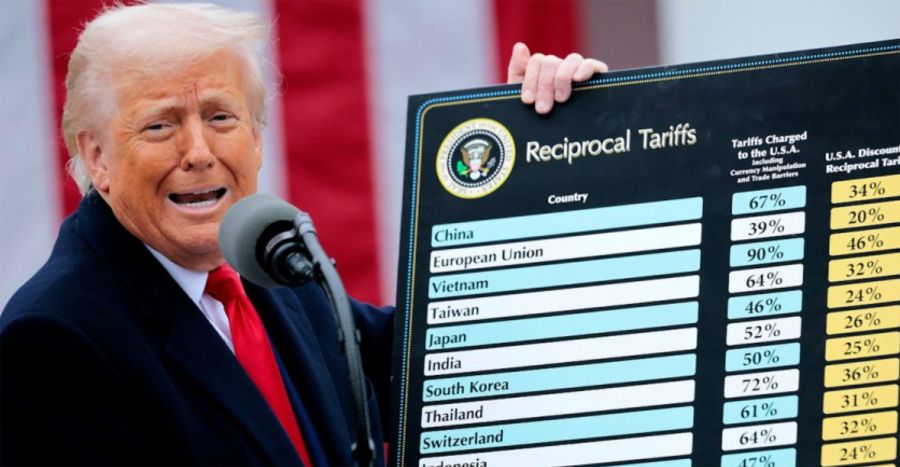
A little tough love: Donald Trump announces reciprocal tariffs in the garden of the White House on the 2nd April 2025, in a day he described as “One of the most important days… in American history” © Pictoral Press Ltd
Donald Trump started his second term across the pond with the Republicans stealing the headlines throughout 2025, yet in the UK, Labour’s first full year had its ups… and definitely its downs with a change in Deputy Prime Minister, a Cabinet reshuffle, tears in the Commons and a budget leak summing up what has arguably been a frantic year for Sir Keir and the Labour Party. Their struggles have not been helped by Reform, who have rocketed up the polls at a rate few predicted, from election challengers to Downing Street hopefuls. With Farage continuing to frustrate the Prime Minister in the polls, receiving record donations, and now overtaking Labour in party members, no one in Westminster can dismiss them as anything but a genuine threat at the next election. Reform’s rise and the widening of the Overton Window (a phrase that’s been fired back into the political lexicon at great speed this year) summarises a global cultural shift in 2025, with rising polarisation on both the left and right and the growth of populist and far right movements. It’s been a frantic year for a party that received the biggest majority in the Commons in 27 years, with their eyes fixed nervously on the next election. At least for now all of Westminster can take a break. If 2026 is anything like this year, we’ll all need it…
Jan: 24.6 million – number of American viewers who tuned in for Trump’s inauguration, down from the nearly 40 million who watched Biden’s ceremony in 2021.
Feb: 13.4% – number of young people not in work, education or training at the end of 2024 – higher than at any point in the past 11 years.
Mar: 250,000 – number of people it was expected would be pushed into relative poverty due to changes in welfare reforms announced in the Spring Statement.
Apr: 145% – level of tariffs imposed by the US on Chinese imports. China retaliated with 125% tariffs on US goods.
May: 500 – total number of extra prison places created during the entire 14 years of Conservative Government it was revealed, despite the soaring prison population.
June: 1,340 – number of written parliamentary questions answered in one day in June... the highest on any day in at least the last five years.
July: 26% – proportion of obese adults in the UK.
Aug: $3.4 trillion – increase in the total budget deficit resulting from the “One Big Beautiful Bill” predicted by the US Congressional Budget Office over the 2025-2034 period.
Sept: 46% – ministerial roles that changed hands in the September reshuffle – just over a year since the Government took office.
Oct: 108 – years since a member of the British Royal Family lost his status as a Prince… when the Crown Prince of Hanover Ernest Augustus (who until 1915 was also the Duke of Cumberland) was de-princed by King George V for backing Germany in the First World War.
Nov: 942 – number of amendments laid in the House of Lords ahead of the Assisted Dying Bill’s committee stage.
Dec: £8.3bn – additional taxes UK workers will pay each year, after income tax thresholds were frozen for a further three years from 2028.
Back in January, Elon Musk went after Farage and Starmer in a five-day frenzy on X. When Musk, who had been a vocal supporter of Farage and Reform went from posting in December that Britain “absolutely” needs Reform UK, to tweeting on January 5th that Farage “doesn’t have what it takes”, many were left wondering, why the change of heart? Farage suggested a disagreement over Musk’s support for far-right activist Tommy Robinson was to blame. At the same time Musk was also tweeting that Home Office Minister Jess Philips “deserved to be in prison” over the Government’s response to grooming gangs. The billionaire’s interventions in UK politics eventually petered out, only to reignite in September when he told a far-right rally in London by video message to “fight back or die”.
In February, President Trump was invited to the UK for a second state visit, as the Prime Minister used his trip to the White House to present Trump with an invitation letter from King Charles. Calling Trump’s 2019 visit a “tremendous success” and the invite for a second “unprecedented” and “historic, Trump accepted and thanked the King who he described as a “beautiful man, a wonderful man”. Second-term US presidents are not usually offered a state visit yet at the time, the PM was using every tool in his shed to secure a deal with the US and a foothold into Trump’s influence in Russia’s invasion of Ukraine.
In March, well before the Budget debacle, the OBR downgraded their predicted growth for 2025 from 2% to 1%. Forecast estimated growth for the next four years was increased, to 1.9% next year, 1.8% in 2027 and 1.7% in 2028 (but downgraded to 1.4% then 1.5% at the Budget). The Chancellor used the Spring Statement to set out her plans for the UK economy including significant welfare reforms and major cuts to disability benefits like universal credit… only for the Prime Minister to undertake a pretty epic U-turn a couple of months later after backlash from his own backbenches.
In April, “Liberation Day” saw President Trump impose reciprocal tariffs on all countries not subject to other sanctions. A minimum 10% tariff was put on almost all US imports, with the UK also receiving a 10% tariff on top of existing US duties, fees and taxes on imports from the UK. Panic created by the announcement led to the largest global market decline since the 2020 Covid stock market crash, with the S&P 500 declining 4.88% by April 3rd, the second largest daily point loss ever. Overall, the US has collected more than $200 billion in tariffs this year because of the more than 40 executive orders put in place by the Trump Administration.
May Day, May Day: Reform made big gains in the local elections proven themselves a real challenge to both Labour and the Conservatives. Reform won 677 out of 1,600 seats across mainly Tory-held councils that were last contested in 2021. The party won control of 8 councils from the Conservatives including Kent and Staffordshire, as well as Doncaster – the only council Labour was defending. The Tories, who had been anticipating big losses, ended up losing 676 seats and control of all 16 authorities they were defending, with Kemi Badenoch acknowledging the “bloodbath” for her party, and the “long journey ahead”.
In June, the 51st G7 summit took place in Canada with leaders Keir Starmer, Donald Trump and Ukraine’s Volodymyr Zelenskyy attending. Issues (seemingly) agreed on included prosperity and security in Ukraine, peace in the Middle East and support for a lasting peace in Sudan and the DRC. Starmer and Trump used the summit to announce a “US-UK Economic Prosperity Deal” reducing tariffs on UK automobiles from 27.5% to 10%.
In July, Rachel Reeves’ tearful appearance at PMQs raises big questions at the top of Government. After the spectacular unravelling of the government’s plans for the benefits system, Reeves was under huge amounts of pressure, but none expected the Chancellor’s tears to be live-streamed in the most public way possible, sitting next to the Prime Minister on the frontbench of the House of Commons. In somewhat chaotic scenes that followed, the Government tried to brush it off as a personal matter, while multiple cabinet ministers seemed to contradict Downing Street’s messaging that this was the only reason.
In August, a usually quiet summer recess was shattered by allegations Angela Rayner had underpaid stamp duty by £40,000. The allegations first became public on the 28th of August when the Telegraph alleged the Deputy Prime Minister had legally structured her property arrangements to minimise her tax liability by £40,000, and had used NHS compensation money from a trust set up to care for her disabled son to purchase her apartment in Hove. Eventually, following the publication of Sir Laurie Magnus’s report that concluded she had not met the “highest possible standards of proper conduct” she announced her resignation from the Government and forced the Prime Minister into an early reshuffle.
In September, Zack Polanski stormed to victory in the Green Party’s leadership elections promising to become a mass membership “eco-populism” movement, to directly take on Reform UK. Polanski – the party’s deputy leader and a member of the London Assembly, defeated Adrian Ramsay and Ellie Chowns by 20,411 to 3,705 votes. Since his election, the Greens have brought the fight to Labour from the left, and an impressive performance at next year’s local elections will only put more pressure on Keir Starmer’s premiership.
In October, the PM joined 30 other world leaders for the Gaza Peace Summit in Egypt to discuss the next steps in the implementation of the Gaza peace plan, mainly aimed at the future governance of the Gaza Strip. The summit saw the signing of the “Trump Declaration for Enduring Peace and Prosperity”, but was criticised for being too simplistic and offering a lack of detail on how to achieve regional peace agreements, with some analysts arguing that the whole summit was largely symbolic and offered no substantial peace deal.
In November, the OBR was back in the headlines for leaking Reeve’s second budget, appearing online an hour before she was set to announce it. The Chairman of the OBR Richard Hughes resigned, citing the organisation’s “worst failure” in its 15-year history. In the actual budget itself, the Chancellor focused on the cost-of-living crisis by scrapping the two-child limit on Universal Credit from April 2026, and increasing the National Living Wage to £12.71 per hour, whilst freezing personal allowances and introducing a smorgasbord of additional taxes that led Conservative Party Leader Kemi Badenoch to brand it a “Budget for ‘Benefits Street’, paid for by working people”.
And finally, in December, Reform UK claims to have the largest party membership in the UK after a report in The Times alleged Labour’s membership has fallen to below 250,000. With Reform’s internal figures claiming it has over 270,000, the party has more than doubled its membership in 2025, as it storms ahead in the polls in the lead up to the local elections in May next year.
In amongst the chaos, resignations and leaks, there have genuinely been some quite eye-popping and [insert palm face emoji] moments in 2025, which we’ve enjoyed rounding up each week. Here are a few of our favourites from this year…
From January: Keir Starmer has had a rather eventful first week back in Parliament, with Elon Musk reportedly discussing ways to oust him before the next election and Liz Truss hoping for a 2025 rebrand by sending him a cease and desist letter, demanding that Starmer stops claiming that she crashed the economy. The former PM’s lawyers argue that the statement is “false and defamatory” and even suggest that it contributed to Truss losing her seat as the MP for South West Norfolk in July. However, her mini-Budget disaster has already been mentioned 11 times by MPs and Peers speaking in Parliament this week so they might need to send out a few more letters…
From May: Move over Bruce Wayne, there’s a new capped crusader in town, and he aint messin’. In scenes reminiscent of a Ross Kemp on Gangs documentary, Shadow Justice Secretary Robert ‘Bobby J’ Jenrick took on fare-dodgers at East London’s Stratford Station this week in a video clip that makes you question if you’ve ever seen the Tory leadership hopeful and Gotham’s infamous masked vigilante in the same room at the same time…? Barrier-hoppers weren’t his only target, as he took aim at bike thieves, phone snatchers, tool thieves, shoplifters and… “weird Turkish barber shops… chipping away at society”. The TSSA Union responded to criticise the Conservative MP for ‘inappropriate’ and ‘dangerous’ behaviour in the name of political point-scoring on the underground (define irony…); However perhaps even more ironically, it turned out the MP for Newark – who one Times reader described as a ‘mix between Alan Partridge and a suburban Batman’ (h/t John Hind) – hadn’t received permission to film on TfL property. Jenrick’s response? – Sue me.
From July: Ever wondered how the Leader of the Opposition keeps her head in times of stress? The New Stateman this week claimed to have the answers, having allegedly seen a notebook with Badenoch’s handwriting from a post-election Shadow Cabinet meeting last year. Sharing a few of the affirmations on the pages, the magazine details that under the heading “personal improvement” phrases like “breathe, breathe, breathe”; “you are a serious person who does big things” and “pivot to attacking Labour when uncomfortable” can be found. One to keep hold of for the next PMQs, eh?
From November: It’s reassuring to know that even as Prime Minister, you can still get told off by the headteacher. During a visit to a primary school in Peterborough with Education Secretary Bridget Phillipson, Keir Starmer was reading with pupils when one of them noted that they were on pages 6 and 7. (For those of you with children on social media, you know where this is going.) The father of two then mimicked the viral “6–7” meme, which involves a juggling hand gesture, resulting in many of the children laughing and following suit. He was promptly told off by the headteacher, who noted that the pupils “get into trouble for saying that”, prompting the Prime Minister to sheepishly insist: “I didn’t start it, Miss.”
From the whole year: Your Party.
A big thanks to Monty Taylor who joined the Navigate Politics team on work experience this week for his brilliant work helping to pull together this year in review.