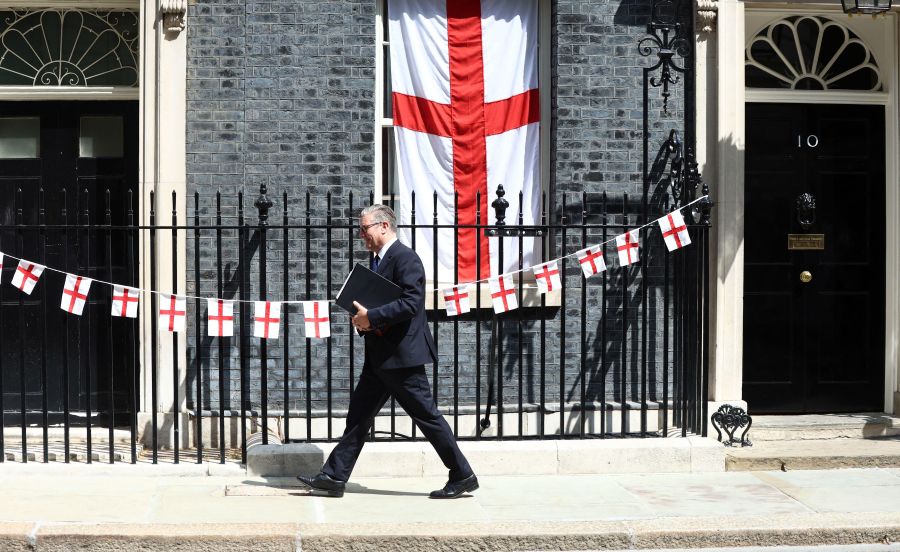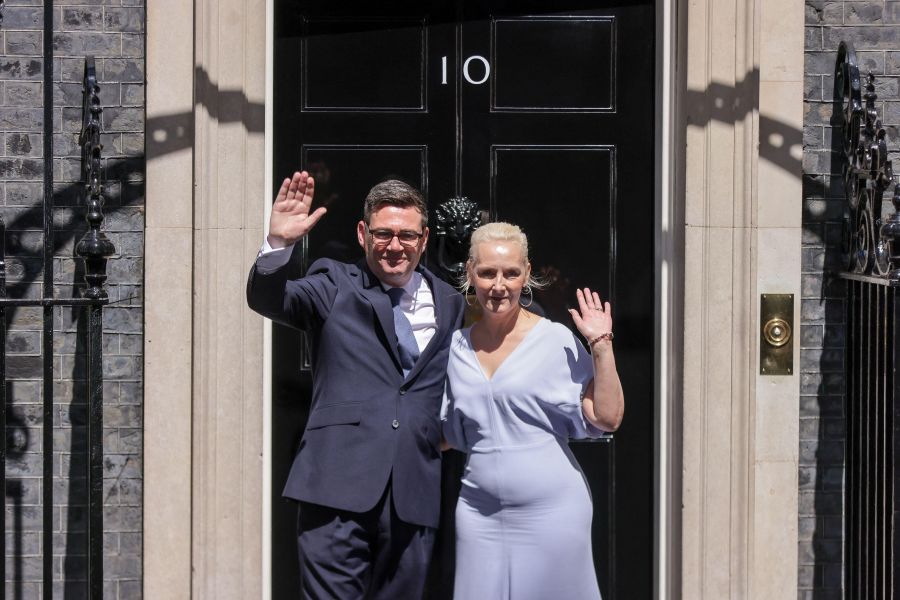
Posing outside 10 Downing Street/the new gaff with his wife, Andy Burnham officially became the country’s latest Prime Minister on Monday, exactly four weeks after being sworn in as an MP. © SOPA Images Limited / Alamy Stock Photo
Andy Burnham became the UK’s seventh Prime Minister in a decade, meeting with the King on Monday to accept his invitation to form a government before delivering a speech outside No 10 (no podium in sight), where he set out his focus on ensuring stability, declared his intention to end rough sleeping, spoke about extending devolution, pledged to build more council housing, and said he would ensure “life’s essentials” return to strong public control. Soon after heading into No 10, Burnham had his first call with a foreign leader, speaking with US President Trump to offer to show him around Manchester, among other slightly more important topics like defence and security, and reindustrialisation. Trump also said the pair had discussed North Sea oil, although this was absent from Downing Street’s readout.
It might have taken all evening on Monday to finalise his Cabinet, but Burnham wasted no time pumping out announcements this week in a bid to help people with the cost of living – having told his Cabinet in their first meeting that he would seek to lead a “cost of living Government”. His first major announcement dropped early on Tuesday morning, promising a 5% VAT cut to household electricity bills from 1 October. This is expected to save households £45 a year, with the cost of this to be funded from the cancellation of the Digital ID programme… although this remains unclear, after Starmer ally Darren Jones took a swipe at the new administration as he claimed the Digital ID programme was unfunded and that ‘the Government will have to set out how it will pay for its new policies at the Budget.’ Also announced so far this week: a cap on single bus tickets at £2 from 1 January 2027 for the rest of the year, funded through a ‘reprioritisation’ of DESNZ’s budget; a 20% cut to business rates bills for pubs, clubs and live music venues, funded through reviewing reliefs for businesses that ‘do not make a positive contribution to local communities’ like vape shops; and a pause to the prisoner early release scheme.
Who will be tasked with delivering Burnham's agenda? By late Monday evening, the shape of his Government was becoming clear. The first arrival at Downing Street was former Defence Secretary John Healey, who was quickly installed as Chancellor in what appears to have been a careful balancing act by Burnham, avoiding upsetting either the Miliband or Mahmood camps too heavily. Both nonetheless secured senior roles, with Ed Miliband appointed Foreign Secretary (a role his brother was rumoured to be eyeing; some things never change) and Shabana Mahmood retained in the Home Office brief. Two familiar northern faces also made a return to the Cabinet table: Angela Rayner resumed her former role as Housing Secretary, while Louise Haigh emerged as one of the night's biggest winners, taking on the roles of Cabinet Office Minister, Chancellor of the Duchy of Lancaster and First Secretary of State, a position last held by Dominic Raab in 2021. Former leadership hopeful Wes Streeting was moved to Defence, while Dan Jarvis, who succeeded Healey following his resignation and was tasked with delivering the Defence Investment Plan, was returned to his former role as Security Minister. Yvette Cooper, having previously occupied both the Foreign and Home Office portfolios, appeared to take a step down the ministerial ladder as Health and Social Care Secretary, while Alex Norris was elevated to Justice Secretary, Angela Eagle became Environment Secretary, and Miatta Fahnbulleh was handed the Energy Security and Net Zero brief. Deputy Labour Leader Lucy Powell will return to Cabinet after winning the deputy leadership in 2025, taking on the Education portfolio, with Bridget Phillipson moving to Women and Equalities.
Spare a thought, meanwhile, for those not making the return journey into government. Rachel Reeves reportedly declined the offer of a ‘big role’ (rumours suggest Defence or Education Secretary), while David Lammy, Steve Reed, Peter Kyle, Jo Stevens, Hilary Benn and Liz Kendall all departed the front bench, making way for Burnham's new administration.
It’s all change at the top, as Andy Burnham rewarded his supporters, placated his opponents and banished Starmer’s ultras from the top table. As such, we’ve explored how Andy’s new appointments to Cabinet might make their mark on their new departments:
John Healey’s appointment as Chancellor took almost everyone off guard, but his reputation for pragmatism and general lack of factionalism could serve Burnham well. Ending up with his hand on the tiller, after his high profile spat with the Treasury over the Defence Investment Plan which led to his ultimate resignation as Defence Secretary last month, is a stunning turnaround that Burnham surely intends as a signal that defence will not be neglected, as some of his detractors had sought to argue. His intense loyalty to Starmer (before his explosive resignation) may have also drawn him to Burnham’s attention as he sought a solid frontman to head No. 11. Those with a longer memory will recall Healey’s pre-defence career, when he served as a Treasury minister for five years in the 2000s. This solidified his reputation for managerialism, but little is known about his economic outlook, although in his first statement this week he said his five priorities were fiscal control, delivering "growth in every postcode", supporting the nation through public procurement, wealth creation, and reducing the cost of living.
Ed Miliband’s move to the Foreign Office is an interesting one, potentially mollifying him after he was denied the chancellorship following intense briefings by his opponents that such a move would be anti-business. It also removes him somewhat from policymaking, which could serve Burnham well as Miliband’s commitment to the energy transition has become a key attack line for the Conservatives and Reform. His most famous (or infamous) move on foreign affairs was during his days at the Labour helm, when in 2013 he opposed the UK’s involvement in bombing the Assad regime in Syria after it gassed hundreds of its own people. In a butterfly effect he surely couldn’t have foreseen, this not only caused the vote to fail in the House of Commons but led to President Obama pulling back from his own strikes, which in turn emboldened Assad and gave Russia a free hand to support the regime. More recently, he pressed Starmer to recognise Palestine and was reportedly a key voice against any UK involvement in the US and Israel’s war with Iran.
Louise Haigh’s return to government as Chancellor of the Duchy of Lancaster (head of the Cabinet Office, in modern parlance) is an impressive turnaround for someone who was forced to resign as Transport Secretary 18 months ago over the phone fraud saga. Although Starmer clearly regretted seeing her go and implied he would like to see her return in the near future, she would never have risen this far had she not hitched her horse to Burnham’s carriage. As the Cabinet Office functions as the nerve centre of government, a close ally of the PM is needed to run it (her predecessor, Darren Jones, became one of Starmer’s closest allies), and Haigh looks set to fill this role. She’ll also have slightly less on her plate to think about than originally planned, after Burnham scrapped the Digital ID scheme and responsibility for Government fraud was quietly moved out of the Cabinet Office…
Jonathan Reynolds returns as Business Secretary, heading the beefed-up Department for Business, Innovation, Science and Trade after the Department of Science, Innovation and Technology was dismembered. He will pick up where he left off as Labour pushes advancements on workers’ rights and industrial policy, but also face new issues since he left office, such as the nationalisation of British Steel and the perennial issue of high industrial energy costs. Assuaging the concerns of the science and tech community after the abolishment of DSIT will be high up his list of priorities, as the UK seeks to navigate the dominance of American tech suppliers and ever-advancing AI models. Reynolds insisted DSIT’s abolition in no way reflected a de-prioritisation of tech, arguing it will be “at the forefront” of DBIST.
Wes Streeting’s appointment as Defence Secretary was one of the most left field appointments, with Streeting’s apparent lack of defence knowledge leaving many wondering if such a move undermined Burnham’s pro-defence appointment of Healey as Chancellor. In his first speech in the role at Farnborough International Airshow, he suggested he would carry over his attitude of departmental “reform and modernisation” from the DHSC to the Ministry of Defence to justify the planned increases to defence spending over the next decade. Perhaps Burnham feels he can bring a managerial approach to the MOD as Healey oversees increased spending; but as we’ve learnt over the past few months, Streeting tends to dance to his own tune.
Yvette Cooper’s move to the Department for Health and Social Care casts her out of the great offices of state for the first time since Labour won the 2024 election. Some detractors suggest she failed to make an impact on major issues such as immigration while Home Secretary, and her subsequent appointment as Foreign Secretary cut her from policymaking somewhat. Streeting’s record at DHSC, including on ending junior doctor strikes and overseeing a fall in waiting lists, means that comparisons will inevitably be made. However, she isn’t entirely ignorant of the department – her first ministerial position in 1999 was as a junior health minister…
Angela Rayner made a triumphant return to the Ministry of Housing, Communities and Local Government following her resignation last year, allowing to pick back up on her priorities there, including on renters’ rights, leasehold and building safety. Her focus on social housing aligns with Burnham’s pledge to deliver the largest council housing building programme in history, as opposed to Starmer’s focus on planning reform to deliver more market-rate housing. Despite having overseen the journey of the English Devolution Act through Parliament, she will be able to focus more on these issues as responsibility for devolution has been shuffled to the Cabinet Office and No.10 North.
Miatta Fahnbulleh’s promotion to the Department for Energy Security and Net Zero sees her as one the biggest winners of the reshuffle, as the only new 2024 intake MP to become a Secretary of State. An ally of Miliband’s, Fahnbulleh was an economic advisor to both Ed Miliband and Angela Rayner in the run up to the 2024 election and served under Miliband as Energy Consumers Minister in DESNZ after being elected. A former Chief Executive of the New Economics Foundation, Fahnbulleh occupies the soft left of the Party and has consistently campaigned for further action to tackle the climate crisis. Seemingly a strange choice if one is to believe the media reports that Burnham wants to increase oil and gas drilling, Fahnbulleh is widely expected to continue the same rhetoric that Miliband pursued in the Department.
Angela Eagle returned to the Department for Environment, Food and Rural Affairs, having served as Food Security Minister for nine months from September last year. A seasoned politician, the Environment brief is relatively new to Eagle, who, prior to her appointment as a Defra Minister, only mentioned the word “farming” three times in the Commons in over 30 years. However, in the short time Eagle was in Defra, she made her mark through introducing the new Sustainable Farming Incentive and showing support for initiatives like campaigns to introduce the Good Food Bill. With Burnham’s focus on the water industry and ambitions to lower the cost of living for essential goods, Eagle will have plenty to focus on.
Alex Norris was promoted from the Home Office, where he oversaw illegal migration, to Justice Secretary, taking over from David Lammy. Norris will immediately have to grapple with the two separate but related issues that have bedevilled the MoJ since Labour took office: the huge national court backlog, and the prison capacity crisis. Norris has not been helped on the latter by Burnham’s move to pause the next round of planned prisoner releases, and, with magicking new prisons into existence not an option, will somehow have to think of a new way of avoiding a total collapse of the prison system.
Lucy Powell’s arrival back to the Cabinet as the new Education Secretary sees her take over a role she shadowed in Jeremy Corbyn’s Labour Party. During the nine months Powell held the Shadow role, she opposed plans to make every state school an academy and advocated for greater investment into post-16 skills. The state-educated Mancunian enrolled at Oxford University to study Chemistry, but moved to KCL a year later, stating she felt like “a duck out of water” at the former. As a backbencher, Powell referred to spelling tests for Primary School children “draconian” and urged teachers to focus more on children’s creativity.
Although she is not overseeing a department, Anneliese Midgley will attend Cabinet as the new Chief Whip, where she will be responsible for overseeing Burnham’s new, conciliatory approach to keeping his troops in line (we’ll see how long that plan survives contact with reality when the Commons returns from its summer recess). Midgley, a relatively obscure backbencher who was only elected in 2024, was a senior trade union official and has long been close to Burnham, serving as one of his best-placed supporters in Parliament as Starmer’s premiership collapsed. Having navigated Burnham into power, she and Louise Haigh are now the two most powerful women in Westminster.
$37.5bn – amount the Iran war has cost the US so far, an increase of nearly $8bn since the last estimate in May
300 – recommended size of No 10 North’s workforce within the next 18 months
60 – countries hit with new Trump tariffs of at least 10%, including the UK
£16,876 – Angela Rayner’s ministerial severance package that she will not be paying back despite returning to the same post
1/3 – average increase in drop-off fees at UK major airports since last summer
74 – nations competing at the 2026 Commonwealth Games in Glasgow
5% – tourist tax introduced by Edinburgh on overnight stays, coming into force today
Andy Burnham worked his first day at his No.10 North, chairing a meeting of the National Economic Council alongside senior ministers and regional mayors, focused on devolution and how it can ensure it creates a better Britain. Education Minister Lucy Powell and First Secretary of State Louise Haigh are expected to work out of No.10 North on a regular basis.
Kemi Badenoch delivered a speech to tell the new Prime Minister that he was thinking “too small” with his energy relief and bus fare cap, and not going far enough to help those that are working hard and not feeling the benefits. In her speech, Badenoch raised concerns that Burnham was yet to outline where the funding for his policies would come from, whilst also arguing that cuts in business rates were not enough, nor covered enough types of businesses. She also queried where Burnham was going to find his extra £8bn in defence funding, and whether a failure to do so would lead to new Chancellor John Healey resigning from a Cabinet post once again. Additionally, she argued against the nationalisation of Thames Water as this would not build any new reservoirs, nor pipes, and instead shift further costs onto the taxpayer.
Sadiq Khan launched his Home Energy Saving Fund through a £58m investment that is set to improve the energy efficiency of up to 5000 homes across the capital, aiming to save residents up to £500 a year on their energy bills. More efficient homes are expected to keep the homes cooler as summers get warmer and make it ‘more affordable’ to heat homes in the winter months.
The Welsh Government launched their National Food Strategy, setting out how Wales is going to ‘transform the way it thinks about food.’ The Strategy’s Export Working Group will be chaired by Simon Wright, who owns Wright’s Food Emporium in Llanarthne, helping to identify what works well and where gaps exist. The strategy will aim to ensure that food policies work better together to support producers, and ‘reinvest more of the value of Welsh food in Wales’ to promote healthy eating.
An open letter was written to Andy Burnham by millionaires, including ex-footballer Gary Lineker, screenwriter Richard Curtis and musician Brian Eno, asking for themselves, and other millionaires to be taxed more. The letter comes from ‘Patriotic Millionaires’ and argues that a 2% tax on wealth over £10m would lead to a more equal society, insisting that the geographical devolution Burnham is pledging can also exist in wealth.
Across the pond, US President Donald Trump hit the UK with a 10% trade tariff, alongside 59 other trading partners, including China and the European Union. Whilst you might remember that back in February the US Supreme Court struck down the President’s tariffs, he claimed that these nations have not adequately tackled forced labour. A UK Government spokesperson insisted that significant work is done to ensure UK businesses are not complicit in forced labour within global supply chains. Furthermore, as a result of King Charles III’s state visit in April, UK whisky will not be affected by the new tariffs.
Former Conservative Party Chairman Sir Grant Shapps had his application to stand in the next election declined by leader Kemi Badenoch. Shapps had also served as Home, Defence, Transport, Business, Energy and Net Zero Secretary during his 19 years as an MP, before losing his seat to Labour in the 2024 election. This comes as Badenoch pledged to not make “the mistake of the past,” citing the 250 MPs lost in 2024 election, and stated she wants those who “are going to meet the standards” of her new version of the Tories.
Andy Burnham hit pause on the Sentencing Act, that would have seen some prisoners in England and Wales released early after only serving a third or half of their sentence. Whilst the rest of their sentence would have had to have been served in the community, with punishment for reoffending a return to prison, the scheme drew criticism after the family of Thames Valley Police officer Andrew Harper, called the plans “deplorable” as his killers would have been eligible for early release in June 2027.
New Housing Secretary Angela Rayner ruled out rent controls in England, instead arguing that the Renters’ Right Act, which entered into effect in May, is “already having a significant impact on the market.” This is despite Andy Burnham calling for a freeze in private sector rent to deal with the cost-of-living crisis in 2023 whilst he was Mayor of Manchester. Rayner argued his comments were made at a time where the crisis in the rental market was more significant, and further stated that rent controls that have come into force in some parts of the UK haven’t necessarily had the desired impact.
The UK Space Agency announced access to more than £62m of Government funding for British businesses, universities and researchers to develop homegrown satellite communications and space technologies. This will aim to 'strengthen the UK’s ability to monitor and protect assets in orbit and access space-based services.’ The funding includes £42m for developing new British satellite communications technologies, and £20m to support space innovation projects in industry and at universities.
Edinburgh’s tourist tax came into effect today, meaning that those staying overnight in hotels, B&B’s and self-catered accommodation will be charged an extra 5%. The charge is expected to raise around £50m annually, and comes just ahead of some of Edinburgh’s biggest events, including its Fringe Festival.
Click here to download a high res. version of our latest Cabinet organogram.
Rounding up all the other Government movements this week, there were a few more changes to the Cabinet:
Hamish Falconer will sit in Cabinet as EU Relations Minister; and Kanishka Narayan and Matthew Pennycook have retained their portfolios as AI Minister and Housing Minister respectively, but will also now attend Cabinet. Joining them is Stephen Kinnock, the new Secretary of State for Wales and Chris Bryant, the Northern Ireland Office’s counterpart. Completing the Cabinet changes, Emma Reynolds moves back to Chief Secretary to the Treasury (stepping down from Defra) and Ellie Reeves becomes Attorney General.
It wasn’t just the Cabinet, as a whole load of Ministers were appointed, sacked and shifted around too:
Joining the Cabinet Office is Sally Jameson and Mark Ferguson; the FCDO welcomes Uma Kumaran and former Scotland Minister Kirsty McNeill; new to the Home Office are Anna Turley, Jo White and Satvir Kaur (who will also join MHCLG); while the MoJ welcomed Catherine McKinnell and welcomed back Alex Davies-Jones. Alongside this, Nic Dakin was appointed Senior Parliamentary Private Secretary to the PM.
Joining Rayner’s MHCLG is recent Chair of the Select Committee Florence Eshalomi, former Local Government Minister Jim McMahon, Simon Lightwood and Stephen Timms (who retains his position in DWP); Alison McGovern and James Frith have joined DHSC, while Paul Waugh is the newbie in DfE.
Fahnbulleh’s new DESNZ will see Blair McDougall and Polly Billington joining the team, with McDougall also in the new mega-department DBIST. Joining him is Anas Sarwar from Scotland (who will be installed in the Lords); and Lillian Greenwood moves from the DfT to DWP.
And breathe… DCMS is joined by Vicky Foxcroft and theatre director Ruth McKenzie (who will join Sarwar in the Lords); Justin Madders has entered DfT; Jenny Riddell-Carpenter is the only newbie in Defra; Melanie Ward joins the Scotland Office; Claire Hughes is in the Wales team and Sarah Owen will work with Bryant in the Northern Ireland Office.
Finally, Andy Slaughter has been appointed Solicitor General, while Emma Foody, Claire Hughes, Gregor Poynton, Shaun Davies, Uma Kumaran, Laurance Turner, Rachel Hopkins, Harpreet Uppal, Michael Wheeler, Liam Conlon and Sarah Coombes have all joined the Whips Office.
But the Government can’t have all the limelight… outside of Burnham’s dream team:
The Financial Services Ombudsman appointed Jenny Simmons as Chief Executive and James Dipple-Johnstone as Chief Ombudsman; Graham Stallwood became the Planning Inspectorate’s permanent Chief Executive; and the UK Sport Board welcomed four new Board Members – Michelle Dite, Charlotte Samuelson, John Steele and Dame Sarah Storey.
The Lords sat for a final week before joining MPs on their summer jollies. Before they rose, they completed their scrutiny of the Civil Aviation Bill and the Sporting Events Bill, and in the absence of the Commons, saw an urgent question on the Government’s pausing of the prisoner early release scheme.
Although recess has begun, the Work and Pensions Committee published a report on youth employment, education and training, which recommended that NI be cut for all workers under 25 to boost employment.
No. 10 North needs to be more than just a simple relocation if it’s going to transform how we govern, so concludes Re:State this week in its report on Andy Burnham’s new one-day-a-week set-up in Manchester. The report argues that success should be judged by how much power is devolved from Whitehall to local institutions, and proposes four core units focused on devolution, growth and investment, arm’s-length bodies, and public-service innovation, supported by a Prime Minister’s Transformation Directorate. New expertise, stronger data-sharing, and a greater focus on place-based policymaking and delivery will also be crucial.
Delaying smartphone use until the age of 14 may reduce a child’s social, emotional and mental-health needs. That’s the conclusion of an Institute for Fiscal Studies report published this week on what it describes as the first quasi-experimental evidence on the impact of delaying smartphone ownership among children. The research found that in schools where at least 20% of families pledged to delay the use of smartphones until age 14, social, emotional and mental-health needs fell by around 8% relative to similar schools, whilst child psychiatric disability claims also declined by around 6%.
Labour has seen a 1% boost in voting intention since Andy Burnham took over, according to YouGov’s latest polling tracker, which has shown support for Labour steadily rising to 21% since its low of 16% in May this year. Reform on the other hand are back to their lowest since April 2025, at 23% of the vote, a mere whisper ahead of Labour on 21% and the Conservatives on 20%. The Lib Dems and Greens aren’t that far behind either on 14% and 13% respectively. TLDR: if someone swigging a glass of Pimm’s at a party this summer starts confidently lecturing you on the result of the next general election… walk away, they’re talking a load of…
Keir Starmer’s ill-fated official TikTok account published a final video following his departure from office, featuring his face crudely superimposed on that of Vin Diesel in a clip from one of the later and more forgettable Fast and Furious films. The clip was interspersed with scenes from Starmer’s premiership, and was described as ‘bizarre’ in the press. Nonetheless, it ended up a viral hit – perhaps a new career turn as an influencer awaits?
Motorists are reminded not to heckle and drive, following an incident in which Reform UK leader Nigel Farage was jeered at rudely by a passing driver, before they promptly slammed into the vehicle in front with almost perfect comedic timing. Of course, the clip was seized upon by Reform’s social media campaign and Farage himself chimed in, remarking that the whole affair was an example of “instant karma” and that the driver “won’t be doing that again in a hurry.”
No good intention goes unpunished, as Stella Creasey found out this week when she posted a video of a green parakeet up a tree in London, worrying that it was a pet which had become separated from its owner. As she was soon told over the course of a merciless barrage of social media mockery, the Walthamstow MP did not seem to realise that tens of thousands of the birds have been living in London quite happily for decades (she insisted that she did know this, but that this bird was uncharacteristically big and “tame”). In response, she published a video accusing the press of ‘parroting’ (yes, really) social media trolls, and went for the unconventional defence that only electing people who “know everything” to Parliament “wouldn’t actually be very representative.” Undeterred, she later posted a photo of a lost dog found in the local area. As might have been expected, one of the replies read ‘think you might be safe on this one’…